Article
Sep 23, 2026
How AI Surveillance Helps Prevent Employee Fraud
AI surveillance helps businesses detect employee fraud, monitor activities, and strengthen workplace security.
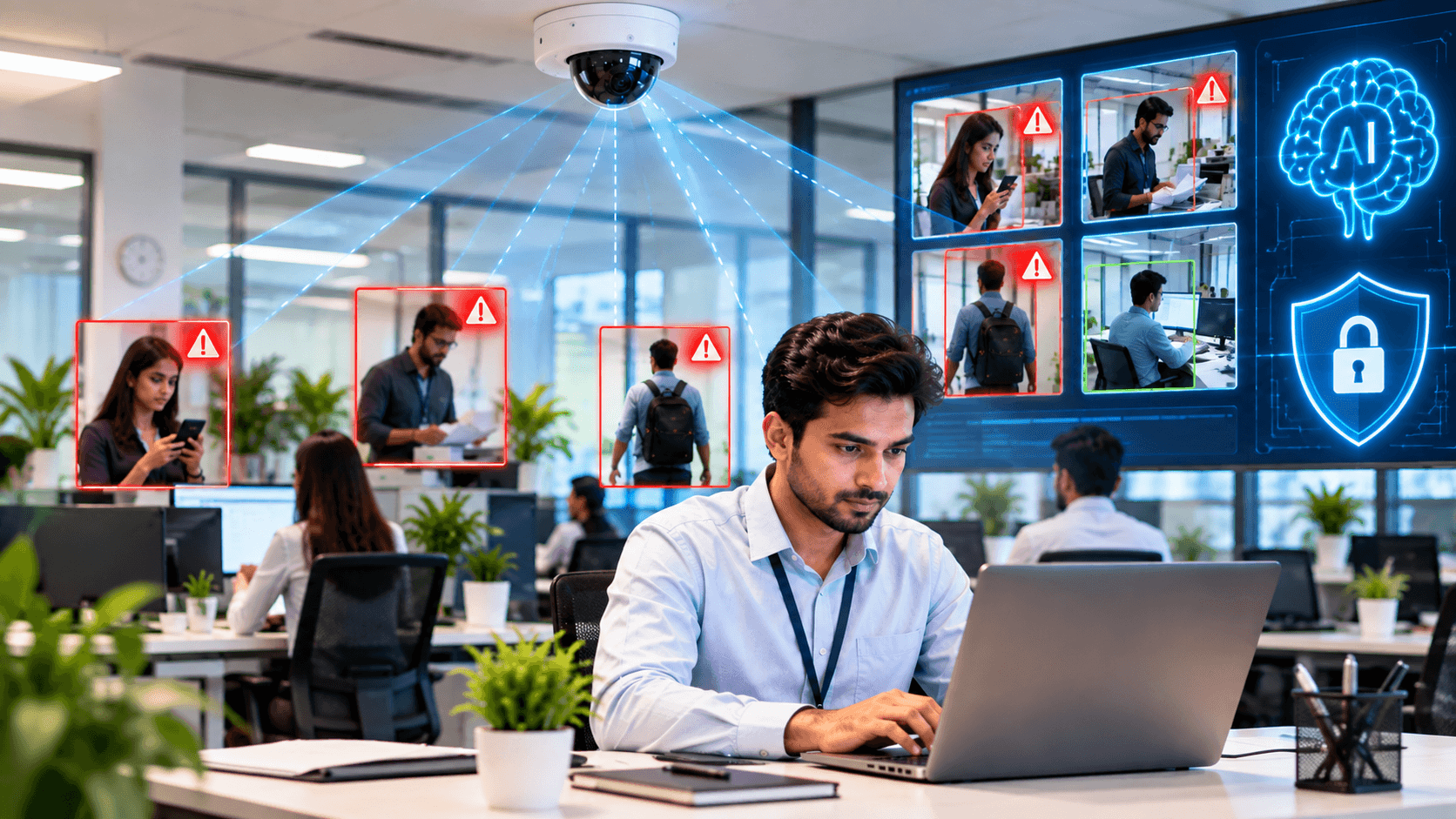
Fraud by employees might become quite troublesome for companies, especially if there is any suspicion of fraud that occurs over time instead of being committed in a single instance. There are possibilities of discrepancies, unauthorized discounting, stealing of inventory, refunds without basis, and policy violations that may slip through when management cannot oversee everything.
Old-fashioned video surveillance systems can be valuable in providing evidence after the event, but such systems usually rely on someone viewing the tapes to find out what took place.
AI surveillance for employee fraud adds another layer by analysing video activity and helping businesses identify unusual behaviour in real time. When combined with transaction data and human verification, AI-powered monitoring can help businesses detect potential risks earlier and investigate incidents more efficiently.
Why Employee Fraud Can Be Difficult to Detect
The employee’s fraudulent activity is not necessarily similar to a typical security problem. For instance, the employee could issue an irregular refund, make a discount, take goods from the inventory, enter into an area that is restricted, or manipulate the transactions. These actions performed by the employee during operational periods are unlikely to be detected immediately.
There may be numerous workers from a company who work in various departments, thus rendering continuous monitoring impossible. In such cases, technology can help traditional internal control systems.
1. AI Can Identify Unusual Employee Activity
Modern AI video surveillance uses computer vision and analytics to analyse activity captured by security cameras.
Depending on the system, businesses can configure rules around specific locations, behaviours, or events.
For example, AI monitoring may help identify:
Activity in restricted areas
After-hours movement
Unusual activity around cash registers
Suspicious inventory handling
Repeated activity in specific locations
Other predefined security events
The idea is not to blame the employee for fraud automatically but to use AI to detect actions that need to be checked manually.
2. Connect Video With Transaction Data
Video becomes more useful when businesses can compare it with transaction activity.
In the case of retail firms, this may include activities like refunds, voids, discounts, no-sales, and opening of cash drawers.
For instance, a manager might discover a strange refund in the point-of-sale system. With integrated security, he can then use video to trace back to the particular video around the time when that transaction was made.
This gives more information about whether the transaction is valid or needs to be looked into further.
3. Detect Potential Employee Theft
Employee theft can involve cash, inventory, merchandise, equipment, or other business property.
Even the old-fashioned camera can document the events, but viewing the video will only occur after discrepancies in the inventory have been found.
Employee theft detection can become more proactive when AI monitors relevant areas continuously.
Firms may set up surveillance in stockrooms, loading areas, cash-handling areas, or other high-risk areas.
When activity matches predefined rules, an alert can direct attention to the relevant footage.
4. Monitor High-Risk Areas
Not every area of a business carries the same security risk. Cash registers, stockrooms, warehouses, offices containing sensitive information, loading docks, and restricted employee areas may require greater visibility. Businesses can use business security cameras to provide coverage in these locations and use AI analytics to identify activity that requires attention.
Proper placement of cameras is very important. There should be proper visibility through cameras without creating unnecessary blind spots, and companies need to take privacy laws into consideration.
5. Identify Suspicious Activity in Real Time
One of the biggest limitations of traditional surveillance is that it often becomes useful only after an incident has occurred. Real-time security monitoring can change this by allowing businesses to receive alerts when configured events occur.
For instance, if an employee goes into a restricted area outside the scope of the regular work hours, there is a possibility that the system will trigger a notification for assessment. The monitoring operator or the authorized management personnel will then assess the incident to find out whether any actions need to be taken.
6. Reduce the Burden on Managers
A manager cannot be able to observe every individual and transactions that happen in the organization all through the day. This may lead to missing some important activities, since human observation is not limitless.
AI will keep analysing the video feed and picking out any activity which fits into certain rules. In effect, this means that the managers can spend their time checking only those events which are important rather than spending hours checking normal events. AI acts as a supplementary mechanism and not as a substitute for management.
7. Combine AI With Human Verification
AI detection should not automatically be treated as proof of fraud. An unusual action may have a legitimate explanation. An employee might process a refund because of a customer complaint, enter a restricted area for an approved task, or handle inventory as part of normal responsibilities.
Human verification provides the context needed to interpret an alert. A practical employee fraud prevention strategy can therefore combine AI detection with trained personnel who review relevant footage and transaction information before deciding whether further investigation is appropriate.
8. Monitor After-Hours Activity
Employee fraud and unauthorized activity can also occur outside normal business hours.
For businesses that function during the night or employ workers with access outside normal working hours, greater visibility may be necessary around entrance points, storage facilities, office space, and other restricted areas. This can be accomplished by using AI-based surveillance to observe activities in a set period of time.
9. Create Better Evidence for Investigations
When a potential fraud incident is discovered, businesses need accurate information to understand what happened.
Video footage can help establish a timeline of events and provide context around transactions or physical activity.
AI-powered systems can make this process more efficient by helping security teams locate relevant events instead of manually reviewing large amounts of footage.
Businesses should also establish clear procedures for storing, accessing, and handling surveillance footage to support internal investigations while respecting applicable privacy and employment requirements.
10. Look for Patterns Instead of Single Events
Employee fraud may not always involve one major incident. Sometimes, unusual activity becomes meaningful only when several events are considered together. For example, repeated refunds, frequent discounts, unusual after-hours access, or recurring activity around inventory areas may warrant closer review when they occur over time.
AI-powered analytics can help businesses identify recurring patterns and focus investigations on activity that meets predefined criteria. This can give security and management teams a broader view of potential risks.
Building a Practical Employee Fraud Prevention Strategy
Technology should be one part of a wider internal security process.
Businesses should combine surveillance with:
Clear employee policies
Access controls
POS monitoring
Inventory controls
Regular audits
Appropriate employee training
Defined investigation procedures
Secure handling of surveillance footage
Human review of AI alerts
Businesses should also communicate workplace surveillance policies appropriately and follow applicable federal, state, and local privacy and employment requirements.
The goal should be to create a transparent security process that protects the business while respecting employees.
Final Thoughts
Employee fraud can be difficult to identify when businesses rely only on manual supervision and traditional CCTV. AI-powered surveillance can provide another layer of visibility by analysing activity, connecting relevant video with transactions, and highlighting events that may require investigation.
When combined with business security cameras, real-time alerts, transaction data, and human verification, AI can help businesses develop a more proactive approach to employee fraud prevention.
Survill combines AI-powered video surveillance with real-time monitoring and human oversight to help businesses identify potential security risks, review important events, and respond more efficiently.