Article
Apr 20, 2026
Why Shoplifters Choose Your Store Over the One Next Door — And How to Change That Calculation
Shoplifters pick stores based on perceived risk. Learn the psychology behind theft deterrence and the changes that make your store a harder target.
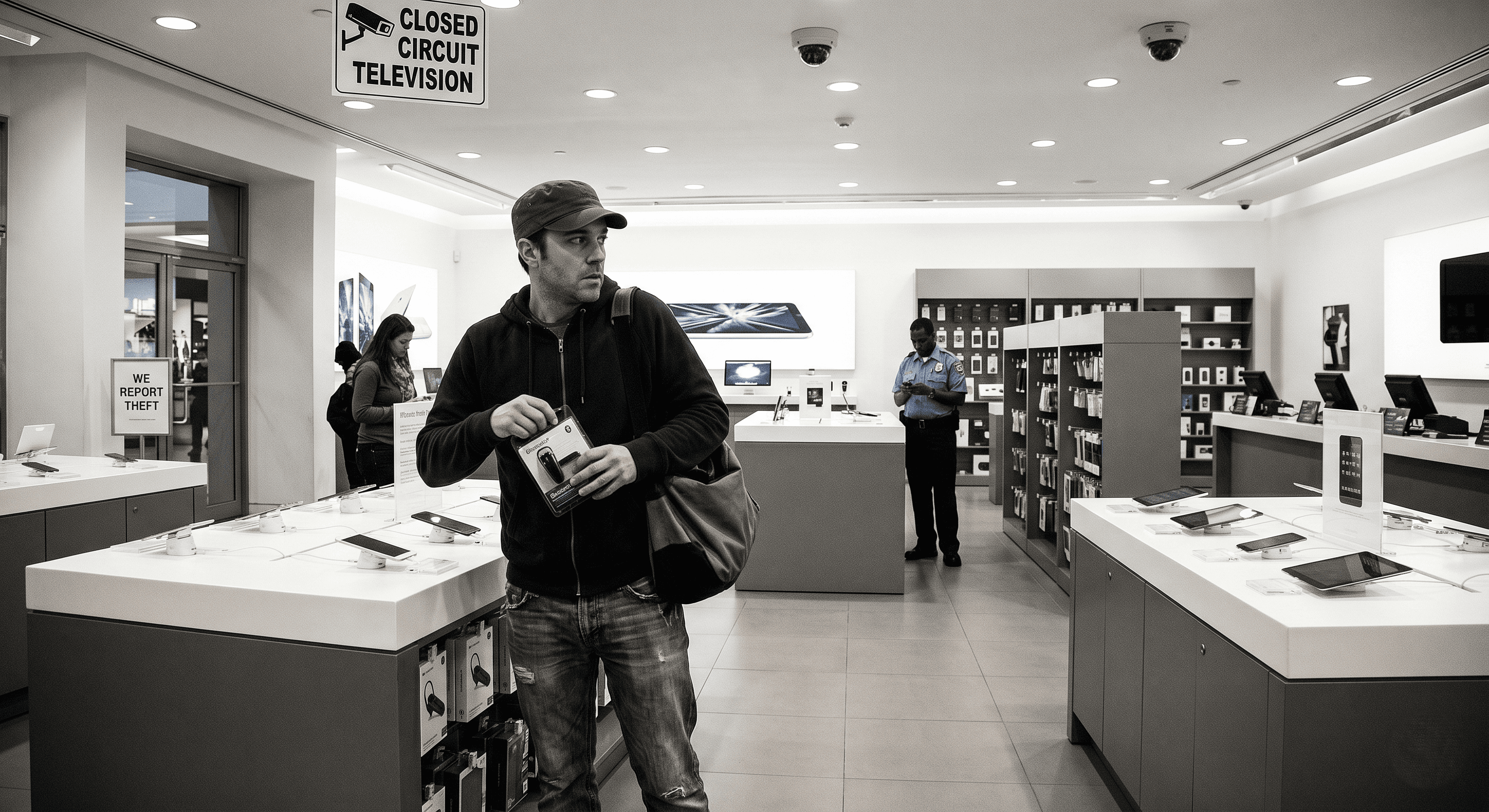
Shoplifters Don't Pick Your Store Randomly. They Evaluate It First.
The shoplifting incident that happened at your store last Tuesday wasn't random. That individual didn't wake up that morning and select your location by chance from a mental list of nearby businesses. They assessed your store — consciously or through practiced instinct — and concluded that the risk-to-reward ratio of stealing from you was acceptable.
That assessment happened before they walked through your door. And your current security infrastructure is a significant input in that calculation.
Understanding theft deterrence psychology for retail business means understanding that most theft — particularly the repeat incidents, the organized retail crime activity, and the pattern shoplifting that accounts for the majority of your losses — is chosen behavior, not impulsive behavior. Chosen behavior responds to choice inputs. Change the inputs and you change the behavior.
The question isn't how to make your store impossible to steal from. It's how to make your store a less attractive choice than the alternatives — to shift the calculation so that whoever is evaluating your location decides the risk isn't worth it and moves on to somewhere less protected.
The Risk Assessment Shoplifters Actually Make
Here's what an experienced shoplifter evaluates when they case a retail location. This isn't speculation — it's documented in research on retail theft behavior and in loss prevention interviews with individuals who have been caught and are willing to describe their process.
Probability of detection. Is someone likely to notice what they're doing? This includes: is there an active cashier with sightline to the target merchandise? Are there other customers who might notice? Are there cameras that look like they're being actively monitored versus passively recording? The "actively monitored" distinction is something experienced shoplifters assess with reasonable accuracy — they know what a live monitoring setup looks like versus a recording-only system.
Response capability. If they're detected, what happens? Can the cashier leave the register to intervene? Is there an audio announcement system? Is there visible evidence of a monitoring team presence? Will law enforcement be called with useful information? The response capability assessment determines whether detection produces a meaningful consequence or just an awkward moment before walking out.
Target value. What merchandise is accessible, what is its value, and how easy is it to conceal and carry? High-value compact merchandise in accessible locations with poor camera coverage is a combination that scores high on this dimension.
Exit predictability. Is the exit clear, is there a parking lot with good escape options, is the layout such that reaching the exit from the target merchandise area is straightforward? Physical layout factors into the assessment.
Repeat visit risk. Will they be recognized if they return? Is there any indication that facial recognition or behavioral pattern recognition is active? Experienced shoplifters assess whether their previous visits have been documented in ways that create risk for future visits.
Your store is being evaluated on all five of these dimensions every time someone walks through your door with theft in mind. Your current security infrastructure is producing a score on each dimension. And if you're experiencing repeat theft, your score on the dimensions that matter most — detection probability and response capability — is not where it needs to be.
How Passive Cameras Score on the Deterrence Assessment
Let's be direct about what a passive recording camera system scores on the five-dimension theft deterrence assessment.
Detection probability: Low to medium. Cameras are visible, which creates some uncertainty. But experienced shoplifters assess whether cameras are being monitored in real time — and most are not. The uncertainty disappears quickly.
Response capability: Very low. A passive recording system has no response capability. The cashier can call 911 after the fact. The footage can be reviewed after the fact. Nothing happens during the theft because no one is watching during the theft.
Target value impact: None. Camera positioning might create some blind spot awareness, but experienced shoplifters navigate blind spots routinely.
Exit predictability: None.
Repeat visit risk: Low. A passive camera records the individual's appearance on each visit, but without active monitoring and pattern recognition, this data isn't being used to flag repeat visitors in real time.
Total deterrence score: your passive camera system deters opportunistic theft from unsophisticated shoplifters and almost nothing else. The organized retail crime participants and repeat shoplifters who account for the majority of your dollar losses have already assessed your system and concluded that it's not a meaningful obstacle.
How Active Monitoring Changes Every Dimension
Definition moment: Retail theft deterrence through active monitoring works by changing the perceived probability of detection and the real certainty of response, which alters the risk-reward calculation that determines whether a shoplifter targets your store, stays in your store, or completes a theft attempt.
When professional live monitoring with AI behavioral detection is active:
Detection probability: High. The uncertainty is genuine because someone actually might be watching right now. This isn't a bluff — an agent may actually be looking at their camera feed at this exact moment. Experienced shoplifters cannot assess whether they're being watched at any given second because the answer is genuinely uncertain. Genuine uncertainty functions as deterrence even when no agent is actually watching at that precise moment.
Response capability: High. An audio announcement can be triggered within 60 to 90 seconds of a behavioral flag. That announcement arrives before the merchandise is concealed in many cases. Law enforcement can be contacted with a live feed. The consequence of being detected is immediate and real.
Target value impact: Medium. Active monitoring paired with AI behavioral detection and camera position optimization addresses the high-value merchandise coverage gaps that experienced shoplifters exploit.
Repeat visit risk: High. AI pattern recognition flags behavioral signatures across visits. Monitoring teams document repeat individuals. The risk of a second visit producing a worse outcome than the first is real and detectable.
The shift in deterrence score is dramatic. And the behavioral response is measurable: stores that implement active monitoring see their theft incident frequency drop 40 to 60 percent within 90 days — not because active monitoring catches more thieves, but because the deterrence calculus changes and fewer people attempt theft in the first place.
The Visible Deterrence Layer: What Signage Actually Does
There's a specific communication step that most operators underestimate in building a theft deterrence environment: visible signage that conveys active monitoring accurately.
Generic "This premises is under video surveillance" signs have no deterrence effect in 2026. Every store has them. They communicate nothing about whether anyone is actually watching. Experienced shoplifters treat them as noise.
Specific signage that accurately describes what your monitoring system does — "This store is monitored 24/7 by a professional live surveillance team. All activity is observed in real time. Suspicious behavior is reported to law enforcement immediately." — communicates meaningfully different information. It tells the evaluating shoplifter that the probability of detection is genuinely higher, that there is response capability beyond the cashier, and that repeat visit risk is real.
Specific, accurate signage works as a deterrence tool because it's true — and because experienced shoplifters who read it will assess its credibility. A sign that describes a system that actually exists is credible in ways that generic surveillance notices are not.
The Word-of-Mouth Effect in Local Theft Networks
Here's something that doesn't appear in most discussions of retail security but that loss prevention professionals observe consistently: theft deterrence at one store in a market affects theft attempt frequency at that store network-wide.
Shoplifters — particularly the repeat offenders and organized groups who account for disproportionate losses — communicate within their networks about which stores are actively protected and which are not. A store that triggers multiple active monitoring audio announcements in a short period develops a local reputation among these networks as a high-risk target. Attempt frequency at that store drops not just because of direct deterrence of individuals who experienced the intervention, but because word travels.
This network effect is not instantaneous and not universal. But it's real enough that loss prevention professionals refer to it when explaining why stores with active monitoring sometimes see steeper theft reductions than the direct deterrence math would predict.
Your store's reputation in local theft networks is part of your deterrence infrastructure. Active monitoring with consistent, credible response capability builds that reputation faster than any other security investment.
How Survill's Approach Addresses the Full Deterrence Stack
Survill's monitoring approach is built around the complete deterrence calculation — not just the detection component. The combination of 24/7 live agents, AI behavioral detection for pre-theft pattern identification, audio announcement capability with certified response time under 90 seconds, and monitoring communication guidance for how to convey active surveillance to staff and customers addresses each dimension of the theft risk assessment that determines whether your store gets targeted.
The signage guidance, staff communication protocols, and monitoring transparency approach that Survill provides to clients are as much part of the deterrence system as the technology itself. Deterrence is a communication function as much as a detection function.
Conclusion: You Are Not Competing With Thieves. You Are Competing With Other Stores.
The shoplifter who hit your store last Tuesday made a comparative assessment. Your store's deterrence score was higher than the threshold they were willing to accept — or it wasn't high enough relative to whatever they were willing to risk.
The goal of active monitoring isn't to make theft impossible. It's to make your store a worse choice than the alternatives. To score high enough on detection probability and response capability that the calculation points somewhere else.
In a market where most stores are running passive cameras and alarm systems, a store with documented professional active monitoring isn't competing with impossible. It's competing with mediocre. And mediocre is easy to beat.
Make your store the one they drive past.
Get Your Free Deterrence Assessment
📞 (253) 362-3578 | 🌐 www.survill.com | ✉️ hello@survill.com
Frequently Asked Questions
Q1. Why do shoplifters choose specific stores over others? Shoplifters evaluate target stores on five dimensions: detection probability (how likely is someone to notice?), response capability (what happens if they're detected?), target merchandise value and accessibility, exit predictability, and repeat visit risk. Stores with passive recording cameras score low on detection probability because experienced shoplifters can assess whether cameras are actively monitored, and low on response capability because passive systems have no real-time response mechanism. Stores with active live monitoring score high on both dimensions — creating genuine uncertainty about detection and credible certainty about response — which shifts the risk-reward calculation toward other targets.
Q2. Does visible security signage actually deter shoplifters? Generic surveillance signage has minimal deterrence effect in 2026 — experienced shoplifters treat it as background noise. Specific, accurate signage that describes what your active monitoring system actually does — professional 24/7 monitoring, real-time observation, law enforcement reporting — functions as a deterrence tool because it conveys credible, meaningful information about detection probability and response capability. The key word is accurate: signage describing a monitoring system that actually exists is assessed as credible by experienced shoplifters in ways that generic notices are not. Survill provides clients with monitoring-specific signage language that communicates the actual capabilities of the system rather than generic surveillance language.
Q3. What percentage of shoplifting incidents are committed by repeat offenders? Industry research consistently shows that a small percentage of shoplifters account for a disproportionate share of retail losses. Repeat offenders — individuals who steal from the same or similar locations multiple times — are estimated to represent 10 to 20 percent of shoplifting incidents but 40 to 60 percent of total theft value in retail environments. Organized retail crime group members, who operate systematically across multiple locations, produce even higher per-incident values. These are the individuals most likely to be evaluating your store's deterrence infrastructure rather than shoplifting impulsively — and most likely to redirect to less-protected alternatives when they encounter credible active monitoring.
Q4. How long does it take for active monitoring to change your store's theft incident rate? Deterrence effects from active monitoring begin within the first week of deployment — specifically from the first audio announcements triggered in your store, which establish your monitoring system's credibility within local theft networks. Measurable statistical reductions in incident frequency are typically visible in your first monthly inventory cycle. Full statistical impact — including the word-of-mouth reduction from your store's improved reputation in local theft networks — is typically measurable at 60 to 90 days. Most operators implementing Survill's active monitoring report 40 to 60 percent reductions in theft incident frequency within the first 90-day period.
Q5. Can active monitoring deter organized retail crime groups specifically? Yes — and deterrence is the most effective approach against organized retail crime because prosecution rates for ORC incidents remain low in most jurisdictions. Organized retail crime groups conduct advance reconnaissance of target stores, and stores with credible active monitoring infrastructure are deprioritized in favor of lower-risk targets. AI behavioral detection is particularly effective at identifying the reconnaissance behaviors that precede ORC-style incidents — team entry patterns, systematic store assessment movements, coordinated positioning — and flagging them for live agent review. An ORC group that encounters a credible active monitoring response on a reconnaissance visit typically removes that store from their target rotation.