Article
Apr 6, 2026
Retail Security in 2026: Why AI-Powered Live Monitoring Is No Longer Optional for Small Businesses
Retail theft hit record levels in 2025. In 2026, passive cameras aren't enough. Here's what smart business owners are doing differently — and why it's working.
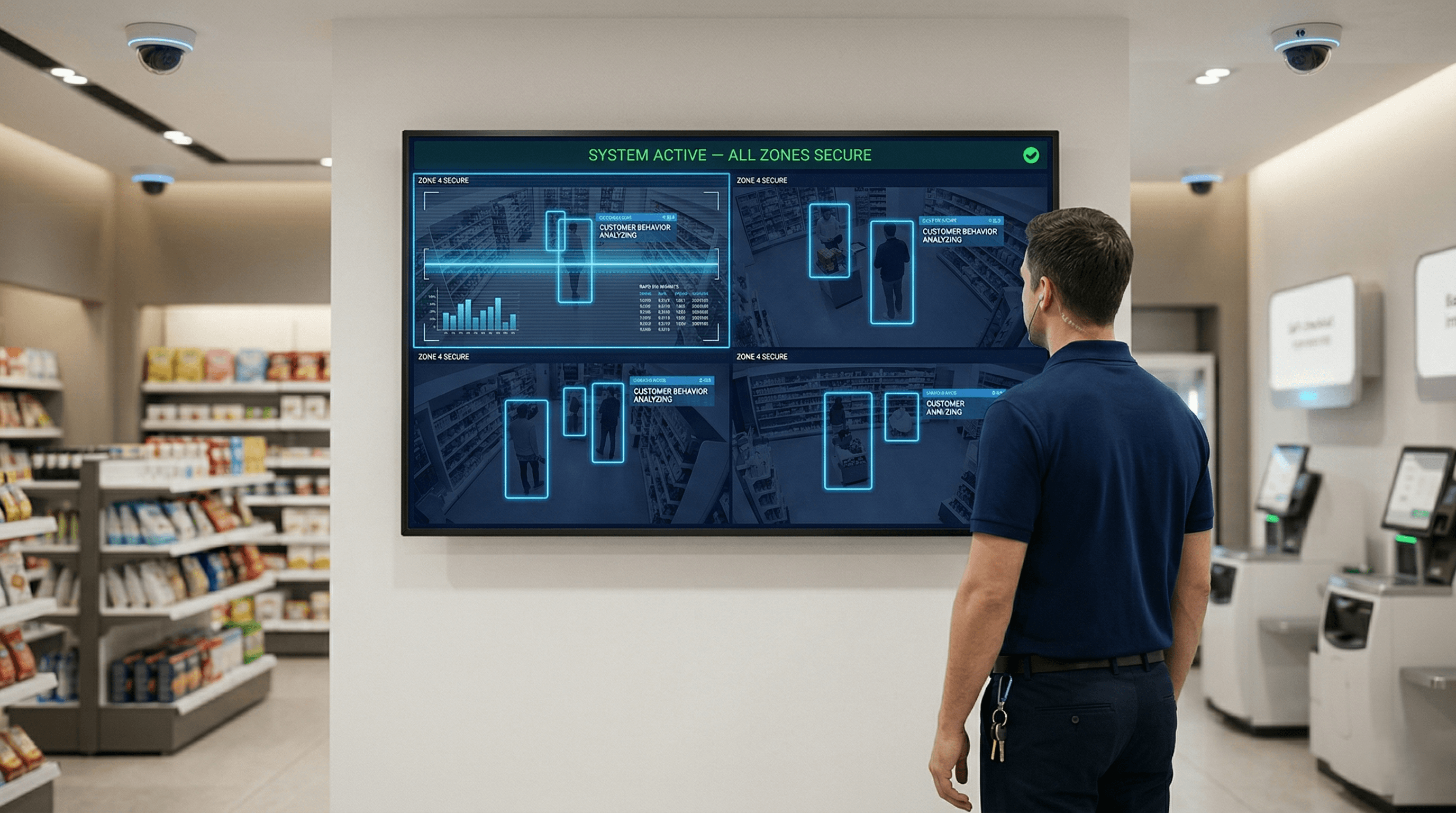
Introduction: 2026 Is a Different Game
If you're still running your store's security the same way you were three years ago, you're behind. Not slightly behind. Significantly behind.
The retail theft landscape in 2026 looks nothing like it did in 2022 or even 2024. Organized retail crime groups have become more sophisticated. Shoplifters have adapted to passive camera systems — many don't even flinch walking past them anymore. Employee theft methods have evolved with technology. And the businesses absorbing the largest losses are almost universally the ones that haven't updated their security infrastructure to match.
Meanwhile, the businesses that have made the shift — to AI-assisted detection, to live human monitoring, to systems that prevent rather than just document — are running with measurably lower shrinkage, higher employee accountability, and something that's harder to put a number on but just as valuable: actual confidence that their business is protected.
This is the state of retail security in 2026. Here's everything you need to know.
The Threat Landscape Has Changed — Have You?
Let's be direct about what's different in 2026 compared to just a few years ago.
Shoplifters Know Your System Better Than You Do
This sounds harsh but it's true. The widespread adoption of passive CCTV systems over the past decade has educated an entire generation of retail thieves about exactly how those systems work. They know cameras record. They know footage is reviewed after the fact. They know the cashier isn't watching monitors while they're running a register. They know that most shoplifting incidents — particularly under a certain dollar threshold — result in no meaningful consequence even when documented.
In 2026, walking into a store with recording cameras is not a deterrent for anyone who has shoplifted more than twice. The deterrent is active monitoring — the genuine possibility that someone is watching right now and will respond before they reach the exit.
Organized Retail Crime Is More Coordinated Than Ever
The National Retail Federation's data from 2025 showed organized retail crime groups operating with levels of coordination that would have seemed implausible a decade ago. Designated roles, pre-surveilled locations, coordinated distraction techniques, real-time communication between group members inside and outside the store. These groups specifically target businesses with passive security infrastructure because they've learned to read the difference between a store that's being watched and one that's just being recorded.
In 2026, if your store doesn't have active monitoring with intervention capability, organized retail crime groups in your area already know it.
AI Has Completely Changed What's Possible — and What's Expected
Three years ago, AI-powered behavioral detection was an enterprise technology. Large retail chains could afford it. Independent gas station and convenience store operators largely couldn't.
That's not the case anymore. In 2026, AI-assisted surveillance with real-time behavioral flagging is available at price points that make sense for a single-location independent operator. The technology has matured, the deployment has simplified, and the cost structure has shifted dramatically. What was a $2,000/month enterprise system in 2022 is a $400/month small business solution in 2026.
The implication: there's no longer a technology access gap between what large retailers use to protect their inventory and what you can deploy at your convenience store or gas station. The gap that remains is simply awareness — knowing this is available and deciding to use it.
What the Data Is Telling Us Heading Into 2026
The numbers that should be driving every retail security decision right now:
Shrinkage rates hit a five-year high in 2025. Multiple industry reports put average retail shrinkage rates at 1.5–1.8% of revenue — rates that in a thin-margin business like a gas station c-store translate directly into the difference between a profitable year and a break-even one.
Internal theft is growing as a share of total loss. The combination of post-pandemic labor market disruption, rising cost of living pressures on retail employees, and the expanded use of sophisticated POS manipulation techniques has pushed internal theft's share of total retail shrinkage above 30% at many unmonitored locations.
Response time matters more than documentation. Law enforcement data consistently shows that retail theft cases resulting in arrest or merchandise recovery almost exclusively involve either real-time intervention or immediate post-incident reporting with clear identification. Footage reviewed days after an incident produces arrests at a fraction of the rate of real-time reported incidents.
Deterrence outperforms documentation by a wide margin. The financial value of preventing a theft is always higher than the value of documenting one. A $90 vape product that never leaves your store is $90 in margin you kept. A perfectly documented $90 theft produces a police report and a $90 loss. Active monitoring generates deterrence. Passive cameras generate documentation.
The 2026 Retail Security Stack: What Actually Works
The businesses running the most effective retail security operations in 2026 are doing five things consistently.
1. Live Monitoring With Real Intervention Capability
Not a monitoring center that sends you an email. Not an app that shows you camera footage. A trained agent — a human being — watching your feeds in real time with the ability to trigger audio announcements through your store speakers, alert your staff, and contact law enforcement with live footage while an incident is active.
This is the foundational layer. Everything else amplifies it. Nothing replaces it.
The audio intervention capability deserves specific attention because it's consistently underestimated by business owners evaluating monitoring systems. A clear, professional announcement — "Attention: this location is under active 24/7 live surveillance. Our monitoring team is watching all activity in real time" — triggered at the moment suspicious behavior is detected stops the majority of shoplifting incidents before they complete. Not 20%. Not 40%. Most of them. Because most shoplifters are operating on a risk calculation, and active monitoring announcements shift that calculation immediately and decisively.
2. AI Behavioral Detection Running Continuously
In 2026 the AI layer is not supplementary — it's load-bearing. A monitoring agent watching multiple locations simultaneously cannot maintain perfect attention across every camera frame at every moment. AI detection fills that gap, running behavioral analysis continuously and flagging events for human review.
What 2026-generation AI detection catches that earlier systems missed:
Micro-concealment behaviors. Subtle movements associated with merchandise concealment that don't look dramatic on camera but follow statistically consistent patterns the AI has been trained on across millions of hours of retail footage.
POS interaction anomalies. Register behaviors — specific timing patterns, drawer open sequences, transaction flow anomalies — that correlate with fraud even when they don't look immediately suspicious to a human observer watching in real time.
Cross-camera behavioral correlation. A person who enters through the main door, moves to a specific section, and then shifts position relative to the camera angle in a pattern consistent with blind spot exploitation — flagged even if no single camera frame looks alarming.
Repeat individual recognition. Behavioral pattern matching that flags individuals whose movement patterns across visits correlate with previous documented incidents at your location.
3. Full POS Integration
In 2026 there is no excuse for running surveillance that doesn't talk to your point-of-sale system. The technology is mature, the integration is straightforward with most modern POS platforms, and the detection capability it creates is orders of magnitude beyond what camera-only surveillance can achieve.
When your surveillance is POS-integrated, every transaction event has a corresponding video timestamp. Every anomaly — void, refund, no-sale, discount override, unusually fast transaction, unusually slow transaction — pulls the camera angle for that moment automatically. What would take an investigator hours to reconstruct manually happens in seconds.
For catching internal fraud specifically — which represents an increasing share of 2026 retail losses — POS integration is the difference between catching a problem in week two and not catching it for eight months.
4. License Plate Recognition at the Pump
For gas station operators in 2026, LPR is table stakes. The technology is affordable, the installation is straightforward, and the impact on drive-off rates is immediate and dramatic.
Modern LPR systems integrated with live monitoring do more than capture plates after a drive-off. They flag vehicles with associated drive-off history before fuel is dispensed, enable pre-authorization holds on flagged plates, and feed into regional databases that identify organized fuel theft operations.
A gas station operator in 2026 without LPR at the pump island is not just losing fuel revenue — they're contributing to a theft pattern that affects every unprotected station in their market.
5. Remote Access and Real-Time Owner Visibility
The 2026 version of running a retail business means having full visibility into your store from wherever you are. Not a delayed feed. Not a report at the end of the day. Live access — the same feed your monitoring team is watching — on your phone.
This matters operationally beyond just security. When your monitoring team flags an incident and you get a push notification, you can pull up the live feed and make informed decisions in real time. When you're on vacation and something happens at 3 AM, you know about it as it's happening, not when you come back.
The remote visibility layer also significantly improves the operational relationship between owners and overnight staff. When employees know the owner can pull up a live feed at any moment — not just review recorded footage — their behavior reflects it.
The Businesses Winning in 2026: What They Look Like
Across the US markets Survill serves — gas stations, convenience stores, hotels, restaurants — the businesses running the strongest security operations in 2026 share a consistent profile.
They treat security as infrastructure, not insurance. The mindset shift from "security camera system" as a one-time capital purchase to "active monitoring" as a monthly operational investment changes everything about how the system is deployed, maintained, and used.
They measure security performance. Monthly reports on flagged incidents, intervention outcomes, drive-off rates, and POS anomaly trends give them visibility into whether their security investment is producing results. This is very different from only noticing the security system when something goes wrong.
They communicate openly with their staff about monitoring. The days of secret surveillance creating the deterrence effect are over — experienced employees know what passive cameras look like and what active monitoring looks like. Telling your team that a professional live monitoring service watches your feeds 24/7 is the most cost-effective deterrent investment you can make.
They've done the ROI math. Every operator who commits to active monitoring has run the calculation: what are my current monthly losses to theft, what does active monitoring cost, and what reduction in losses is realistic? When those numbers are honest, the decision is almost always obvious.
What the Next 12 Months Look Like for Retail Security
A few developments shaping the retail security landscape through the rest of 2026 that every small business owner should be aware of:
AI detection accuracy continues to improve. The false positive rates that made early AI behavioral detection systems frustrating to work with have dropped significantly. 2026 systems are meaningfully more accurate at distinguishing genuine threat behaviors from normal customer activity — which means more relevant alerts and less alert fatigue for monitoring teams.
Insurance carriers are making monitoring infrastructure a pricing variable. This trend accelerated through 2025 and is increasingly mainstream in 2026. Commercial property and liability carriers are offering documented premium reductions — in some cases 15–25% — for businesses with verified professional monitoring systems. For a business paying $18,000/year in commercial insurance, that's $2,700–$4,500 in annual premium savings. In many cases, that reduction alone covers a significant portion of the monthly monitoring cost.
Multi-location operators are centralizing monitoring. Franchise groups, multi-location c-store operators, and hotel chains are increasingly consolidating their surveillance infrastructure under single monitoring agreements rather than managing separate systems per location. Centralized visibility across five locations costs meaningfully less per location than five separate arrangements — and produces more consistent security outcomes.
Prosecution outcomes are improving where documentation quality is high. In markets where law enforcement has built working relationships with professional monitoring providers — receiving real-time footage and timestamped incident documentation — retail theft prosecution rates are measurably higher than in markets relying on passive system documentation. This is creating a slow but real deterrence effect in markets where professional monitoring adoption is higher.
Survill Technologies in 2026: Built for Where the Industry Is Heading
Survill's platform is specifically designed around the retail security requirements of 2026 — not the requirements of five years ago.
The combination of 24/7 live US-based monitoring agents, continuously improving AI behavioral detection, full POS integration capability, LPR support for gas station operators, and a unified multi-location dashboard puts Survill's clients in a fundamentally different security position than businesses relying on traditional camera-plus-alarm setups.
In 2026 the question for small business owners isn't whether active monitoring technology exists or whether it works — the data on both is unambiguous. The question is how long to wait before making the shift from a system that documents your losses to one that prevents them.
The businesses that made that shift in 2023 and 2024 have three years of compounding savings behind them. The ones making it now in 2026 will have the same advantage over the businesses that wait until 2027.
Conclusion: 2026 Rewards the Proactive
The retail security environment in 2026 is not forgiving to businesses running passive infrastructure. Thieves are more sophisticated, organized crime groups are more coordinated, and the methods used for internal fraud have kept pace with every POS system improvement.
But the protective technology has kept pace too — and in many respects has outrun the threat. AI-powered behavioral detection, live human intervention, POS integration, and real-time owner visibility have created a security capability that simply didn't exist at accessible price points until recently.
The businesses losing the most to theft in 2026 are not unlucky. They are under-infrastructure. And the solution is available, affordable, and proven.
Your store deserves protection that matches the threat environment it's actually operating in — not the one from five years ago.
Get a Free 2026 Security Assessment
Survill Technologies is offering a complimentary 30-minute security assessment for US retail business owners. We'll review your current setup against 2026 threat patterns, identify specific gaps in your overnight and daytime coverage, and give you a clear picture of what active monitoring would look like for your location — including a realistic ROI projection based on your actual operation.
📞 Call or text: (253) 362-3578 🌐 Visit: www.survill.com ✉️ Email: sales@survill.com
Frequently Asked Questions
Q1. What is the biggest retail security threat in 2026? Organized retail crime remains the highest-dollar threat to US convenience stores and gas stations in 2026, but internal employee theft has grown significantly as a share of total losses. The combination of more coordinated external theft groups and increasingly sophisticated internal fraud methods — particularly POS manipulation — means businesses need protection against both simultaneously. The most effective 2026 security systems address both threats through the same integrated platform rather than treating them as separate problems.
Q2. Is AI surveillance actually effective for small retail businesses in 2026? Yes — and more accessible than most small business owners realize. AI behavioral detection technology that was enterprise-only in 2022 is now available through managed service providers at price points starting under $400/month for single-location retailers. Effectiveness data from 2025 deployments shows 40–60% reductions in theft incidents within 90 days at convenience stores and gas stations — driven primarily by the deterrence effect of active AI-assisted monitoring rather than just improved detection.
Q3. How does 2026 retail security technology differ from what was available in 2022? The three biggest differences are AI accuracy, integration depth, and price accessibility. AI behavioral detection in 2026 operates with significantly lower false positive rates than 2022 systems — making it practical for small retail environments without generating constant false alerts. POS integration is now standard rather than enterprise-only. And the overall cost of professional AI-assisted live monitoring has dropped enough to make it financially rational for independent single-location operators based on loss prevention ROI alone.
Q4. Should I tell my employees that my store has live monitoring in 2026? Yes — and this is more important in 2026 than it was in previous years. The deterrence value of employee awareness that active monitoring is in place is substantial and immediate. Experienced retail employees in 2026 understand the difference between passive recording cameras and active live monitoring. Announcing that your store uses professional live monitoring changes behavior among employees who might otherwise consider internal theft as relatively low-risk. Honest employees are unaffected. The deterrence effect on dishonest ones is significant.
Q5. What return on investment should I expect from a 2026 live monitoring system? For a typical single-location gas station or convenience store losing $3,000–$5,000 per month to combined theft and shrinkage, a professional monitoring system at $399–$649/month produces positive ROI with a loss reduction of less than 20% — a threshold most operators exceed significantly. Most Survill clients report full monthly cost recovery within 45–60 days of activation. Annual ROI across a full year of operation typically runs 3–6x the monitoring investment for single-location operators, with higher multiples for multi-location operators benefiting from consolidated monitoring pricing.