Article
Apr 8, 2026
Restaurant Theft Prevention in 2026: How Restaurants Are Quietly Losing Thousands Every Month
Restaurants lose billions to theft every year — and most of it happens from the inside. Here's what's actually happening in your restaurant and how to stop it in 2026.
Introduction: The Restaurant Industry Has a Theft Problem No One Talks About
Running a restaurant in 2026 is already hard enough. Razor-thin margins. Rising food costs. Staffing challenges. Supply chain unpredictability. The last thing any restaurant owner wants to hear is that on top of all of that, their own team might be stealing from them.
But the data is uncomfortable and consistent: the restaurant industry loses an estimated $162 billion annually to theft. Not from armed robberies. Not from burglaries. From the inside — employees, management, and in some cases the systems and processes that were never designed to prevent fraud in the first place.
Restaurant theft is uniquely difficult to catch for a specific reason: almost every theft mechanism in a restaurant environment is also a completely legitimate operational action. A voided table transaction could be a genuine correction — or it could be a server pocketing cash from a table that paid in full. A food waste writeoff could be an accurate record — or it could be inventory walking out the back door. A discount applied to a check could be an authorized promotion — or it could be a friend's table getting a free meal.
This ambiguity is exactly what makes restaurant theft so persistent. It hides in the noise of normal operations. In 2026, the businesses that have solved this problem have done it by removing the ambiguity — with monitoring systems that see through the noise and identify the pattern underneath.
This blog covers what restaurant theft actually looks like, why traditional oversight fails to catch it, and what the most effective prevention systems in 2026 look like in practice.
The Six Ways Restaurants Lose Money to Theft
Before you can protect against restaurant theft, you need to understand the specific mechanisms. Most restaurant owners are aware of one or two of these. Very few are actively monitoring for all six.
1. Cash Skimming at the Register
The most straightforward form of restaurant theft — and still one of the most common. A server or cashier collects cash from a customer, doesn't enter the transaction in the POS system or voids it after entry, and pockets the difference.
In a busy restaurant environment where transactions are happening simultaneously, where the POS system has void and discount permissions extended to floor staff, and where the manager is focused on service quality rather than transaction monitoring, skimming is extraordinarily easy to execute and extraordinarily hard to catch without synchronized POS and camera monitoring.
A server skimming $50 per shift on three shifts per week generates $7,800 per year. In a restaurant's financial statements, that amount is invisible inside normal revenue variance.
2. Sweethearting — Free Meals for Friends and Family
A server processes a table occupied by friends. They enter some items and not others. They apply unauthorized discounts. They void items after the table has consumed them. The friends pay a fraction of what they should.
Sweethearting in restaurants is both extremely common and extremely difficult to detect without camera coverage that correlates with POS transaction data. You need to see the table, see what was ordered, and compare it against what was actually rung in. Without that correlation, it looks like a normal table.
3. Void and Refund Manipulation
This is the restaurant equivalent of retail void fraud — and it's remarkably sophisticated in 2026.
A transaction is entered, the customer pays cash, the transaction is voided after payment, and the cash is retained by the employee. Or a refund is processed for a customer who never actually complained about or returned anything. Or multiple small transactions are voided and re-entered in ways that create a clean register at end of shift while obscuring what actually happened during service.
POS data alone doesn't catch this reliably because the transactions look procedurally correct. Camera correlation — seeing what was physically happening at the register during each void event — is what exposes the pattern.
4. Food and Inventory Theft
Restaurants have something most retail environments don't: a back-of-house where significant monetary value moves in the form of food inventory with limited natural oversight.
A line cook who consistently takes home a portion of expensive protein at the end of their shift. A bar manager who helps themselves to full bottles during inventory transitions. A receiving manager who accepts short deliveries from a vendor contact and splits the difference.
Food theft is particularly damaging because food cost is already the largest variable expense in most restaurant operations. When food theft is layered on top of legitimate food cost, the combined impact on margin can be catastrophic — and it almost always shows up as a food cost percentage problem rather than being identified as theft.
5. Tip Skimming and Tip Pool Manipulation
In restaurants operating tip pools, there are multiple opportunities for manipulation. Managers or senior servers misrepresenting tip pool totals. Cash tips not being entered into the pool. Reported tip amounts that don't match table totals visible on camera.
Tip fraud is particularly pernicious because it affects the income of your entire service staff — not just your revenue. High-performing honest servers are financially harmed by colleagues or managers manipulating the pool.
6. Bar Theft — The Highest-Margin Category
Bars and restaurants with full liquor service are particularly vulnerable to theft because alcohol has high value, small physical size, and consistent resale or personal consumption value.
Free drinks poured for friends. Short pours that allow a portion of each bottle to be retained and removed. Bottles walked out at end of shift. Cash collected for drinks that were never rung in. In a high-volume bar environment, bartender theft of $100–$200 per shift is not unusual and is almost impossible to detect without pour monitoring or synchronized POS and camera correlation.
Why Traditional Restaurant Oversight Fails
Most restaurants run some combination of manager floor presence, end-of-shift POS reviews, and periodic inventory audits as their primary internal controls. In 2026, these measures are insufficient for several interconnected reasons.
Manager floor presence doesn't scale to the whole operation. A manager watching the dining room can't simultaneously monitor the bar, the kitchen, the register, and the back door. Experienced restaurant thieves know exactly when manager attention is occupied elsewhere and time their actions accordingly.
End-of-shift POS reviews catch the obvious, not the sophisticated. A review of daily totals catches major discrepancies. It doesn't catch a server who ran $50/shift in unreported cash sales with individual transaction voids that each look procedurally legitimate in isolation.
Inventory audits are lagging indicators. A monthly food cost review that reveals a 2% food cost increase is telling you that something has been happening for weeks. It doesn't tell you what, where, or who. Without the ability to correlate the food cost variance with specific shift data and camera review, an inventory audit produces a number, not an answer.
Trust deteriorates oversight. The longer an employee has been with a restaurant, the less scrutiny their behavior typically receives. This is exactly backwards from a loss prevention perspective. Experienced employees have more POS permissions, more access to high-value inventory, and more knowledge of operational patterns than new staff. The trust that builds with tenure is precisely what makes long-tenured employees the highest-risk for significant ongoing theft.
What Effective Restaurant Theft Prevention Looks Like in 2026
The restaurants running the strongest theft prevention programs in 2026 have built systems that remove the ambiguity from their operations — making theft both harder to execute and faster to detect.
Synchronized POS and Camera Monitoring
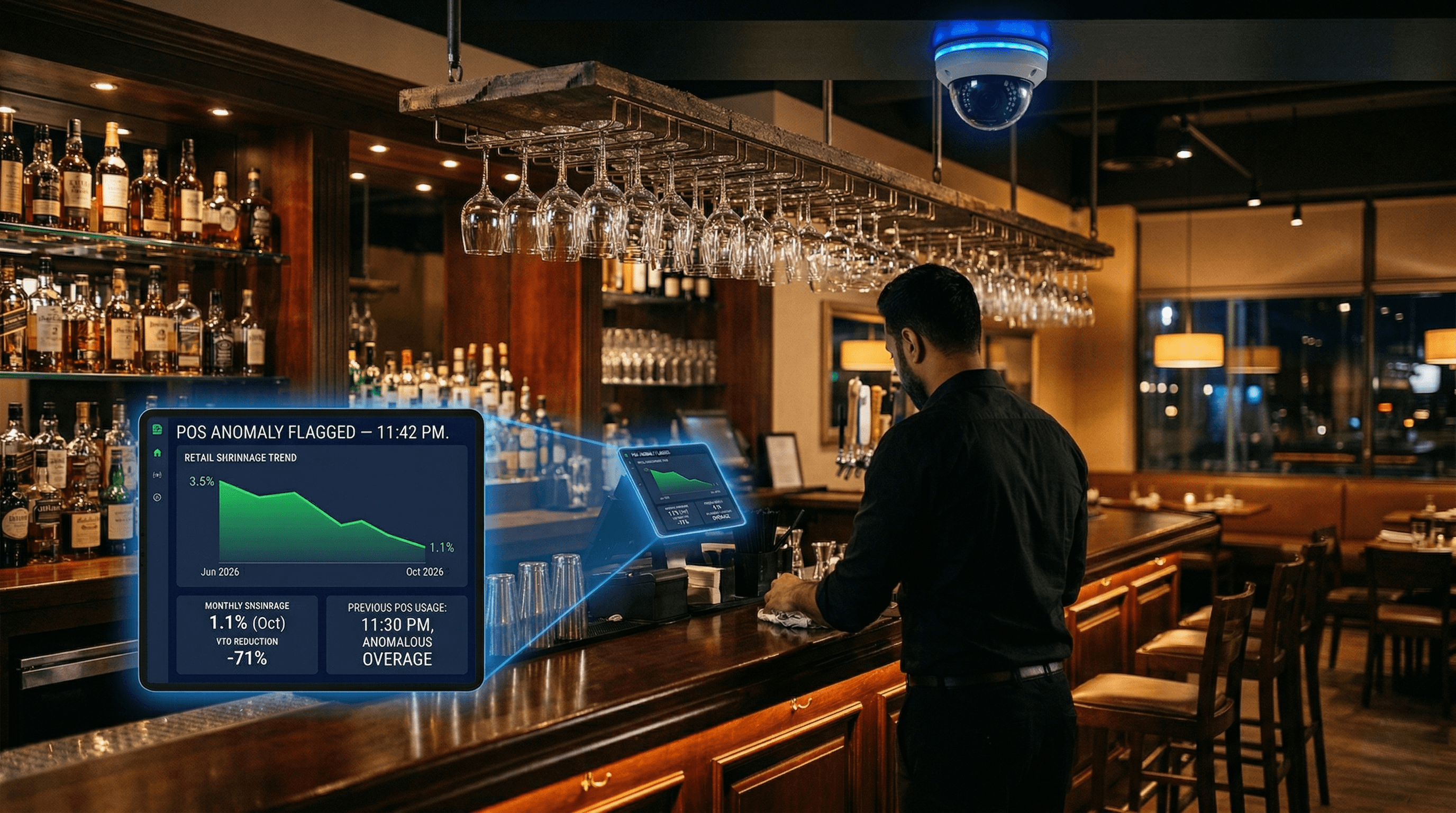
The foundational requirement. Every POS event — transaction, void, refund, discount, comp — has a corresponding camera timestamp. When an anomalous POS event occurs, the camera angle on that register or station at that exact moment is pulled automatically.
This eliminates the primary protection mechanism of sophisticated restaurant theft: procedural correctness. A void that looks right in the POS log looks very different when the camera shows cash being placed in a pocket immediately before the void was entered.
AI-Assisted Behavioral Pattern Detection
In a busy restaurant environment, individual events are ambiguous. Patterns across dozens or hundreds of events over days and weeks are not.
AI detection running on your restaurant camera system and POS data simultaneously identifies patterns that no human reviewer would catch in normal operations: a specific server whose cash table totals consistently run 8% below the average of tables served by other staff, a bartender whose transaction voids cluster in a specific 20-minute window during each shift, a kitchen staff member whose clock-out timing consistently follows high-value inventory receipt days.
These patterns are invisible to human oversight. They are exactly what AI behavioral monitoring is designed to surface.
Back-of-House Camera Coverage
Most restaurants have cameras covering the dining room and register areas. Significantly fewer have adequate coverage of the kitchen, receiving dock, and storage areas. In 2026, this represents a significant blind spot.
The kitchen is where food theft happens. The receiving dock is where delivery fraud happens. The storage area is where inventory removal happens. Without camera coverage of these areas, you are protecting the front of your operation while leaving the back completely exposed.
Real-Time Live Monitoring During Service
A live monitoring agent watching your restaurant during peak service hours can catch events that no internal system would surface: a bartender's physical movements behind the bar that are inconsistent with the drink totals being rung, a server who visits a cash-paying table twice but only enters one transaction, a kitchen manager who brings multiple personal bags into a storage area at the end of their shift.
Real-time monitoring during restaurant service is the equivalent of having a security professional watching every area of your operation simultaneously — something no manager can physically do.
Real Restaurant Scenarios: What Gets Caught
Scenario 1 — The Longtime Bartender
A restaurant and bar in Nashville had a bartender who had worked there for six years. Trusted by management, well-liked by regulars, producing strong sales numbers. The owner had no reason to suspect anything.
POS-integrated monitoring identified the pattern within three weeks of activation: the bartender was consistently ringing fewer drinks than were being poured during the final 90 minutes of each shift, when the manager had typically moved to closing administrative tasks. Cash collections during that window were not entering the register at the transaction-per-transaction level that the opening hours showed.
Documented loss estimate over a conservative 18-month period: $31,000. The evidence package from POS and camera correlation was sufficient for termination and law enforcement involvement.
Scenario 2 — The Kitchen Inventory Problem
A full-service restaurant in Dallas had been running food costs at 34–36% for over a year — two to four points above their target. Multiple interventions had been tried: vendor renegotiation, menu engineering, portion standardization. Nothing moved the number.
Back-of-house camera monitoring combined with receiving dock coverage identified two separate issues within 30 days. A line cook was removing protein portions at the end of Friday and Saturday shifts — the highest-volume inventory days. A delivery driver for a produce vendor was consistently short-delivering on high-value items with the knowledge of the receiving manager, who was compensated with a monthly cash payment.
Resolving both issues brought food cost to within 0.8% of target within 60 days.
Scenario 3 — Server Comp Abuse
A casual dining restaurant in Phoenix discovered through POS-and-camera correlation that a server was applying manager-level comp codes — codes they didn't have legitimate authorization for — to tables of acquaintances during weekend brunch service. The comps averaged $45–$65 per table, applied to an average of two to three tables per shift.
The pattern was invisible in end-of-shift POS reviews because the total comp dollar amounts fell within normal weekend ranges. The correlation between specific server, specific tables, and specific comp timing only became visible through synchronized monitoring.
Building Your Restaurant Security Plan for 2026
Camera Coverage Audit Ensure full coverage of: the bar from above and front, every register station, the kitchen entrance and main prep areas, the walk-in cooler entrance, the receiving dock, the manager's office if cash counting occurs there, and the main entrance and dining room.
POS Permission Review Review which employees have which POS permissions — void capability, comp authorization, discount application, refund processing. In most restaurants, POS permissions expand with tenure without corresponding oversight. Audit whether current permission levels are appropriate and whether each permission category has adequate monitoring in place.
Shift-Level Reporting Generate and review shift-level performance reports that show each employee's metrics: average transaction value, void rate, comp rate, cash versus card split. Outliers from the team average deserve investigation — not accusation, but investigation.
Back-of-House Accountability Protocol Implement a bag check policy for kitchen and bar staff at end of shift. This is legal in all US states for employer-owned premises with proper notice to employees. It is also one of the most effective single deterrents for food and beverage theft. Post a clear policy and enforce it consistently.
Vendor Receiving Verification Count every delivery. Sign no delivery receipt before physically verifying quantities. Maintain a log of delivery driver names alongside receipt quantities. Discrepancies should be reported to the vendor immediately and documented for pattern tracking.
How Survill Helps Restaurants in 2026
Survill's platform is deployed in restaurant environments across the US with specific configurations for the unique theft patterns the industry faces.
POS integration with major restaurant platforms — including Toast, Square for Restaurants, and NCR — enables the synchronized transaction-and-camera monitoring that is the foundation of effective restaurant theft detection. AI behavioral analysis is calibrated for restaurant-specific patterns including service timing, inventory movement, and register interaction. Live monitoring coverage during peak service hours provides the real-time intervention capability that post-hoc review cannot replicate.
Conclusion: The Theft Hiding in Your Operations
Restaurant theft in 2026 is not dramatic. It doesn't announce itself. It hides inside the normal operational noise of a busy service environment — in voids that look like corrections, in comps that look like hospitality, in food costs that look like waste.
The restaurants winning the theft prevention battle in 2026 have decided to stop accepting that noise as inevitable. They've built systems that see through it — POS integration, camera correlation, live monitoring, AI pattern detection — and they've made the financial and operational improvements that follow from actually knowing what's happening in their business.
Your restaurant deserves the same clarity.
Frequently Asked Questions
Q1. What is the most common form of theft in restaurants? Cash skimming and void manipulation at the POS system are the most common and highest-dollar theft methods in US restaurants in 2026, followed by food and inventory theft from back-of-house areas. Bar theft — unreported cash drink sales and inventory removal — is the highest per-incident value category in restaurants with full liquor service. All three require synchronized POS and camera monitoring to detect reliably.
Q2. How do I know if my restaurant employees are stealing? Key indicators include: food cost percentages consistently above target despite operational changes, specific servers or cashiers whose end-of-shift POS metrics consistently differ from team averages, unusually high void or comp rates on specific shifts, inventory discrepancies in high-value categories like proteins and premium spirits, and cash register shortages that cluster around specific employees or shifts. Without POS-integrated monitoring, most restaurant theft is invisible until losses have compounded significantly.
Q3. Can a restaurant use security cameras in the kitchen and back-of-house? Yes — in all US states, employers are legally permitted to use video surveillance in kitchen, storage, and receiving areas where employees have no reasonable expectation of privacy. We recommend posting visible signage noting that surveillance is active in all monitored areas. Back-of-house coverage is where most restaurant food theft occurs and where monitoring produces some of its fastest and most dramatic results.
Q4. How does POS integration help prevent restaurant theft? POS integration connects every transaction event — void, refund, comp, discount, no-sale — with a corresponding camera timestamp. When an anomalous event occurs, the exact camera angle for that moment is pulled automatically. This correlation removes the primary protection of sophisticated restaurant theft — procedural correctness — by making the physical actions accompanying each transaction visible. A void that looks legitimate in the POS log looks very different when the camera shows cash being pocketed immediately before the void was entered.
Q5. What is the ROI of restaurant theft prevention systems? For a restaurant losing 2–3% of revenue to theft — a common range for unmonitored full-service operations — a professional monitoring system at $399–$649/month produces positive ROI with a loss reduction of less than 15%. Most restaurant operators report loss reductions of 40–60% within 90 days of active monitoring deployment. The combination of reduced food theft, improved register accuracy, and bar theft prevention typically produces annual savings of $30,000–$80,000 at mid-volume full-service restaurant locations.