Article
Apr 13, 2026
POS Surveillance Integration: The Theft Detection System That Reads Your Register and Watches Your Cameras at the Same Time
POS surveillance integration catches employee fraud that cameras alone never could. Here's exactly how it works — and what it finds in your store.
Your Register Is Lying to You. You Just Can't Prove It Yet.
The register balanced at the end of last Tuesday's shift. Technically. The numbers added up. The cashier counted out correctly and clocked out on time. Everything looked fine on paper.
Except that your vape inventory doesn't reconcile with Tuesday's sales. Your energy drink count is short again. And this is the fourth Tuesday in a row where the numbers on paper and the numbers on shelves tell different stories.
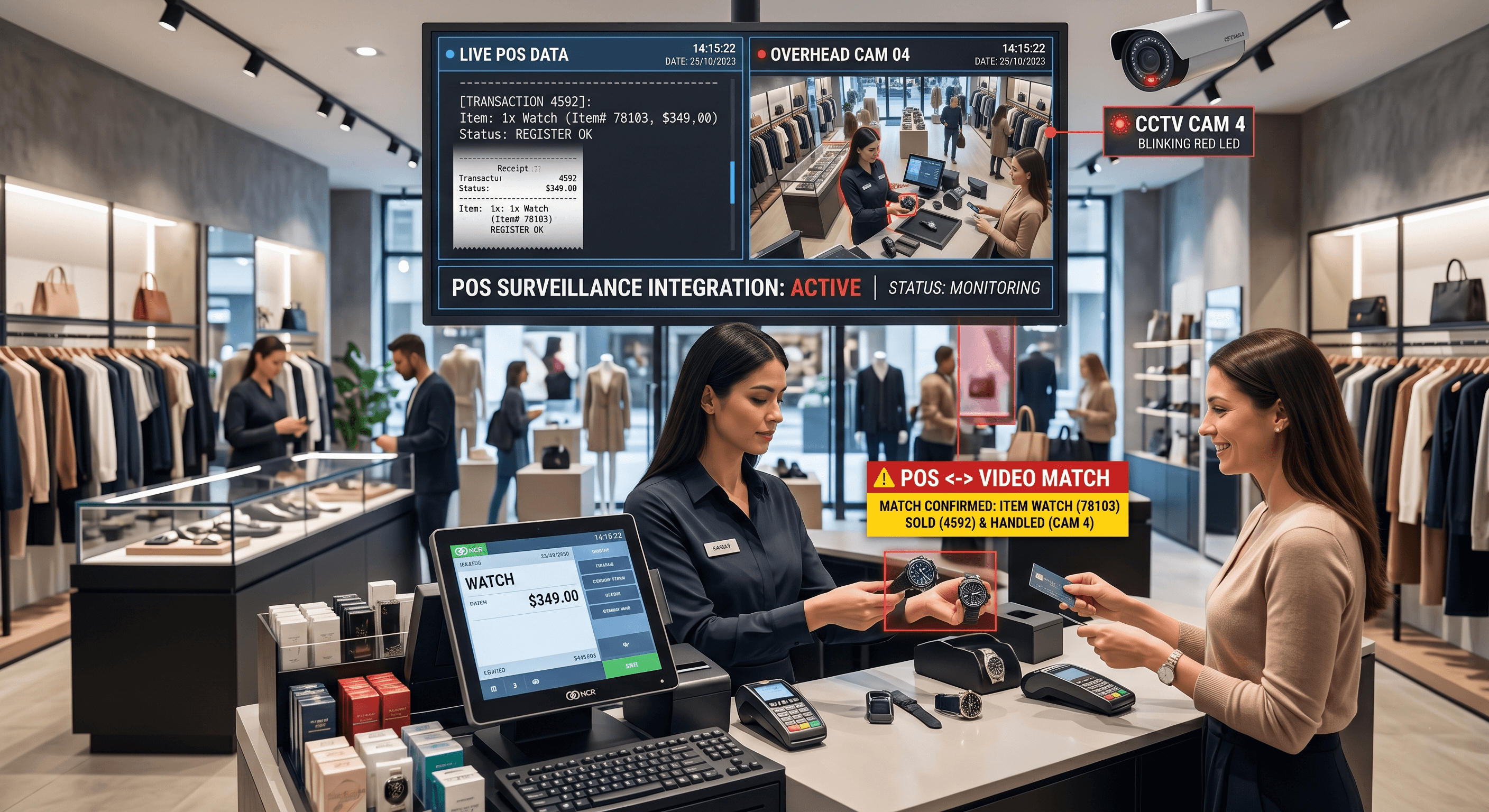
POS surveillance integration for retail theft prevention is the technology that resolves that gap — not by adding more cameras, but by connecting the camera footage you already have to the transaction data you're already generating and making both searchable by the other. When something goes wrong at your register, the system doesn't wait for you to manually pull footage and manually cross-reference transaction logs. It does both simultaneously, automatically, and flags the result within seconds.
Here's what that actually looks like in practice.
Why Cameras Alone Can't Catch Register Fraud
Security cameras are remarkably good at capturing what happens physically in your store. What they're poor at — without additional context — is identifying when a physical action is fraudulent versus legitimate.
A cashier opening the register drawer looks the same on camera whether they're making correct change or pocketing $40 before entering a void. A refund transaction processed at the register looks identical on camera whether the customer actually returned the item or not. A no-sale event looks unremarkable whether the drawer was opened for a legitimate reason or not.
The camera shows you the physical event. It cannot tell you whether that event matches the transaction record. And that gap — between what happened physically and what the transaction record says happened — is exactly where register fraud lives.
POS surveillance integration closes that gap by synchronizing your transaction data with your camera timestamps in real time. Every transaction event has a corresponding video pull. Every anomalous transaction pattern triggers an automatic camera review. The system doesn't wait for you to suspect something and manually investigate. It flags the correlation as it happens.
What POS Integration Actually Detects — In Specific Terms
The power of synchronized POS and camera monitoring is in the specificity of what it catches. This isn't a general surveillance upgrade. It targets precise fraud mechanisms that are invisible to camera-only systems.
Void-and-pocket fraud is the most common register theft method in US convenience stores and restaurants. A cashier accepts cash from a customer, processes the transaction, then voids it after the customer leaves — keeping the cash rather than entering it into the register. Camera-only systems record both the transaction and the void. They don't flag the pattern because each event looks procedurally correct in isolation. POS integration flags the void as anomalous, pulls the camera footage from that exact timestamp, and presents both to a monitoring agent simultaneously. The footage shows whether cash changed hands before the void was entered. That's the difference between a plausible mistake and documented fraud.
Sweethearting — running items for friends without scanning them, or scanning one item from a multi-item purchase — produces a pattern where transaction totals for specific tables or customers consistently run below the store average for comparable purchases. POS integration identifies the statistical anomaly across dozens of transactions and flags the specific employee and shift for camera review. No single transaction looks obviously wrong. The pattern across thirty transactions is unambiguous.
Refund manipulation leaves a clean POS record — a refund was issued, a return was processed — but no corresponding customer on camera during the refund transaction. POS integration catches this by correlating the timestamp of every refund event with the camera feed at that register. An empty counter during a refund is not a documentation problem. It's evidence.
Definition moment: POS surveillance integration is the synchronization of point-of-sale transaction data with camera footage timestamps so that every register event has a corresponding video record and every anomalous pattern triggers automatic camera correlation and human review.
Three Things That Change When Your Register Talks to Your Cameras
Beyond the specific fraud mechanisms it catches, POS integration changes the operational reality of your store in three concrete ways.
Investigation time drops from days to seconds. Without POS integration, investigating a suspected register discrepancy means pulling the POS transaction log, identifying the specific time window, manually reviewing hours of camera footage from that window, and attempting to correlate what you see with what the log says. That process takes hours and requires significant management attention. With integration, you pull the transaction, the corresponding camera footage loads automatically. Investigation time for a single flagged event: under two minutes.
Pattern detection becomes automatic. Manual investigation identifies specific events after you're already suspicious. POS integration identifies patterns you weren't looking for — a specific cashier whose void rate is 4x the store average, a shift time where no-sale drawer events cluster in ways that correlate with cash handling anomalies. You don't need to suspect something to find it. The system surfaces patterns that create suspicion where none existed.
Evidence quality improves dramatically. When you need to act on suspected employee fraud — whether for termination, HR proceedings, or law enforcement — synchronized POS and camera evidence is categorically more compelling than either alone. A timestamp, a transaction event, and a corresponding video showing the physical action that accompanied that event creates an evidence package that is difficult to dispute and straightforward to present.
Real Outcomes From POS-Integrated Monitoring
A gas station operator in suburban Atlanta had been running quarterly inventory audits that consistently showed tobacco category discrepancies averaging $280 per week. Loss prevention attributed it to shoplifting. POS integration identified the actual source within 18 days: a cashier processing tobacco sales for a regular group of customers at prices approximately 40% below shelf price by applying unauthorized discounts rather than scanning correctly. The camera correlation confirmed the pattern across 23 separate transactions. Documented loss over seven months: $8,540.
A full-service restaurant in Dallas had been experiencing bar revenue that consistently ran $1,100 to $1,400 per week below projections during weekend late-night service. Manual review had produced nothing conclusive. POS integration flagged a bartender whose cash transaction void rate during the final 90 minutes of Saturday and Sunday shifts was 6x their rate during all other service periods. Camera correlation showed cash handling behavior inconsistent with the void explanations entered into the system. The pattern had been running for at least 11 months before detection.
A hotel in Houston identified front desk cash manipulation — walk-in guests charged below the rack rate with the difference pocketed — through POS integration within three weeks of activation. The pattern was invisible in end-of-shift totals because the transactions were processed as legitimate discounts within the POS system's authorization range. Camera correlation showed the specific physical interactions accompanying each discounted transaction. Documented loss in an eight-week period: $3,200.
The Financial Math on POS Integration
POS integration typically adds $50 to $150 per month to a base monitoring service cost depending on your specific POS platform and the complexity of the integration. That's the incremental cost of the feature.
The incremental value depends on your starting condition. For operators with active internal fraud — a category that includes roughly 30 to 35 percent of US convenience stores and restaurants based on industry data — POS integration routinely identifies losses within the first 30 days that dwarf the annual cost of the feature.
An operator discovering $3,000 in monthly employee fraud through POS integration that has been running undetected for eight months has recovered $24,000 in annual losses with a feature costing $1,200 per year. That's a 20x annual return on the integration investment — before any reduction in future losses from the deterrence effect.
For operators without active fraud, POS integration functions as an ongoing audit — continuously verifying that your POS processes are running cleanly and providing immediate detection if fraud begins. The insurance value of that continuous verification is real even when it produces no fraud findings.
How Survill's POS Integration Works
Survill's POS integration is compatible with the major platforms used across US convenience stores, restaurants, and hotel operations — including NCR, Clover, Toast, and Square. The integration is bidirectional: POS events trigger camera pulls, and camera flags trigger POS log correlation.
The monitoring team receives synchronized data views — not separate camera feeds and separate transaction logs, but a unified interface where every flagged event shows both the transaction record and the corresponding camera footage in the same screen. Response time from event to agent review is under 60 seconds. Evidence packages for confirmed fraud events are formatted for HR, law enforcement, or insurance use automatically.
This isn't an add-on that sits alongside your security system. It's the feature that makes your camera investment produce outcomes instead of just footage.
Conclusion: Your Data Already Knows. The Question Is Whether Your System Does.
Your POS system logs every transaction. Your cameras record every action. Somewhere in the intersection of those two data streams is the evidence of every fraud event that's happening in your store right now.
Without integration, those two streams never meet. You have the evidence. You just can't see it because nobody has connected it. POS surveillance integration makes the connection — automatically, in real time, continuously — so that what your register knows and what your cameras see are finally telling the same story.
The fraud in your store is already documented. You're just not reading both pages yet.
Book Your Free POS Integration Assessment
📞 (253) 362-3578 | 🌐 www.survill.com | ✉️ sales@survill.com Free consultation — no obligation. We'll show you specifically how POS integration would work with your current system.
Frequently Asked Questions
Q1. What POS systems does surveillance integration work with? Professional POS surveillance integration works with most major retail and restaurant POS platforms in 2026, including NCR, Clover, Toast, Square, and Lightspeed, among others. The integration connects your transaction event data with your camera system timestamps so that every POS event — sale, void, refund, no-sale, discount override — has a corresponding video record. Compatibility depends on your specific POS version and API access. A reputable monitoring provider will confirm compatibility during the initial assessment and describe specifically which transaction events their integration flags and how.
Q2. How does POS camera integration actually catch employee theft? POS surveillance integration catches employee theft by correlating transaction anomalies with camera footage automatically and in real time. When a void, refund, or no-sale event occurs, the system pulls the camera footage from that exact timestamp. A trained monitoring agent reviews both the transaction record and the corresponding video simultaneously. Fraud patterns — void-and-pocket theft, sweethearting, refund manipulation — become visible because the physical action accompanying the transaction is now documented alongside the transaction record itself. Neither the POS data nor the camera footage alone proves fraud. Together, they create evidence that is difficult to dispute.
Q3. Can POS integration detect employee theft that isn't obviously visible on camera? Yes — and this is one of its most powerful capabilities. POS integration catches fraud through statistical pattern analysis across dozens or hundreds of transactions, not just individual events that look suspicious on camera. A cashier whose void rate is 4x the store average, a shift where no-sale drawer events cluster in ways that correlate with cash handling anomalies, a specific employee whose average transaction value consistently runs below team average — these patterns are invisible to manual review and to camera-only systems but are automatically surfaced by POS integration. Individual events may look unremarkable. The statistical pattern across many events is unambiguous.
Q4. How long does it take for POS integration to identify fraud after it's set up? Most operators with active internal fraud see the first statistically significant pattern flags within 11 to 18 days of POS integration activation. The system needs a baseline period to establish what normal transaction behavior looks like for your specific location before anomalies become statistically meaningful. Operators without active fraud see clean pattern data during this period — which is itself valuable confirmation that their POS processes are running correctly. Detection speed depends on fraud volume: a cashier running 30 fraudulent transactions per week is detectable faster than one running 3 per week.
Q5. Is POS surveillance integration legal in all US states? Yes — POS data is your own business transaction data, and correlating it with your own surveillance footage is fully legal in all US states. You are monitoring your own financial records against your own camera system on your own property. No additional consent is required beyond what applies to your baseline camera monitoring (which varies by state, particularly for audio). POS integration does not affect audio monitoring compliance, does not involve monitoring customer payment data, and does not create any new employee privacy concerns beyond those already addressed by your existing surveillance disclosure policies.