Article
Apr 5, 2026
Night Shift Security for Small Businesses: How to Protect Your Store When You're Not There
Your store is most at risk between 10 PM and 6 AM. Learn what happens overnight and how to protect your business when you are not there to watch.
Introduction: The Hours That Cost You the Most
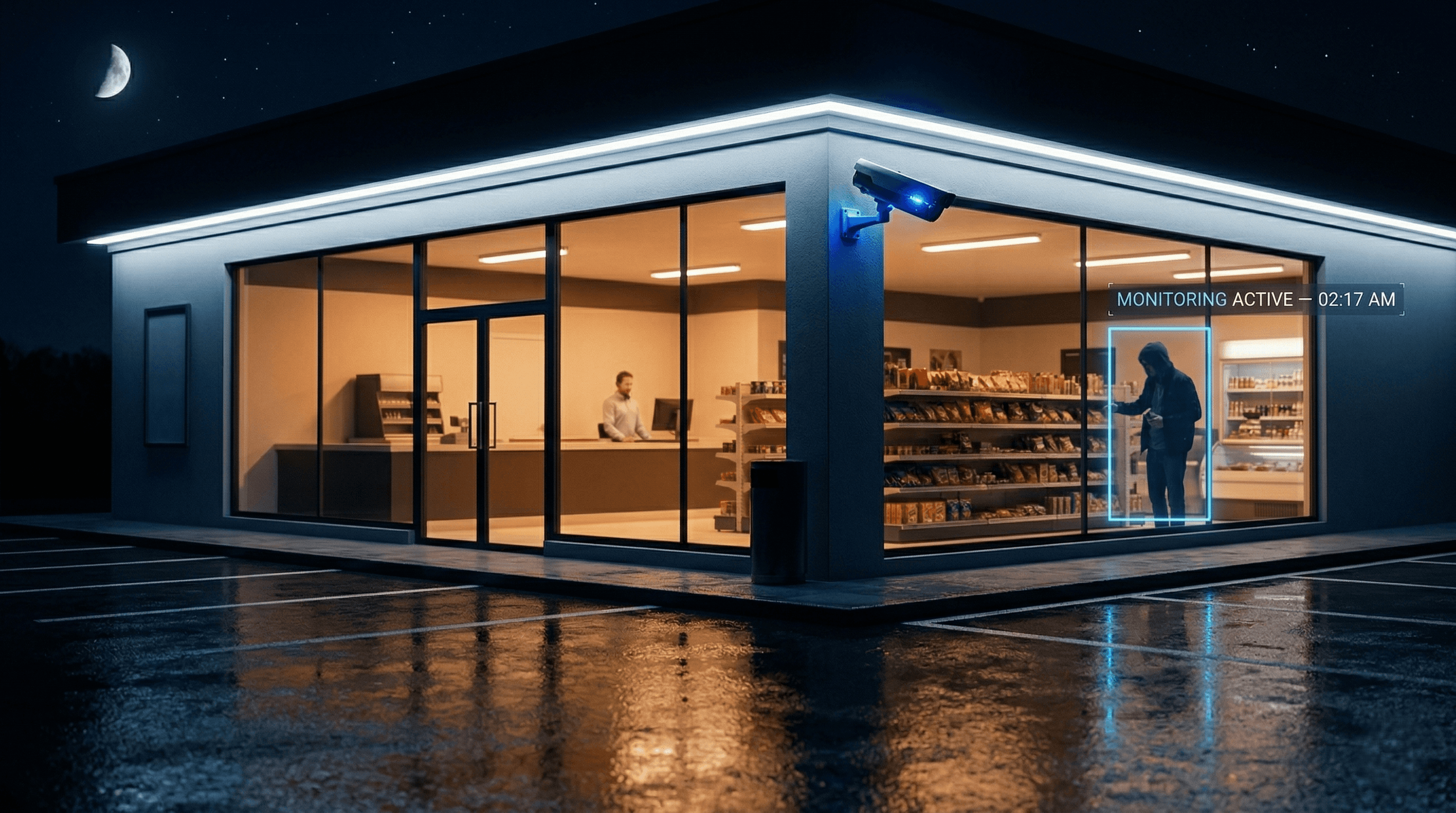
Think about the last time something went wrong at your store. There's a good chance it happened at night.
Not because nighttime criminals are smarter. Not because your staff is careless. But because the overnight hours create a perfect combination of low visibility, minimal staffing, reduced foot traffic, and zero active oversight — all at the same time.
Most small business owners know this intuitively. They feel it when they leave for the night and wonder what's going to happen while they're gone. They feel it when they come in the next morning and something's off — the register is short, a shelf is lighter than it should be, or a camera shows footage of something they wish they'd caught in real time.
Here's the hard reality: the 8 hours you're closed or understaffed are responsible for a disproportionate share of your annual losses. Industry data suggests that nearly 45% of retail theft incidents occur during evening and overnight hours, when staffing is at its lowest and the ability to respond is essentially nonexistent.
This blog is about understanding exactly what happens to your business after dark — and building a security infrastructure that works even when you can't be there.
What Actually Happens During Night Shift
Before you can protect against it, you need to understand what overnight theft actually looks like in practice. It's not always what you'd expect.
The Obvious: Break-Ins and After-Hours Burglary
Yes, smash-and-grab incidents and forced entries happen — particularly at gas stations and convenience stores in high-traffic urban areas. But these are actually among the easier crimes to document and the most likely to result in a police report. They're also the incidents your alarm system is most likely to catch.
What's more common, more costly, and far harder to identify is everything else.
The Non-Obvious: Overnight Employee Behavior
Here's what typically doesn't make it into the incident report: the cashier who works the 11 PM to 7 AM shift at your gas station and has developed a system over the past four months. Not dramatic theft — just consistent, calculated, small-scale fraud that looks like normal variance in your end-of-week numbers.
They know exactly when the cameras are passively recording versus actively monitored. They know the manager checks the register total at the end of the shift, not the individual transaction log. They know that when it's slow at 2 AM and there are no customers in the store, nobody is watching.
So they skim. Fifteen dollars here. Twenty there. An occasional void on a transaction that did go through. A friend who comes in, picks up $40 worth of merchandise, hands over a $20, and walks out with change.
Over four months, that's $8,000–$12,000. In your monthly numbers, it looks like shrinkage. You blame it on shoplifters.
The Late-Night Shoplifter Profile
Shoplifters who operate during late-night hours are different from daytime opportunists. They've made a deliberate choice to come in when staffing is minimal, when the cashier is tired, when the parking lot is empty enough that no one will see them leave, and when the likelihood of active surveillance intervention is essentially zero.
These aren't nervous first-timers pocketing a candy bar. Late-night shoplifters at convenience stores and gas stations tend to go for high-value compact merchandise — vape products, tobacco, energy drinks, prepaid debit cards, over-the-counter medications. Items that are easy to resell, hard to track individually, and small enough to disappear under a jacket without a dramatic concealment movement.
A single late-night shoplifter hitting your store three times a week takes $150–$300 in product per week. That's $600–$1,200 per month from one person you may never identify without active monitoring.
The Drive-Off Window
For gas station operators, the overnight hours represent the peak window for fuel drive-offs. The reasons are straightforward: fewer vehicles at the station means the cashier's attention is divided across fewer pumps, the parking lot is darker, there are fewer witnesses, and response time after a drive-off is longer because the cashier may not notice immediately.
Late-night drive-offs also tend to involve higher fuel quantities. Someone filling up at 2 AM isn't topping off — they're fueling a vehicle for a longer drive. That's $60–$100 in fuel per incident, not $20.
Why Your Current Setup Isn't Enough
Most small business owners have some combination of the following overnight security measures in place:
Security cameras covering the main areas
A locking front door
A cash drop safe the cashier uses during the shift
An alarm system connected to a monitoring center
A policy that the cashier should call 911 if something happens
This is better than nothing. It is not adequate.
Here's why each of these fails specifically during overnight hours:
Cameras that record but aren't monitored do nothing to prevent a theft that's happening right now. The footage will be there in the morning. The merchandise won't be.
Alarm systems detect intrusions after a perimeter has been breached. They do nothing about the shoplifter who walked in through the open front door at 1:15 AM, or the cashier who voided three transactions between midnight and 3 AM.
Cash drop safes protect against robbery of the safe itself. They don't protect against a cashier who simply doesn't ring a transaction and pockets the cash before it ever touches the register.
Calling 911 is the correct response to an active emergency. It is not a theft prevention strategy. By the time law enforcement arrives in response to a shoplifting call, the individual is gone, the merchandise is gone, and you have a case number that almost certainly goes nowhere.
The pattern is the same in every case: your existing measures are reactive. They respond to things that have already happened. For overnight security to actually work, you need something that responds to things as they're happening.
The Overnight Security Infrastructure That Actually Works
Effective night shift security for a retail business in 2025 isn't complicated in concept. It's the combination of three things working together simultaneously.
Active Human Monitoring — Not Just Recording
The most important shift in overnight security thinking is from recording to watching.
A live monitoring agent watching your overnight camera feeds in real time changes every calculation a potential thief — external or internal — makes about your store. They know someone might be watching. That knowledge alone reduces incidents dramatically.
When your monitoring team observes suspicious behavior — a customer spending too long near a high-value display at 1:30 AM, a cashier opening the register drawer without a corresponding transaction, a vehicle that pulled up to pump 4 and hasn't moved in four minutes — they respond immediately. An audio announcement through your store speakers. An alert to your on-site staff. A call to law enforcement with a live camera feed.
The intervention happens during the incident, not after it.
AI-Assisted Behavioral Detection
Human attention has limits. A monitoring agent watching twelve camera feeds simultaneously across multiple client locations can't catch everything with their eyes alone.
AI surveillance software running on your overnight camera feeds handles the pattern recognition work — flagging concealment behaviors, unusual transaction sequences, after-hours movement, extended dwell time near specific merchandise categories. When the AI flags something, it goes immediately to a live agent for review and response.
The combination matters: AI doesn't get tired at 3 AM, and humans don't miss context that a pure algorithm would misread. Together, they create overnight coverage that's meaningfully more effective than either alone.
POS Integration During Overnight Hours
This is particularly important for catches overnight employee fraud. When your camera system is synchronized with your point-of-sale data, every transaction anomaly during the overnight shift gets flagged and camera-correlated automatically.
A void at 2:47 AM pulls up the camera angle on that register at 2:47 AM. You don't have to manually review eight hours of footage looking for something you're not sure happened. The system identifies it, timestamps it, and routes it to an agent.
For overnight shifts — where transaction volume is lower and each anomalous event is therefore more statistically significant — POS integration dramatically improves the speed and accuracy of internal theft detection.
Real Overnight Scenarios: What Gets Caught With Active Monitoring
Scenario 1 — The 2 AM Shoplifter Who Came Back
A convenience store in Nashville had been experiencing consistent inventory losses in their vape and tobacco section over several weeks. Incidents happened almost exclusively between midnight and 4 AM. Passive cameras had footage of several individuals but no interventions had occurred.
After live monitoring was activated, on the third night a monitoring agent observed an individual enter at 2:15 AM and spend an unusual amount of time in the tobacco aisle with no purchase behavior. The agent triggered an audio announcement: "Attention: this location is under active 24/7 live surveillance. Our monitoring team is watching all activity in real time."
The individual left without merchandise. On camera, they visibly paused, looked up at the ceiling camera, and walked out. The following three weeks showed zero tobacco or vape losses during overnight hours.
Scenario 2 — The Night Shift Void Pattern
A gas station c-store in Columbus, Ohio had run consistent cash register shortages on the overnight shift for nearly six months. The amounts were small enough — $80 to $120 per shift — that they were attributed to counting errors and didn't trigger a formal investigation.
POS-integrated monitoring identified the pattern within 11 days of activation: the overnight cashier was processing void transactions on cash sales, typically on the third or fourth transaction after a legitimate one, always during the quietest period of the shift between 1 AM and 4 AM. Camera correlation showed the cashier pocketing bills before initiating the void.
Documented loss over six months: just under $14,000. The employee was terminated with full evidence documentation.
Scenario 3 — The After-Hours Parking Lot
A hotel gift shop and adjoining convenience mart in Phoenix had a recurring problem with individuals loitering in the parking lot overnight — deterring late-night customers and, on two occasions, resulting in vehicle break-ins that created insurance claims and reputational damage to the property.
Perimeter monitoring with AI motion detection and a live agent response protocol changed the dynamic within the first week. When loitering behavior was detected in the lot after 11 PM, the agent triggered an external speaker announcement and illuminated additional lot lighting remotely. In four weeks of operation, zero loitering incidents progressed beyond the initial detection stage.
Building Your Night Shift Security Plan: Practical Steps
Whether you're starting from scratch or improving an existing setup, here's what a well-structured overnight security plan looks like for a gas station or c-store operator:
Camera Coverage Review Your overnight cameras need to cover every area where theft can occur without a customer transaction: the full store floor including blind corners near coolers, the register from above and front, the stockroom entrance, the parking lot perimeter, and the pump island. If you have coverage gaps, overnight is when they're exploited most.
Lighting Assessment Poor lighting is a theft enabler during overnight hours. A well-lit parking lot and pump island dramatically reduces both the appeal and the practicality of overnight criminal activity. Motion-activated additional lighting — controllable by a remote monitoring team — adds another deterrent layer.
POS Anomaly Parameters Work with your monitoring provider to set meaningful thresholds for overnight POS alerts. Transaction voids, refunds, drawer opens without sales, and discounts applied during overnight hours should be flagged at lower thresholds than during busy daytime periods, when individual anomalous events carry more statistical weight.
Staff Awareness Protocol Tell your overnight staff that live monitoring is active. This is not just legally appropriate — it's strategically smart. Honest employees feel protected. Employees considering theft recalibrate their risk assessment immediately.
Incident Response Plan Know in advance: if your monitoring team flags an active incident at 3 AM, what happens next? Who gets called? What authority does your on-site overnight cashier have to respond? Having a clear protocol prevents paralysis during a real event.
The ROI of Overnight Security: Numbers Worth Knowing
For a typical single-location gas station or convenience store:
A store losing $150/night to combined overnight theft — shoplifting plus register manipulation — loses approximately $54,000 per year to overnight incidents alone. That number is conservative for an unmonitored location.
A professional 24/7 monitoring system with overnight coverage costs $399–$649/month — call it $5,000–$7,800 per year.
A 30% reduction in overnight losses — far below the 40–60% reduction most operators report — generates $16,000 in annual savings on a $54,000 loss baseline. That's a 2–3x return on the monitoring investment from overnight protection alone.
The more realistic scenario — where active monitoring produces a 50–60% reduction in overnight losses — generates $27,000–$32,000 in annual savings. At that level, the monitoring system pays for itself every 10 to 12 weeks.
How Survill Technologies Handles Overnight Protection
Survill was built around the specific problem of retail businesses that need protection during hours when owners and managers aren't present.
The overnight window — 10 PM to 6 AM — is where Survill's combination of trained live agents and AI-assisted detection creates the most measurable impact for gas station, c-store, hotel, and restaurant clients across the US.
Specifically for overnight operations, Survill provides:
Continuous live agent coverage — not reduced overnight staffing on the monitoring side, full coverage through every hour
Fatigue-compensating AI detection — behavioral flagging that operates at consistent accuracy regardless of the hour
Two-way audio response — immediate store announcements triggered by a monitoring agent the moment suspicious activity is detected
POS overnight anomaly monitoring — every transaction event during overnight hours flagged and camera-correlated in real time
Incident documentation — timestamped evidence packages from overnight incidents available for management review first thing in the morning
Perimeter alert capability — after-hours lot monitoring with agent-triggered lighting and audio response for loitering and after-hours intrusion
The goal is simple: by the time you come in at 7 AM, the night shift should have run cleanly — or you should already know exactly what happened and have the evidence to act on it.
Conclusion: The Shift That Defines Your Bottom Line
Your overnight hours don't have to be your most expensive ones.
The losses that happen between 10 PM and 6 AM are not inevitable. They're the product of a security infrastructure designed for daytime operations being stretched — inadequately — across a fundamentally different environment. Low visibility, minimal staffing, reduced deterrence, no active oversight. The overnight shift rewards criminals who have patience and penalizes business owners who have passive systems.
The solution isn't complicated. It's active monitoring — someone, or something, watching in real time and responding to what they see before the loss completes. That capability exists today, it's accessible to businesses of every size, and the financial case for it closes itself within weeks.
You worked hard for what your store earns. The night shift shouldn't be giving it away.
Book a Free Overnight Security Assessment
Survill Technologies offers a free 30-minute security consultation specifically for business owners concerned about overnight and after-hours exposure. We'll review your current camera setup, identify your overnight vulnerability gaps, and show you exactly what active monitoring would look like for your location — including a realistic projection of what it would save you.
📞 Call or text: (253) 362-3578 🌐 Visit: www.survill.com ✉️ Email: sales@survill.com
Frequently Asked Questions
Q1. What time of night is a retail store most vulnerable to theft? The highest-risk window for most convenience stores and gas stations is between midnight and 4 AM. This period combines the lowest customer foot traffic — reducing natural deterrence — with peak fatigue for overnight staff and the lowest likelihood of active management presence. Organized retail thieves and experienced shoplifters specifically target this window. Drive-offs at gas stations peak between 1 AM and 5 AM for the same reasons.
Q2. How do I know if my overnight employee is stealing? The most reliable indicators are POS anomalies correlated with specific shifts — excessive void transactions, refunds processed without corresponding returns, no-sale drawer events without transactions, or cash register shortages that consistently occur on the same employee's shifts. Without POS-integrated monitoring, these patterns often go undetected for months because the amounts per incident are small enough to appear as normal variance in weekly totals.
Q3. Does having cameras prevent overnight theft at gas stations? Passive cameras alone provide minimal deterrence to experienced overnight thieves — both external shoplifters and internal employees. Experienced retail criminals specifically target businesses with recording-only camera systems because they understand those cameras are not actively monitored. Active monitoring — with a live agent watching feeds and the ability to trigger audio announcements — creates genuine deterrence because it introduces the real possibility of immediate intervention.
Q4. What should my overnight cashier do if they see shoplifting? Your overnight cashier should never physically confront a shoplifter. The risk of escalation in a single-cashier overnight environment is too high. The correct protocol is to observe and note details, avoid confrontation, contact law enforcement if safe to do so, and report the incident with any available camera reference. A professional live monitoring system handles the intervention layer — audio announcements, law enforcement contact with live footage, and incident documentation — removing that burden from a lone overnight employee entirely.
Q5. Is 24/7 live monitoring affordable for a single gas station or convenience store? Yes — professional 24/7 live monitoring starts at $399/month for single-location retail businesses. For a store losing even $100/night to overnight theft — a conservative figure for an unmonitored location — that monitoring cost represents less than 14% of the monthly losses it's designed to prevent. Most single-location operators see full return on their monitoring investment within 45–60 days of activation.