Article
Apr 4, 2026
Live Monitoring vs. Traditional CCTV: Why Recording a Crime Is Not the Same as Preventing One
Traditional CCTV records a crime, while live monitoring can stop it. See the real difference and why it matters for your business's bottom line.
Introduction: The Camera Watched. The Theft Still Happened.
Here's a scenario that plays out in thousands of American stores every single week.
A store owner installs a solid camera system — eight cameras, HD resolution, night vision, wide-angle coverage. They spend good money on it. They feel protected. They tell their employees the cameras are always recording. They go home at night feeling like they've done their due diligence.
Then a shoplifter walks in at 11 PM, spends four minutes concealing $80 worth of merchandise, and walks out.
The camera got all of it. Crystal clear. Every angle.
And it was completely useless.
That footage sat on a DVR until the owner noticed a discrepancy during inventory three weeks later. By then, the same person had come back twice. The total loss? A little over $300. The police report? Filed. The merchandise recovered? Zero.
This is the core problem with how most small business owners think about security cameras. A camera that records a crime and a system that prevents one are not the same thing — not even close. And yet the entire security camera industry has spent decades selling the former while implying it delivers the latter.
Let's break down the real difference.
The Traditional CCTV Model: What You're Actually Getting
Walk into any security equipment supplier and you'll find wall-to-wall options — dome cameras, bullet cameras, PTZ cameras, 4K resolution, IR night vision, cloud storage, the works. The specs are impressive. The marketing is convincing.
But here's what every one of those systems has in common: they are recording devices, not prevention devices.
Traditional CCTV works on a simple principle. Cameras capture footage continuously. That footage is stored — either locally on a DVR/NVR or in the cloud. If something happens, you or law enforcement review the footage after the fact to understand what occurred.
That's it. That's the whole system.
The deterrence argument — "criminals will see the cameras and be scared off" — works on opportunistic, first-time, unsophisticated thieves. It does absolutely nothing to deter experienced shoplifters, organized retail crime groups, or your own employees who know exactly how passive your camera setup is.
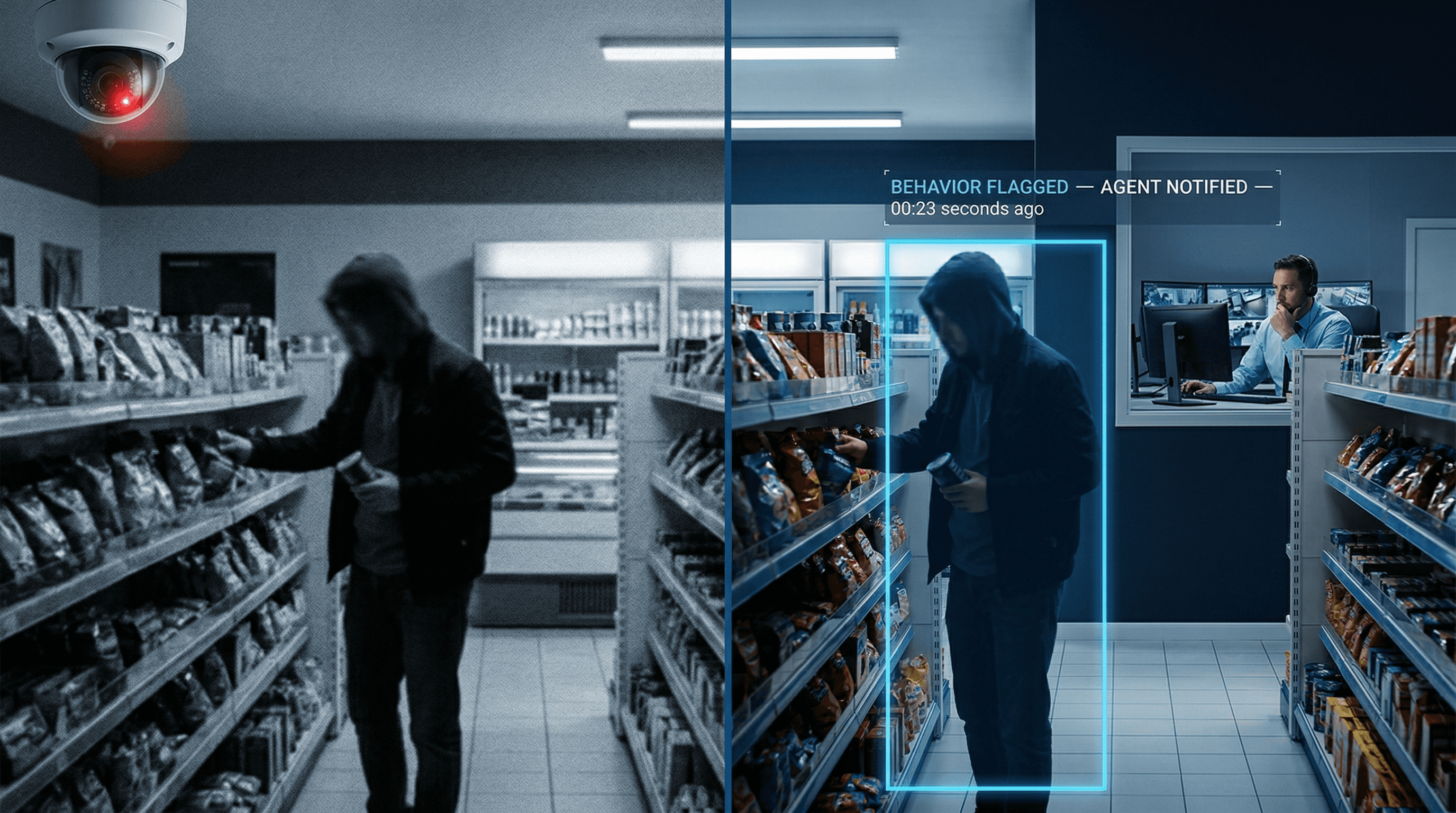
Experienced shoplifters case stores before they hit them. One of the first things they assess is whether there's any active monitoring or just passive cameras. A camera with a blinking red light and no human behind it? That's not a deterrent. That's just documentation of what they're about to do.
Specific Ways Traditional CCTV Fails Businesses
No real-time alert system. When something suspicious happens, nobody is notified. The footage records it faithfully and stores it for later. There is no "later" that helps you recover what was taken five minutes ago.
Footage quality rarely matches marketing claims. Cameras look great in demos. In real stores — with mixed lighting, reflective surfaces, glass, angles, and movement — getting a usable identification image is much harder than the brochure suggested. Ask any police detective who works retail theft cases.
DVR and NVR systems fail silently. Hard drives fill up and stop recording. Cameras go offline. Connections drop. Most owners don't discover these failures until they desperately need footage that doesn't exist. In one study, nearly 1 in 4 surveillance systems checked by loss prevention professionals had at least one critical failure that the owner was unaware of.
Blind spots are exploited systematically. Experienced shoplifters walk a store once, identify the camera angles, and work exclusively in the gaps. If your cameras don't cover every angle — and most systems don't — you've essentially just mapped your blind spots for anyone patient enough to look.
It creates false confidence. This might be the most expensive limitation of all. Business owners who have cameras installed feel like they have security. That feeling reduces their vigilance, their staff's vigilance, and their investment in other protective measures — while their losses continue unchanged.
What Live Monitoring Actually Means
The terminology gets thrown around a lot, so let's be precise about what real 24/7 live monitoring involves.
Live monitoring means trained security professionals — supported by AI detection software — are actively watching your camera feeds in real time, around the clock. Not reviewing footage. Not checking in occasionally. Watching. Right now. While your store is open and while it's closed.
When something happens, they don't record it for later. They respond to it immediately.
That response can take several forms depending on what's happening:
A two-way audio announcement through your store's speaker system — immediate, audible, and surprisingly effective at stopping incidents mid-act
A direct alert to your on-site staff via phone or notification app
A real-time call to local law enforcement with live footage available
Documentation of the incident as it unfolds for clean evidentiary use
The difference in outcome is not incremental. It's fundamental. You're not choosing between a better camera and a worse camera. You're choosing between a recording system and a prevention system.
How AI Makes Live Monitoring Smarter
Here's where the technology gets genuinely impressive — and where the gap between traditional CCTV and modern monitoring systems becomes almost impossible to close.
AI surveillance software running on your camera feeds doesn't just capture footage. It actively analyzes behavior in real time, flagging events that match patterns associated with theft, fraud, or security incidents.
What AI Detection Actually Catches
Behavioral anomalies at the point of sale. Unusual hand movements near cash drawers, items passed across a counter without being scanned, customers handed back more than they paid — the AI flags these events and routes them to a live agent within seconds.
Concealment behavior. Specific movement patterns associated with hiding merchandise — repeated contact with clothing or bags, crouching near shelves, spending unusual time in low-traffic areas — are detected and flagged before a person ever reaches the exit.
Loitering and dwell time analysis. Someone standing near a high-value display for three minutes isn't necessarily stealing. But combined with other behavioral signals, it becomes a pattern the AI recognizes and surfaces for human review.
After-hours perimeter alerts. Intelligent motion filtering distinguishes between a car driving through your lot at 2 AM and a person approaching your door on foot. Only the latter triggers an alert. False alarm fatigue — a real problem with older motion sensor systems — is dramatically reduced.
POS anomaly correlation. When your surveillance is integrated with your point-of-sale system, every transaction anomaly — void, refund, excessive no-sale events, discount override — triggers an automatic camera pull of that exact moment. The AI doesn't just watch the floor. It watches the register simultaneously.
The result is a system that's simultaneously faster than any human at pattern recognition and more contextually aware than any automated system running alone. The AI surfaces what matters. The human agent makes the call.
Side by Side: The Honest Comparison
Let's put this in plain terms for a business owner making a real decision.
When a shoplifter walks into your store:
Traditional CCTV: Records them entering
Live monitoring: A live agent sees them enter, begins active observation immediately
When they begin concealing merchandise:
Traditional CCTV: Records the concealment in whatever camera angle is available
Live monitoring: AI flags the behavioral pattern, agent confirms, two-way audio announcement plays within 30–60 seconds
When they head for the exit:
Traditional CCTV: Records them leaving
Live monitoring: In most cases, the announcement has already caused them to abandon the merchandise or pay for it
After they leave:
Traditional CCTV: You have footage of the theft, usable for a police report that usually goes nowhere
Live monitoring: In most cases, the theft didn't complete. If it did, you have real-time documentation, a timestamped incident report, and footage already flagged for follow-up
Three weeks later:
Traditional CCTV: You're doing inventory and discovering losses you can't explain
Live monitoring: You have a log of every flagged incident, every intervention, and every outcome over the past three weeks — including patterns that identify repeat offenders
Real Business Scenarios Where This Difference Is Everything
The Gas Station at 1:30 AM
A fuel station outside Phoenix had passive CCTV covering the pump island and store interior. Over six months, they averaged 11 drive-offs per month — roughly $7,000 in annual fuel losses — plus consistent in-store shoplifting during late-night hours when one cashier was working alone.
After switching to live monitoring with LPR integration at the pump island and 24/7 agent coverage, drive-offs dropped to two in the first month. The mechanism wasn't complicated: when a vehicle approached a pump without completing pre-authorization, the monitoring agent triggered an audio announcement at the island canopy speaker within 90 seconds. Most drives-offs don't happen because someone is committed to stealing fuel. They happen because the opportunity presented itself and nothing stopped them. Take away the opportunity — or make it feel risky — and most people make a different choice.
The Convenience Store With the Mystery Shrinkage
A c-store owner in suburban Illinois had been running consistent inventory discrepancies for eight months. Shrinkage was attributed to shoplifting. The owner installed better cameras. The discrepancies continued. The cameras, it turned out, were recording the problem beautifully without identifying it.
A POS-integrated live monitoring system identified the actual issue within two weeks: a cashier was consistently failing to scan one item per transaction during busy morning shifts — a single item, low value, entirely plausible as an honest mistake in any individual instance. Across 90+ transactions per shift, it amounted to $200–$250 in daily unscanned merchandise. The behavior was so deliberate and consistent that the POS anomaly detection flagged it as a pattern on day nine. Camera correlation confirmed it on day eleven. Total documented loss over eight months: over $40,000.
The Hotel Gift Shop That Kept Getting Hit
A hotel in Nashville had a gift shop that absorbed regular losses during peak check-out periods — 11 AM to 1 PM on weekdays — when a single attendant was managing the shop while also handling lobby inquiries. Traditional cameras recorded multiple theft incidents clearly. Recoveries: zero.
Live monitoring changed the dynamic immediately. During the first week of deployment, a monitoring agent observed two individuals using the classic distraction method — one engaging the attendant with questions while the other pocketed merchandise near the register. The agent triggered an audio announcement within 40 seconds. Both individuals left without merchandise. On their second visit three days later, the agent recognized the pattern, alerted hotel security pre-emptively, and both individuals were approached before entering the gift shop.
The ROI Conversation: What This Actually Costs vs. What It Saves
Business owners considering live monitoring almost always start with the same question: what does it cost?
Fair question. Here's the full answer.
A professional 24/7 live monitoring system for a single retail location — with AI-assisted detection, POS integration, and trained agent coverage — typically runs $400 to $900 per month depending on the number of cameras, zones covered, and level of integration.
Now the other side of the ledger.
The average convenience store loses $3,000 to $8,000 per month to combined theft and shrinkage. A gas station with regular drive-off activity loses $1,500 to $4,000 in fuel alone before accounting for in-store losses. A hotel gift shop or restaurant can run $1,000 to $3,000 in monthly shrinkage without a prevention system in place.
A live monitoring system that reduces those losses by 40% — a conservative estimate based on industry data — generates a return of $1,200 to $3,200 per month on a $400–$900 investment.
The payback period at most locations is 30 to 60 days.
Beyond direct loss prevention:
Most commercial insurance carriers offer 10–20% premium reductions for businesses with documented professional monitoring — a reduction that often covers a significant portion of the monthly service cost
Incident documentation packages from a professional monitoring service dramatically improve police response outcomes and insurance claim processing, recovering costs that passive camera systems leave on the table
Employee behavior changes meaningfully when active monitoring is present — productivity, register accuracy, and general accountability improve in ways that have measurable operational value
Where Survill Technologies Fits Into This
Most surveillance companies sell cameras. A few sell monitoring. Survill Technologies was built specifically around the gap between those two things — the gap where your business is currently losing money.
Survill operates a 24/7 U.S.-based monitoring center staffed by trained agents who work with AI-assisted detection software across client locations simultaneously. The system is designed not to document what happened to your business, but to prevent it from happening in the first place.
For retail businesses across the U.S. — gas stations, convenience stores, restaurants, hotels, multi-location operators — Survill provides:
Round-the-clock live agent monitoring across all camera zones
AI behavioral detection with real-time flagging and human review
Two-way audio intervention capability through existing or new speaker infrastructure
Full POS synchronization for transaction anomaly detection
LPR integration for drive-off prevention at fuel operations
Incident documentation packages built for law enforcement and insurance use
A single dashboard for multi-location operators
The goal isn't to sell you a system. It's to stop you from losing money you've already earned.
Conclusion: The Question Isn't Whether You Have Cameras
Almost every business owner reading this already has cameras. The question is whether those cameras are actually protecting you — or just building an archive of the losses you're absorbing.
Recording a theft is not the same as preventing one. The technology to actually prevent theft — to watch in real time, respond immediately, and make your store an environment where the cost of attempting theft is simply too high — exists right now and is accessible to businesses of every size.
The math is straightforward. The decision, once you see it clearly, usually is too.
Book a Free Security Assessment
Survill Technologies offers a no-obligation security consultation for U.S. business owners. We'll review your current setup, identify your specific vulnerability gaps, and show you exactly what a live monitoring system would look like for your location — including a realistic ROI projection based on your actual numbers.
📞 Call or text: (253)-362-3578 🌐 Visit: www.survill.com ✉️ Email: sales@survill.com
Frequently Asked Questions
Q1. What is the difference between live monitoring and a regular security camera system? A traditional security camera system records footage continuously and stores it for review after an incident occurs. Live monitoring means trained agents — supported by AI detection software — are actively watching your camera feeds in real time, 24 hours a day. The critical difference is intervention: live monitoring can respond to suspicious behavior while it's happening through audio announcements, staff alerts, or law enforcement contact. Traditional CCTV can only document what already happened.
Q2. Does live surveillance actually reduce theft or just record it better? Live surveillance with active monitoring reduces theft — it doesn't just document it more clearly. The combination of AI behavioral detection and real-time human response creates genuine deterrence. Studies and operator data consistently show 40–60% reductions in theft incidents within 60–90 days of deploying an active monitoring system, compared to minimal deterrence effect from passive recording cameras.
Q3. How much does 24/7 live monitoring cost for a small retail business? Professional 24/7 live monitoring for a single retail location typically costs between $400 and $900 per month depending on the number of cameras, coverage zones, and integrations like POS synchronization or license plate recognition. For most businesses losing $3,000 or more monthly to theft, this represents a strongly positive ROI — often recovering the full annual cost within the first 60 days.
Q4. Can AI surveillance work with my existing cameras? In many cases, yes. Modern AI monitoring platforms can integrate with existing camera infrastructure if the cameras meet minimum resolution and connectivity requirements. A professional surveillance provider will assess your current setup and determine whether new hardware is needed or whether your existing cameras can be brought into an AI-monitored system. Survill Technologies offers this assessment as part of their free consultation.
Q5. Is live monitoring legal for my business? Yes — in all U.S. states, businesses can legally use video surveillance in customer-facing areas and employee work zones where there is no reasonable expectation of privacy. This includes sales floors, registers, parking lots, stockrooms, and fuel pump areas. Audio monitoring laws vary by state and require more careful review. A reputable monitoring provider will ensure your system is deployed in full compliance with your state's specific requirements.