Article
Apr 12, 2026
Human + AI Surveillance: Why the Combination Stops Theft That Either One Alone Never Could
AI cameras miss context. Human agents miss patterns. Here's why human and AI surveillance for retail business works when nothing else does
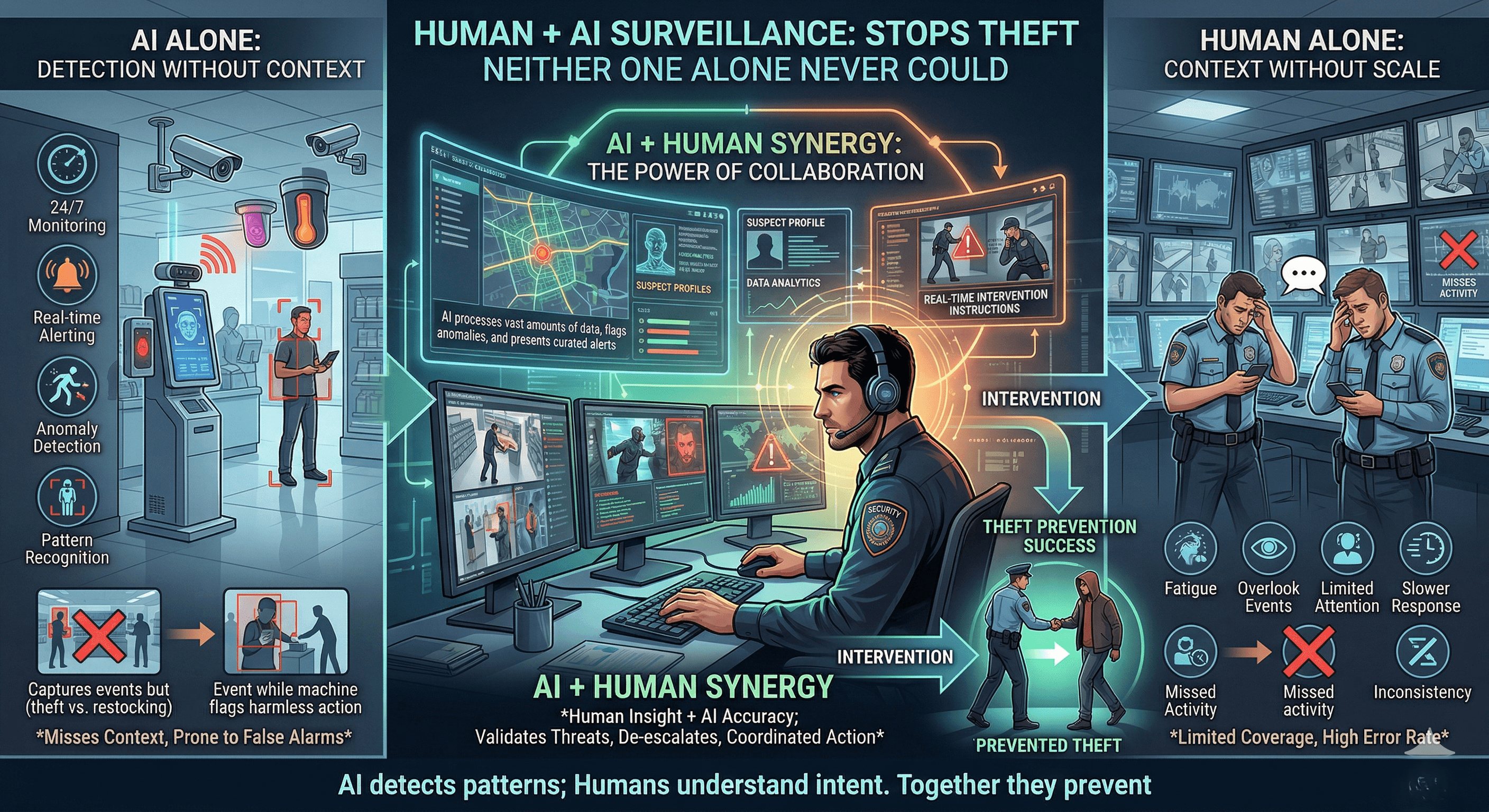
Your Camera Recorded It. Nobody Stopped It. Here's Why.
You have cameras. Good ones. They recorded the whole thing — the concealment, the exit, the drive-off, every second of it. And it didn't matter at all because nobody was watching when it happened and nobody could do anything when they reviewed it three days later.
This is the experience that sends retail business owners searching for answers about human and AI surveillance for retail business — not because they've heard a sales pitch, but because they've lived the failure of passive security firsthand. They know something is wrong with what they have. They're not sure what the right alternative actually looks like.
Here's the honest answer: the right alternative isn't better cameras. It isn't smarter AI. And it isn't more security guards. It's the specific combination of AI pattern detection and trained human oversight working simultaneously — a system where each component does what the other fundamentally cannot. Understanding why that combination works starts with understanding why each piece fails alone.
Why Human-Only Security Can't Scale to Your Actual Problem
Picture your most attentive employee. The one who notices everything, catches details others miss, takes the job seriously. Now ask them to watch eight camera feeds simultaneously for eight hours straight without losing focus.
It's not possible. Not because they're not good at their job. Because human attention doesn't work that way.
Research on security monitoring has consistently shown that human attentiveness to passive video feeds degrades dramatically within the first 20 minutes of sustained watching. By the 30-minute mark, the average observer misses roughly 45% of significant events on screen. By hour two, that number climbs past 70%.
This isn't a staffing problem you can solve by hiring better people or paying higher wages. It's a cognitive limitation that applies to every human being who has ever watched a monitor for a living. Experienced shoplifters know this. Organized retail crime groups specifically time their operations to exploit fatigue windows — late shift, post-rush, just before closing.
The human security model also has a response problem. Your on-site cashier working alone at 2 AM is not a security professional. Expecting them to identify, confront, and manage a theft incident while running the register, managing fuel authorizations, and handling legitimate customers is not a security strategy. It's an unfunded mandate that puts your employee in an impossible position.
Human oversight, without technological support, cannot maintain the consistent coverage and pattern recognition that modern retail theft requires. That's not a criticism. It's a design constraint. And designing around it requires something other than more humans.
Why AI-Only Surveillance Isn't the Answer Either
The AI surveillance market in 2026 is full of systems that promise automated theft detection without any human component. Run the AI, let it flag events, review the alerts at your convenience. Sounds efficient. In practice, it has three serious problems.
First: context blindness. AI behavioral detection systems are trained to identify patterns — concealment movements, loitering, unusual dwell time near merchandise. They're excellent at flagging events that match those patterns. They're poor at understanding context. A customer who spends four minutes in the vape aisle examining products before making a legitimate purchase looks similar in behavioral data to a shoplifter. An AI-only system generates false positives at rates that create alert fatigue — owners and managers who receive dozens of alerts per shift quickly learn to ignore them, which defeats the purpose entirely.
Second: the experience gap. Experienced retail thieves — not first-timers, but the organized groups that cause disproportionate losses — have had years of exposure to AI detection systems. They've learned what triggers them and what doesn't. A group operating in teams knows that if one member creates a behavioral flag near the register, the AI alert focuses there while other team members work elsewhere. They use counter-surveillance techniques specifically designed to exploit the predictability of algorithmic detection.
Third: no intervention. An AI system that flags an event and generates an alert is, at its best, a fast documentation system. Someone still has to decide what to do about that alert — and in an AI-only setup, that decision happens after the fact, not during the incident.
Here's the definition that matters: AI-only surveillance is detection without response. It tells you what happened. It cannot make what's happening stop.
Why Human + AI Surveillance Is Categorically Different — Not Just Better
When trained human agents and AI detection systems operate together on your store's camera feeds, something happens that neither component can produce independently: the system becomes genuinely unpredictable to the people trying to exploit it.
Here's exactly what each component handles and why it's irreplaceable.
The AI layer runs continuously. It doesn't get tired at the 30-minute mark. It doesn't lose focus during a busy period. It analyzes behavioral patterns across every camera simultaneously — not sequentially, the way a human eye moves between feeds, but in parallel, processing multiple data streams at the same moment. When something matches a learned theft pattern, it flags immediately. The AI's job is not to decide what to do. Its job is to ensure that nothing that warrants human attention goes unnoticed.
The human layer provides judgment. When the AI flags an event, a trained monitoring agent reviews it within seconds. They assess context — is this behavior actually suspicious or is there a plausible innocent explanation? If action is warranted, they take it: an audio announcement through your store speakers, a direct alert to your staff, a call to law enforcement with a live feed running. The human agent's job is not to watch every pixel of every frame. It's to respond with appropriate judgment to events the AI has already identified as potentially significant.
The combination creates a third effect that neither component generates alone: deterrence through genuine uncertainty. A shoplifter who cases your store can assess whether cameras are recording. They cannot assess whether a human agent is actively watching right now. They cannot predict when an AI flag will route to an agent versus not. That uncertainty — the genuine possibility that someone is watching, has seen what they're doing, and is about to respond — changes the risk calculation for every person in your store.
Human plus AI surveillance reduces retail theft by 40–60% within 90 days at most single-location operators. That number comes from intervention, not documentation. It reflects what happens when the system can actually respond to what it sees — not just record it.
What This Looks Like in Three Real Businesses
The Gas Station in Memphis
A fuel station operator was losing an estimated $3,800 per month to combined drive-offs and in-store shoplifting during overnight hours. Passive cameras documented everything. Nothing changed. After deploying AI-assisted monitoring with live agent coverage, the first week produced two real-time audio interventions at the pump island when vehicles completed fueling without initiating payment. Both vehicles left without drive-off. By month three, overnight fuel losses had dropped by 68% — from $2,100 in monthly drive-off losses to under $700. The AI flagged the vehicles. The human agent responded before the pump stopped running.
The Convenience Store in Phoenix
A multi-location operator noticed inventory discrepancies in tobacco and vape categories that couldn't be explained by shoplifting alone. POS-integrated monitoring with live AI oversight identified a cashier on the Wednesday overnight shift running a pattern of voids — small amounts, plausibly explained individually, but occurring at a frequency that was statistically anomalous compared to any other employee or shift. A human agent reviewed the flagged transactions on day eleven and confirmed cash handling behavior inconsistent with the void explanations. Total documented loss over four months: $9,400. Total time to detection after monitoring activation: 11 days.
The Hotel Gift Shop in Nashville
A hotel gift shop was absorbing consistent losses during peak check-out periods — 11 AM to 1 PM — when one attendant managed both the shop and occasional lobby questions. The distraction window was predictable, and regular visitors to the property had noticed it. AI monitoring flagged a pair of individuals whose behavioral pattern in the shop matched a previously documented distraction-and-conceal technique. The monitoring agent alerted hotel security before the pair reached the shop exit. Items recovered. Trespass issued. The two individuals had accumulated documented losses of over $1,200 at that property over prior visits.
The Financial Case: What It Costs, What It Saves, and When You Break Even
Let's use honest numbers. A professional human plus AI surveillance system for a single retail location runs $399 to $649 per month depending on camera count, zone coverage, and POS integration requirements.
A typical convenience store losing money at industry-average shrinkage rates is absorbing $3,000 to $5,000 per month in real economic losses — direct inventory, margin replacement cost, insurance premium excess, and administrative burden. That's the real number, not just the inventory variance figure.
A 40% reduction in those losses — again, a conservative estimate relative to what most operators report — generates $1,200 to $2,000 in monthly savings against a $399 to $649 investment. The ROI math closes in under 30 days.
Insurance carriers in 2026 are offering 10 to 20 percent premium reductions for businesses with documented professional monitoring systems. For a business paying $18,000 annually in commercial property and liability premiums, that's $1,800 to $3,600 in annual savings that directly offsets the monitoring cost — sometimes entirely.
The businesses that have made this math work are not large chains with enterprise security budgets. They're independent operators who looked honestly at what their current system was costing them — in losses, in insurance, in management time — and compared it against what active monitoring would cost. The decision, when those numbers are visible, is rarely close.
Why Survill Was Built Around This Combination
Most surveillance companies will sell you one piece of this equation. They'll sell you cameras. Some will sell you AI. A smaller number will sell you monitoring.
Survill Technologies was built specifically around the belief that selling any one component without the others is selling a partial solution to a complete problem. The 24/7 live monitoring agents, the AI behavioral detection, the POS integration, the real-time audio intervention, and the multi-location dashboard all exist because no single piece of that list — deployed alone — produces the outcomes retail business owners actually need.
The result is a platform where the AI works because a human acts on what it finds. And the human works because the AI ensures they never miss what matters. That's not a feature combination. It's a different category of protection entirely.
Conclusion: The System You Have Is Telling You Something
Every time your camera records a theft that nobody stopped, it's telling you the same thing: you have documentation infrastructure, not prevention infrastructure. Those are different problems. And they require different solutions.
The combination of human judgment and AI detection isn't a premium upgrade to your existing security posture. It's the answer to the specific failure mode your current system produces over and over again — footage of losses that have already happened, filed in a folder nobody is ever going to act on.
The theft that happens tomorrow morning at 2 AM doesn't care how good your footage looks. It cares whether anyone is watching.
Book Your Free Security Assessment
Survill Technologies offers a no-obligation 30-minute consultation for retail business owners across the US. We'll review your current setup, identify your specific vulnerability gaps, and show you exactly what human plus AI monitoring would look like at your location — including a realistic projection of what it would save you.
📞 (253) 362-3578 | 🌐 www.survill.com | ✉️ sales@survill.com
Frequently Asked Questions
Q1. What exactly is human and AI surveillance and how does it work for a retail business? Human and AI surveillance for retail business is a security system where artificial intelligence analyzes your camera feeds continuously — flagging behavioral patterns associated with theft, fraud, or suspicious activity — while trained human monitoring agents review those flags in real time and respond immediately through audio announcements, staff alerts, or law enforcement contact. The AI handles pattern recognition at scale and speed no human can match. The human handles context, judgment, and intervention that no algorithm can replicate. Together they create detection plus response — the two things a security system needs to actually prevent losses rather than just document them.
Q2. Can't a good AI system handle retail surveillance without a human involved? No — and this is a critical distinction in 2026. AI-only surveillance systems generate alerts but cannot respond to them, which means every flagged event still requires human action after the fact. Additionally, AI systems have documented context blindness — they struggle to distinguish suspicious behavior from visually similar legitimate behavior without human judgment in the review loop. Experienced organized retail crime groups have also learned to exploit the predictability of purely algorithmic detection. Human oversight in the review and response layer is not optional — it's the component that converts detection into prevention.
Q3. How much does a human plus AI surveillance system cost for a small retail business? Professional human and AI surveillance for a single retail location runs $399 to $649 per month in 2026, depending on camera count, coverage zones, and integrations like POS synchronization or license plate recognition. For a business losing $3,000 to $5,000 monthly to theft and shrinkage at industry-average rates, a 30 to 40 percent reduction in losses more than covers the monitoring cost within the first 30 days. Most single-location operators report full monthly cost recovery within 45 to 60 days of activation, with continued improvement through months two and three as behavioral pattern data builds.
Q4. Does the human monitoring team actually watch my store all night or just check in occasionally? Legitimate 24/7 live monitoring means trained agents have access to your live camera feeds around the clock and review AI-flagged events as they occur — not on a check-in schedule. The AI layer runs continuously so agents aren't watching blank screens; they're reviewing flagged events that have already been identified as potentially significant. Response time from AI flag to human review should be under 60 seconds for any professional monitoring service. When evaluating providers, ask specifically: what is your average flag-to-agent-review time, and what actions can your agents take in real time without waiting for your authorization?
Q5. How quickly does human plus AI surveillance start reducing theft after installation? Deterrence effects begin immediately upon activation — the moment your store's speaker system can broadcast a live monitoring announcement, the theft risk calculation for anyone in your store changes. Measurable loss reduction is typically visible within the first two to four weeks as the AI builds behavioral baseline data and the monitoring team develops familiarity with your specific location's patterns. Full statistical impact on monthly shrinkage numbers is typically measurable at the 60 to 90 day mark. Operators who have deployed Survill's human plus AI monitoring report 40 to 60 percent reductions in theft-related losses within that first 90-day window.