Article
Apr 1, 2026
How to Prevent Theft in a Convenience Store: The Complete 2026 Guide
Proven ways to prevent theft in your convenience store, and why 24/7 AI-powered live monitoring stops more incidents than traditional CCTV alone.
Introduction: The Theft Problem No One Talks About Openly
You unlocked your store at 6 AM. Restocked shelves. Managed staff. Handled hundreds of transactions. And by the end of the day, your register was short — again.
You didn't see it happen. Nobody did.
That's exactly how retail theft works in 2026. It's quiet, calculated, and relentless. According to the National Retail Federation, U.S. retailers lose over $112 billion annually to theft and shrinkage. Convenience stores and gas stations are among the hardest hit — high foot traffic, limited staff, long hours, and often no one watching closely enough.
The painful truth? Most store owners don't discover a theft until it's already over. The cameras recorded it. The loss already happened. And the thief is long gone.
This guide is about changing that. Not just recording crime — preventing it.
The Real Problem: What Store Owners Are Actually Dealing With
Before we talk solutions, let's be honest about the scope of the problem.
Shoplifting is only part of it. The bigger picture includes:
Organized retail crime (ORC): Coordinated groups that hit multiple stores in the same shift, walking out with hundreds of dollars in merchandise.
Employee theft: Industry data suggests employee theft accounts for nearly 28% of all retail shrinkage. This includes sweet hearting (scanning items for friends), skimming cash, or simply pocketing merchandise during slow hours.
Night shift vulnerabilities: Skeleton-crew hours between 10 PM and 6 AM are when theft spikes — fewer witnesses, tired employees, and reduced management presence.
Distraction theft: One person distracts the cashier while another walks out with merchandise. Classic, and still incredibly effective without active monitoring.
Vendor and delivery fraud: Overcharging, short-delivering, or falsely marking returns — happening right at your loading dock without anyone noticing.
Here's a number that should stop you cold: a single convenience store can lose $50,000 to $150,000 per year to combined theft and shrinkage. For most small-to-mid-size operators, that's the difference between profit and breaking even.
Why Traditional CCTV Is Failing Your Store
Most convenience store owners have cameras. Good cameras, even. HD resolution, night vision, wide-angle coverage. And yet — theft continues.
Why?
Because traditional CCTV is a recording system, not a prevention system.
Here's what a standard camera setup actually does:
It records continuously.
It stores footage on a local DVR or NVR.
If something happens, you (or the police) review the footage after the fact.
The thief already knows this. Career shoplifters and organized theft rings specifically target stores with passive CCTV because they understand one simple thing: a camera that no one is watching doesn't stop anything.
Consider the typical scenario. A customer walks into your store at 2:15 AM. Picks up two energy drinks and a snack, slides them into a jacket pocket, puts one item on the counter to appear legitimate, pays $2.49, and walks out. Your camera recorded every second of it. You won't find out until you do a weekly inventory count — if you notice at all.
That footage? Useful for a police report. Useless for getting your money back.
Traditional CCTV also fails in these specific ways:
No real-time alerts — no one is notified when suspicious behavior occurs
Blind spot exploitation — experienced thieves know where cameras point and where they don't
No employee accountability — if your staff is the problem, they know the cameras aren't being monitored live
Hardware failure goes unnoticed — DVRs crash, cameras go offline, and you don't know until you need that footage most
False sense of security — having cameras makes owners feel protected without actually being protected
The Solution: 24/7 Live Monitoring Changes Everything
The fundamental shift in modern retail security is moving from reactive to proactive surveillance.
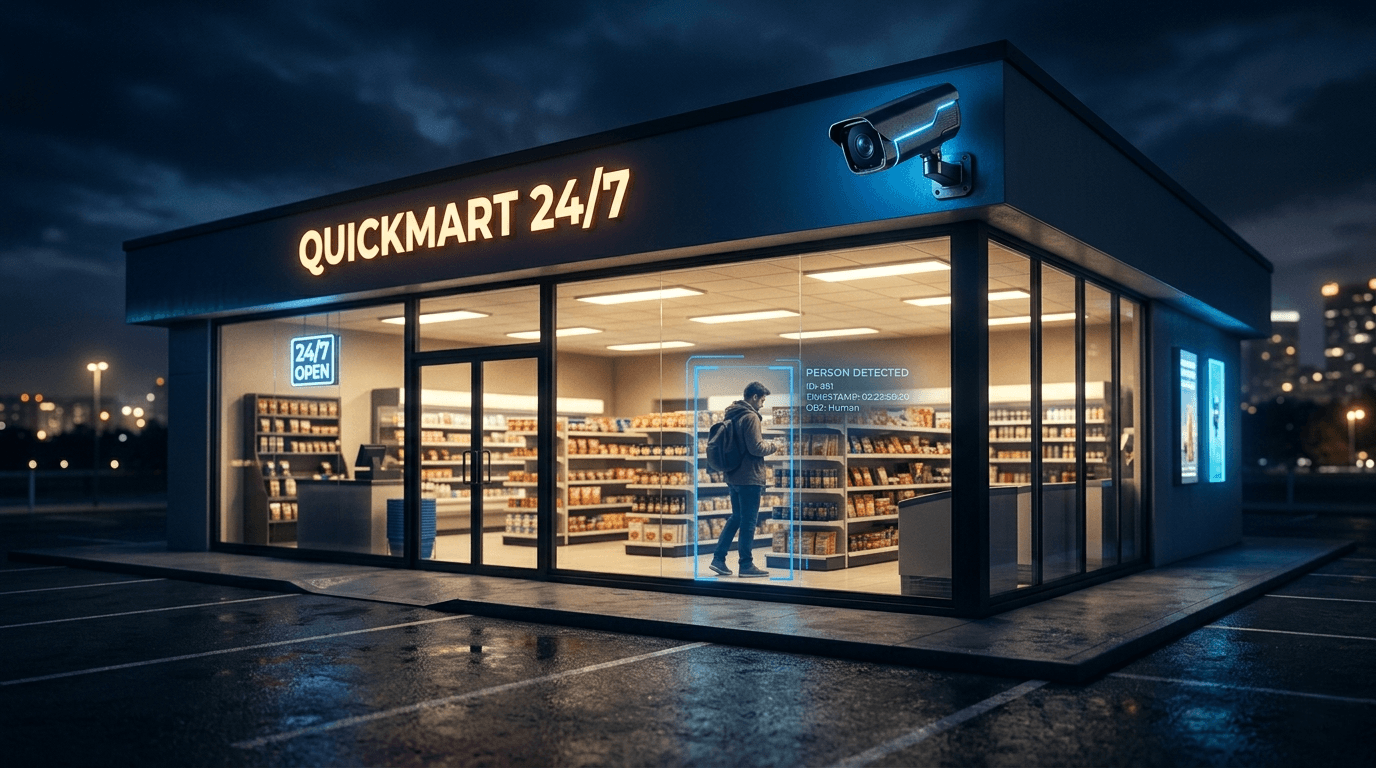
Live monitoring means trained security agents — supported by AI detection software — are watching your store's camera feeds in real time, 24 hours a day, 7 days a week. Not reviewing footage after an incident. Watching. Right now.
Here's what that changes:
When a suspicious individual enters your store at 2 AM, a monitoring agent sees it immediately. They can trigger an audio warning through an in-store speaker — "Attention: This store is under active 24/7 surveillance" — making it clear that someone is watching. Most would-be thieves leave. Immediately.
When an employee begins sweet hearting — running items without scanning them — the behavior is flagged within seconds. A supervisor alert goes out. The behavior is documented.
When a known repeat offender walks through your door, AI-assisted facial pattern recognition can flag the event in real time, allowing staff to be alerted before anything happens.
This isn't science fiction. It's what leading surveillance providers are deploying in American retail stores right now.
How AI Is Transforming Theft Detection in Retail
Artificial intelligence has fundamentally upgraded what's possible in store security. Here's a practical breakdown of how AI-powered monitoring works and why it matters for your store:
Behavioral Pattern Recognition
AI systems are trained to identify theft-correlated behaviors: loitering near high-value shelves, repeated item concealment movements, unusual dwell time near exit zones, or two individuals entering together but acting separately. These behavioral signals are flagged automatically and routed to a live agent for immediate response.
Point-of-Sale (POS) Integration
Modern AI surveillance can sync with your POS system to flag anomalies — a transaction where items were scanned but not bagged, a voided sale that follows a suspicious interaction, or a cashier processing an unusual number of no-sale events. The combination of camera data and transaction data is extraordinarily powerful for catching employee fraud.
Perimeter and After-Hours Monitoring
AI motion detection with intelligent filtering (ignoring wind, animals, and car headlights) can alert a live monitoring center the moment someone approaches your store after hours. Trespassers and burglary attempts are intercepted before entry in most cases.
License Plate Recognition (LPR)
For gas stations and stores with parking lots, LPR can flag known-flagged vehicles — useful for identifying vehicles associated with organized retail crime in your area.
The combined effect: stores using AI-assisted live monitoring report theft reductions of 40–60% within the first three months of deployment.
Real-World Scenarios: What This Looks Like in Your Business
Gas Station — Late Night Fuel Theft + Convenience Walkouts
A gas station in suburban Texas was losing an estimated $3,200/month to drive-offs and in-store theft during the 10 PM–6 AM window. After deploying live remote monitoring with LPR and POS integration, drive-offs dropped 71% in 90 days. The monitoring team identified two employees who were voiding cash transactions and pocketing the difference — discovered through synchronized POS and camera review.
Convenience Store — Employee Sweethearting
A multi-location c-store operator in Florida noticed chronic inventory discrepancies across three stores but couldn't pinpoint the source. Live monitoring identified a cashier at one location systematically under-ringing purchases for a small group of regular customers. The store recovered over $18,000 in documented losses and terminated the employee with full documented evidence.
Hotel Gift Shop — Organized Shoplifting
A hotel gift shop in Las Vegas experienced frequent theft during high-traffic checkout periods — items would disappear while the single cashier was occupied. AI behavioral monitoring flagged a recurring pair of individuals within two visits. On their third visit, on-site security was pre-positioned. Items were recovered and trespassing orders issued.
The Benefits Breakdown: What You're Actually Buying
When a business owner invests in 24/7 live monitoring, here's what they're actually getting:
Theft Reduction Active deterrence — not just documentation — stops incidents before they become losses. Stores see measurable shrinkage reduction within weeks, not months.
Employee Accountability When staff know they're being watched by a trained team (not just a passive camera), behavior changes. Sweet hearting drops. Register accuracy improves. Break time compliance increases. The cultural shift alone has measurable financial impact.
Real-Time Alerts & Intervention Incidents are flagged within seconds. Managers are notified immediately. Law enforcement can be contacted with live footage during an active event, dramatically improving response outcomes.
Insurance Premium Reductions Many commercial insurers offer 10–25% premium reductions for businesses with documented, professional monitoring systems. That reduction alone can offset a significant portion of your monthly monitoring cost.
ROI That's Easy to Calculate If your store loses $4,000/month to theft and a professional monitoring system costs $600/month, the math is straightforward. Even a 30% theft reduction pays for the system three times over.
Peace of Mind Owning a retail business is stressful. Knowing that trained professionals and AI systems are watching your investment 24/7 — even when you're not there — is worth more than most owners realize until they have it.
Why Survill ?
Most security companies will sell you cameras. A few will sell you monitoring. Survill Technologies is built around a different mission: stopping theft before it happens, not after.
Here's what sets Survill apart for American retail businesses:
24/7 Live Human + AI Monitoring — trained agents supported by AI detection, watching your feeds around the clock
Real-Time Intervention — not just alerts, but active response: audio warnings, staff notifications, law enforcement coordination
POS & Transaction Integration — surveillance synchronized with your sales data to catch both external theft and internal fraud
No Long-Term Lock-In — flexible service plans designed for single-location and multi-location operators
U.S.-Based Support — dedicated account management and monitoring teams who understand American retail environments
Survill doesn't just record what's happening in your store. We help make sure the bad stuff doesn't happen in the first place.
Conclusion: Stop Losing. Start Protecting.
Theft in convenience stores, gas stations, and small retail businesses is not inevitable. It feels that way when your only tool is a passive camera system and a monthly inventory report full of discrepancies. But the technology to stop it — actually stop it — exists right now and is accessible to businesses of every size.
The combination of AI-powered detection and 24/7 human monitoring has changed the economics of retail loss prevention. You no longer need a dedicated on-site security guard. You don't need to review hours of footage hoping to catch something. You need a system that watches so you don't have to — and acts the moment something goes wrong.
Your store is your livelihood. Protect it like it.
Frequently Asked Questions
Q1. What is the most effective way to prevent shoplifting in a convenience store? The most effective approach combines visible deterrents (cameras, signage) with active monitoring. Studies consistently show that stores with 24/7 live surveillance — where someone is watching in real time — experience significantly less theft than those relying on recording-only systems. AI-assisted behavioral detection makes this even more effective by flagging suspicious activity before a theft occurs.
Q2. How much do convenience stores lose to theft every year? U.S. convenience stores collectively lose billions annually to shrinkage. Individual store losses vary widely, but estimates suggest a single location can lose $50,000–$150,000 per year when combining shoplifting, employee theft, and vendor fraud. The National Retail Federation reports total U.S. retail theft losses exceed $112 billion annually.
Q3. Does live video monitoring actually reduce theft better than recorded CCTV? Yes — significantly. Recorded CCTV documents theft after the fact. Live monitoring enables real-time intervention: audio deterrents, staff alerts, and law enforcement calls while an incident is occurring. Businesses that switch from passive CCTV to live monitoring typically report 40–60% reductions in theft-related losses within 90 days.
Q4. What is AI-based theft detection and how does it work for small stores? AI theft detection uses trained machine learning models to identify theft-correlated behaviors on camera — concealment movements, unusual loitering, suspicious POS patterns — and alert a live monitoring agent instantly. It works for stores of any size. You don't need a large footprint; even a two-camera setup at a small c-store can be AI-monitored effectively.
Q5. Can I monitor my convenience store remotely from my phone? Yes. Modern surveillance platforms offer mobile dashboard access — live feeds, recorded clips, alert notifications, and POS anomaly reports — all accessible from your smartphone. Professional monitoring services like Survill Technologies also provide direct escalation alerts so you're notified immediately if something unusual is flagged at your location, even if you're off-site.
Published by Survill Technologies | Protecting American Businesses 24/7 📞 Book a Free Security