Article
Apr 11, 2026
How to Choose the Right Surveillance System in 2026: What to Look For Before You Spend a Dollar
The surveillance system market in 2026 is full of options. Here's exactly what matters, what doesn't, and how to avoid buying something that won't actually protect your business.
Introduction: Most Business Owners Buy the Wrong System
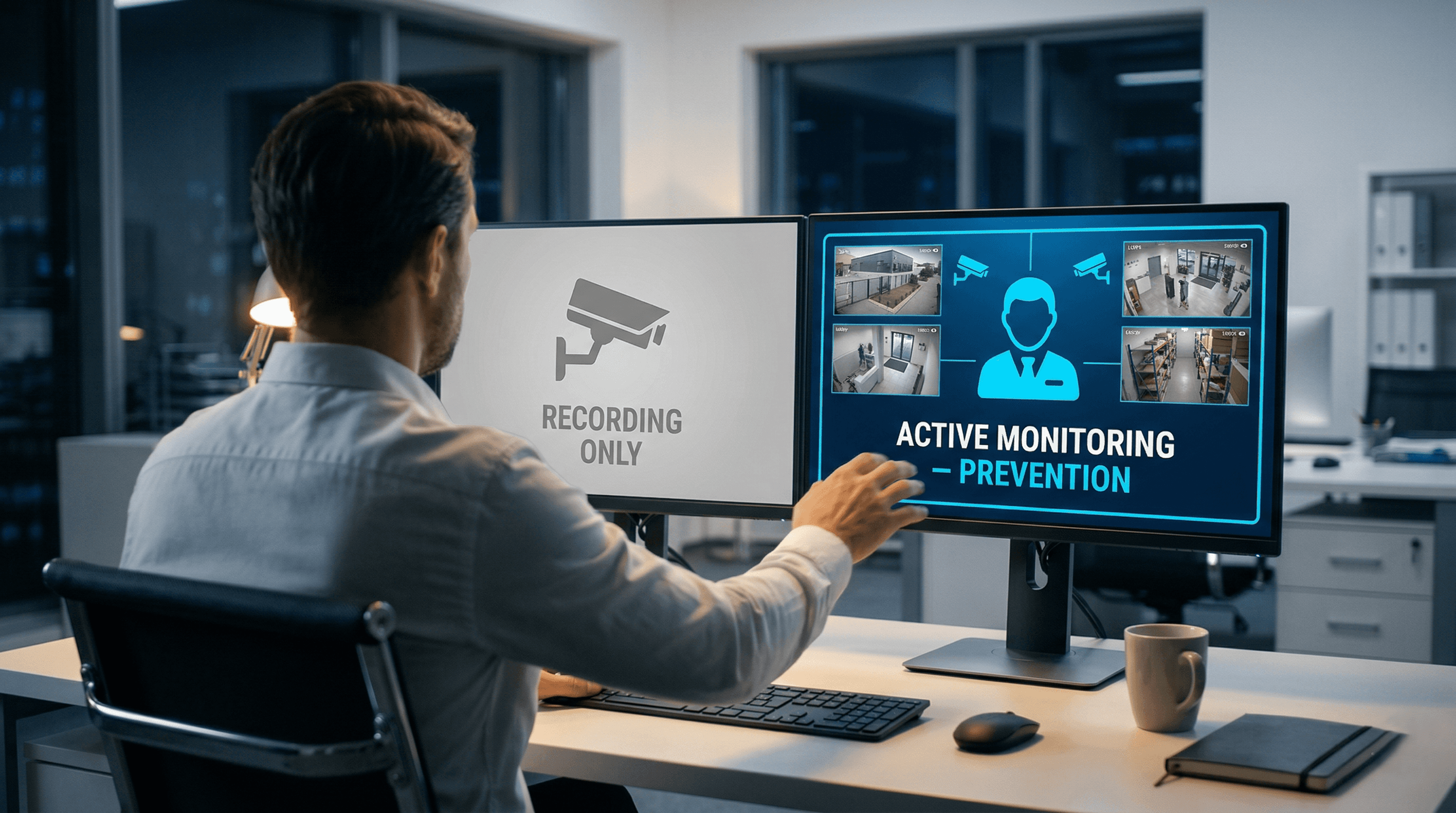
Every year, thousands of US small business owners invest in security camera systems that don't solve their actual security problem. They buy hardware when they needed infrastructure. They buy recording capability when they needed intervention capability. They buy a system designed to document what happened when they needed one designed to prevent it.
This isn't because these owners are uninformed. It's because the security camera industry has done an exceptional job marketing recording systems using prevention language. "Protect your business." "Deter theft." "Keep your store safe." These phrases appear in the marketing of passive recording systems that, by their fundamental design, cannot deliver prevention, deterrence, or active safety.
In 2026 the surveillance market has also become significantly more complex. AI-powered detection, cloud storage, live monitoring services, license plate recognition, POS integration, facial recognition, remote access apps — the feature list of any given system is longer and more technical than it was five years ago. And longer feature lists don't always mean better protection.
This guide cuts through that complexity. Here's exactly what matters when choosing a surveillance system for your gas station, convenience store, hotel, or restaurant in 2026 — and the questions you need to ask before you sign anything.
The Most Important Question: Recording or Prevention?
Before evaluating any specific feature, camera specification, or pricing structure, you need to answer one foundational question about your security goal.
Are you building a system that records what happens in your store? Or a system that prevents things from happening?
These are not the same thing. They require different technology, different infrastructure, and produce different outcomes.
A recording system — traditional CCTV with local or cloud storage — creates documentation of events after they occur. It is useful for police reports. It is useful for insurance claims. It is evidence after a loss has already happened.
A prevention system — active live monitoring with AI-assisted detection and real-time intervention capability — creates deterrence and response during events. It stops incidents before they complete. It catches employee fraud patterns before they compound into major losses. It is useful before the loss happens.
In 2026, most businesses need prevention. Most businesses are sold recording. Be clear about which one you're actually purchasing.
The Eight Questions to Ask Any Surveillance Provider
Question 1: Is This System Actively Monitored or Just Recorded?
This is the most important question on the list. A provider should be able to answer it clearly and immediately.
Active monitoring means a trained human agent watches your live feeds during agreed-upon hours and can respond to what they observe — triggering audio announcements, alerting your staff, contacting law enforcement. If the answer is "our AI monitors it" without a human agent component, follow up: what happens when the AI flags something? Who reviews it? How quickly? What action is taken?
Recording-only systems — regardless of how sophisticated their AI detection is — do not prevent theft. They document it. If prevention is your goal, the answer to this question must include live human agents with real-time response capability.
Question 2: How Does the AI Detection Actually Work?
In 2026, "AI-powered" is a marketing phrase attached to security systems ranging from genuinely sophisticated behavioral analysis to basic motion detection with a rebranded label. You need to understand what the AI is actually doing.
Specific questions to ask:
What specific behaviors does the AI detect? (Concealment movements, POS anomalies, loitering patterns, after-hours perimeter movement?)
What is the false positive rate? (How often does the system flag events that aren't actually threats?)
How is the AI trained and updated? (Static models from 2022 behave very differently from continuously updated models)
What happens when the AI flags an event? (Automatic notification, queue for human review, immediate agent response?)
Vague answers to these questions are a red flag. A provider with genuinely effective AI detection can describe its specific capabilities clearly.
Question 3: Does the System Integrate With My POS?
For any retail business, restaurant, or hotel with transaction-based operations, POS integration is not optional — it's the feature that makes the difference between catching internal fraud and missing it entirely.
Ask specifically: which POS systems does your platform integrate with? What transaction events trigger camera correlation? How quickly does the correlation happen? Can I pull a specific transaction and see the corresponding camera footage immediately?
If the provider can't integrate with your specific POS system or is vague about how the integration works, this is a significant limitation that will substantially reduce the system's effectiveness for internal fraud detection.
Question 4: What Is the Camera Resolution and Coverage Requirement?
Resolution matters — but not in the way most providers imply. You don't need 4K everywhere. You need the right resolution for each specific use case.
For license plate capture: you need LPR-grade cameras positioned at the correct angle and distance. Standard HD cameras pointed in the general direction of your pump island will not capture plates reliably at night.
For register and POS monitoring: you need a clear overhead angle capturing both the employee's hands and the transaction screen. Wide-angle coverage of the store floor doesn't substitute for this.
For facial identification purposes: resolution requirements depend on camera distance and angle. Ask your provider to specify what resolution they're installing at each position and why.
More cameras at lower resolution is generally less effective than fewer cameras positioned correctly at appropriate resolution for their specific purpose.
Question 5: What Is the Storage and Retention Policy?
If something happens at your store, how far back can you go in the footage? Who has access to it? Where is it stored?
Critical specifics to establish:
Minimum retention period: 30 days is standard; 60–90 days is better for catching fraud patterns that take time to surface
Storage location: local DVR/NVR (vulnerable to hardware failure and physical theft), cloud (more reliable, accessible remotely), or hybrid
Access controls: who at your provider can access your footage? Under what circumstances?
Footage delivery: how quickly can they pull and package footage for a police report or insurance claim?
A provider that can't clearly describe their retention and access policies is one whose footage architecture you don't fully understand — which is a problem when you need that footage most.
Question 6: What Are the Contract Terms?
Security system contracts in 2026 range from month-to-month service agreements to 36-month locked commitments with significant early termination penalties. Know exactly what you're signing.
Key contract questions:
What is the minimum commitment term?
What are the early termination penalties?
Are hardware costs included or separate?
What happens if the system goes offline — is there a service level agreement with response time guarantees?
What does the installation process look like and who is responsible for it?
Be particularly cautious of providers who lead with hardware cost rather than service quality. A cheap camera system with inadequate monitoring capability is not a bargain. An expensive camera system with inadequate monitoring capability is not either.
Question 7: Is This Compliant With My State's Surveillance Laws?
In 2026 this question matters more than ever. Surveillance law varies meaningfully by state — particularly for audio monitoring. California, Florida, Massachusetts, Washington, and several other states have two-party or all-party consent requirements for audio recording that affect how speaker-based intervention systems can legally be deployed.
A reputable provider should be able to describe your specific state's requirements and confirm that their deployment is fully compliant. If a provider is unfamiliar with your state's audio monitoring law, that's a significant concern.
Question 8: What Does the ROI Look Like for My Specific Operation?
Any provider worth working with should be able to help you build a realistic ROI projection based on your actual operation: your revenue level, your current estimated shrinkage rate, realistic theft reduction percentages based on comparable client outcomes, and the full monitoring cost including any hardware.
If a provider can't or won't engage with this conversation — if they deflect to marketing language about "comprehensive protection" rather than specific financial projections — that tells you something important about how they view the relationship.
The Feature Comparison: What Matters vs. What's Marketing
Feature | Matters | Why |
|---|---|---|
Live human monitoring | Absolutely | No AI substitutes for human judgment and response |
AI behavioral detection | Yes | Scales human oversight across multiple cameras |
POS integration | Yes for retail/restaurant/hotel | Foundational for internal fraud detection |
LPR for gas stations | Yes | Most effective drive-off deterrent available |
Two-way audio capability | Yes | Real-time intervention without physical presence |
Remote mobile access | Yes | Owner visibility from anywhere |
Cloud storage with 30+ day retention | Yes | Evidence availability when you need it |
4K resolution everywhere | Usually not | Right resolution for each position matters more |
Facial recognition | Situational | Legal restrictions vary by state; confirm compliance |
Analytics dashboards | Useful | Secondary to prevention capability |
Smart home integration | No | Consumer feature, not a business security feature |
Red Flags to Watch For
"AI-powered" without specifics. Every system in 2026 markets itself as AI-powered. Ask exactly what the AI does and get a specific answer.
No live human monitoring component. AI without human oversight is documentation technology, not prevention technology.
Vague response to POS integration questions. If they can't name the specific POS systems they integrate with and describe how the integration works, they probably don't have real POS integration.
Long contract terms without service level guarantees. A 36-month commitment means nothing if the system can go offline for a week with no response obligation.
Hardware-first sales approach. A provider who leads with camera specifications rather than security outcomes is selling equipment, not security.
Inability to discuss ROI. If a provider can't help you understand what the system should return financially, they haven't thought seriously about your actual problem.
No state-specific legal guidance. Surveillance law compliance is the provider's responsibility to understand and communicate. Vagueness here creates real legal risk for your business.
What the Right Provider Looks Like
The right surveillance partner in 2026 for a gas station, convenience store, hotel, or restaurant does the following:
Starts with a site assessment — physically or through detailed consultation — to understand your specific vulnerability zones before recommending any hardware.
Designs a camera layout specific to your operational footprint, not a generic number of cameras applied uniformly.
Provides a clear description of their monitoring operations: who watches your feeds, during what hours, with what response protocols, and with what escalation paths.
Integrates with your existing POS system or recommends one that it integrates with, and demonstrates specifically how that integration works for your transaction environment.
Offers a realistic ROI projection based on comparable client outcomes and your specific operation.
Provides a contract structure that is fair — with appropriate commitment terms, clear service level agreements, and early termination terms that don't create a trap.
Demonstrates knowledge of and compliance with your state's specific surveillance law.
Why Survill Technologies Was Built for This
Survill's design philosophy starts from one conviction: a surveillance system that doesn't prevent theft is a documentation tool, not a security system.
Every component of Survill's platform — the 24/7 live monitoring agents, the AI behavioral detection, the POS integration, the LPR capability, the two-way audio intervention, the multi-location dashboard — is built around the specific goal of preventing losses, not documenting them.
The site assessment process ensures every camera covers a specific vulnerability, not just a general area. The monitoring protocols are designed for the specific environments Survill serves — gas stations, c-stores, hotels, restaurants — with threat profiles and response protocols appropriate to each. The ROI conversation is one Survill is prepared to have with every prospective client, with specific projections based on real client outcomes.
In 2026, that's what choosing the right surveillance system actually looks like.
Conclusion: Buy for Outcomes, Not Features
The surveillance system market in 2026 will show you impressive specifications, sophisticated-sounding AI features, and competitive pricing at every turn. The specification sheet is not the security system.
What protects your business is the outcome: whether theft goes down, whether employee accountability goes up, whether you know what's happening in your store at 2 AM on a Tuesday, whether an incident at your location gets responded to in 30 seconds or discovered three days later.
Buy for those outcomes. Ask the eight questions. Watch for the red flags. And choose a provider whose answer to "what does this actually do for my business?" is specific, financial, and verifiable.
Your security infrastructure is not a capital purchase that sits on your balance sheet. It's a monthly operational decision that either protects your margin or doesn't. In 2026, make it the one that does.
Frequently Asked Questions
Q1. What is the most important feature of a business surveillance system in 2026? Live human monitoring with real-time intervention capability is the most important feature — and the one most frequently absent from systems marketed as comprehensive security solutions. AI detection, camera resolution, cloud storage, and POS integration all amplify a live monitoring foundation. Without it, even the most sophisticated camera system is fundamentally a documentation tool. For any retail business where prevention is the goal, the presence or absence of live human monitoring is the primary evaluation criterion.
Q2. How many cameras does a convenience store or gas station actually need? Camera count should be determined by specific coverage requirements, not a generic number. A typical single-location convenience store with an attached gas station generally needs: two to three cameras covering the pump island and canopy (including LPR positioning), two to three cameras covering the store interior with register coverage, one camera covering the entrance, one covering the stockroom entrance, one covering the loading dock if applicable, and one to two covering the parking lot perimeter. That's eight to eleven cameras deployed purposefully — more effective than twelve cameras deployed generically.
Q3. What is the difference between AI surveillance and live monitoring? AI surveillance analyzes camera footage automatically, identifying behavioral patterns associated with theft or fraud and flagging them for review. Live monitoring means a trained human agent actively watches your camera feeds and can respond to what they observe — triggering audio announcements, alerting staff, contacting law enforcement. In 2026, the most effective systems combine both: AI handles continuous pattern analysis across multiple cameras simultaneously, and human agents review AI flags and exercise judgment on response. Neither works optimally without the other.
Q4. How long should security footage be retained for a small business? A minimum of 30 days is standard, but 60–90 days is significantly better for small retail businesses. Many internal fraud patterns — employee theft methods designed to avoid immediate detection — take 30+ days to become statistically visible in POS anomaly data. If footage retention is shorter than the detection window for a specific fraud method, you can identify the pattern but not pull the footage to document it. Confirm your provider's retention policy before signing any contract.
Q5. How do I compare surveillance system quotes accurately? Compare total monthly cost (including hardware amortization, monitoring fees, and any per-incident charges), the specific monitoring hours and coverage included, whether POS integration is included or an add-on, the contract term and early termination terms, the service level agreement for system downtime, and the provider's demonstrated experience with your specific business type. Do not compare camera specifications in isolation — a technically superior camera without adequate monitoring is less effective than adequate cameras with live human oversight. The outcome comparison is the relevant one: what will this system actually do to my theft loss number?