Article
Apr 18, 2026
How AI Shoplifting Detection Actually Works — And Why the Signs Were There Before the Theft Happened
AI shoplifting detection spots behavioral warning signs before a theft is complete. See exactly what it looks for in your store and how it stops theft.
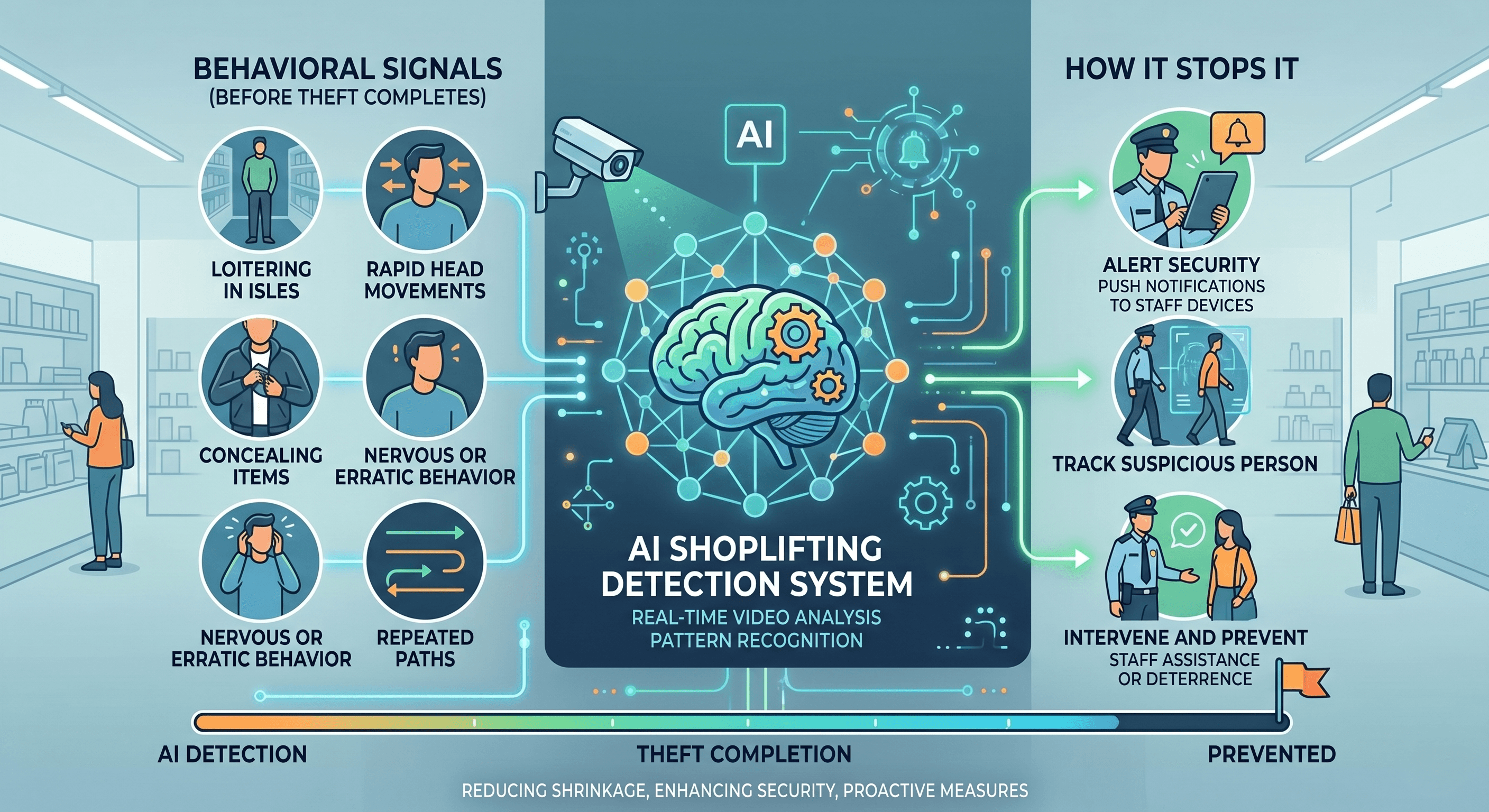
Watch the Footage Again. The Signs Were There 90 Seconds Before They Took Anything.
Go back and watch the last shoplifting footage from your store. Not from the moment of concealment. From two minutes before. Watch how they entered. Watch where they went first. Watch how they positioned themselves relative to the camera. Watch the repeated contact with the merchandise before any concealment movement occurred.
It's all there. The behavior pattern that preceded the theft was visible and identifiable — in retrospect. The problem isn't that the signals weren't present. The problem is that nobody was analyzing them in real time.
AI shoplifting detection for retail stores is built around exactly this insight: theft behavior is not spontaneous. It has a pre-event signature that is consistent enough across incidents, across individuals, and across store types to be machine-learnable. And once it's learnable, it becomes detectable — not after the merchandise is concealed, but during the behavioral sequence that precedes concealment.
This is what "AI detects shoplifting before it happens" actually means in operational terms. Not prediction. Detection — of the pre-theft behavioral sequence, while it's occurring, with enough time to intervene before the incident completes.
The Pre-Theft Behavioral Sequence: What AI Actually Watches For
Definition moment: AI shoplifting detection systems for retail stores identify pre-theft behavioral signatures — specific movement and behavioral patterns that statistically precede merchandise theft — and flag them for human review or automated response before concealment occurs.
What are those signatures specifically? Here's the actual behavioral sequence that trained AI models identify.
Entry pattern. Shoplifters — particularly repeat offenders and organized retail crime participants — enter stores differently than ordinary customers. They scan the store environment rather than moving toward a specific merchandise destination. Their entry movement is observational rather than purposeful. AI systems trained on thousands of hours of pre-theft footage identify entry behavioral patterns with measurably different characteristics than standard customer entry.
Camera assessment. Experienced shoplifters look at camera positions when they enter. This is one of the most consistent pre-theft behaviors and one of the clearest behavioral signals. The specific head movement pattern — a systematic upward scan of corners and ceiling fixtures — is distinct from the normal eye movement of a customer orienting to a store layout.
Zone selection and positioning. Shoplifters select their operating zone based on camera angle assessments. They position themselves in relation to camera coverage, not in relation to merchandise they're genuinely evaluating. This positioning behavior — the slight adjustment of body angle, the choice of which side of a display to stand on, the specific proximity to shelving — is detectable through behavioral analysis even when individual frames look unremarkable.
Merchandise contact pattern. Legitimate customers pick up items, examine them, return them, and move on. Shoplifters make repeated contact with target merchandise in patterns that don't match evaluation behavior — touching, repositioning, partially concealing to test visibility from camera angles, then replacing. This contact pattern is distinct from browsing and is detectable by AI systems trained to distinguish the two.
Environmental monitoring. During the pre-concealment period, shoplifters monitor staff and other customers in patterns that differ from normal social scanning. The frequency, direction, and duration of these checks follows a pattern associated with situational threat assessment rather than normal social awareness.
Not every individual in your store who displays one of these signals is shoplifting. The AI doesn't flag individual signals. It flags the convergence of multiple signals into a pattern — the combination that statistically precedes theft at a rate that warrants human review.
What Happens When the AI Flags a Pattern
This is where human monitoring becomes indispensable. An AI flag is not an accusation. It's a probability assessment that routes a specific camera view to a live monitoring agent for real-time human review.
The agent sees the flagged individual, evaluates the behavioral context the AI has identified, and makes a judgment call. In most cases — particularly for first-time flags of new individuals — the judgment is to continue observation rather than immediate intervention. If the behavioral pattern continues to develop toward the concealment phase, the agent triggers a response.
That response is almost always audio first. A clear, professional announcement through your store's speaker system: "Attention, this store is under 24/7 professional surveillance. Our monitoring team is currently watching all activity in real time." No accusation. No confrontation. No physical engagement.
The effect of this announcement on an individual in a pre-theft behavioral state is consistent and immediate. The majority of shoplifting incidents that are interrupted at the behavioral detection stage — before concealment has occurred — result in the individual leaving without merchandise. The theft never completes. There is no incident to document. There is no loss to absorb.
This is the outcome that passive recording systems cannot produce: the theft that never happened because someone was watching and responded while it was still preventable.
The Organized Retail Crime Problem — Why Experience Doesn't Beat the System
Here's where AI behavioral detection provides its most significant advantage over traditional security measures: it is not fooled by counter-surveillance techniques that experienced shoplifters use to defeat human observation.
An experienced shoplifter can manage their observable behavior in front of a human security presence — they know what human observers look for and they can consciously control the obvious signals. They're trained against human pattern recognition.
They're not trained against machine pattern recognition. AI systems don't watch for the signals that humans watch for. They detect statistical patterns across behavioral dimensions that no individual person would consciously monitor: micro-movement sequences, gaze direction frequency distributions, spatial positioning relative to camera angles, contact-return-contact patterns with specific merchandise categories. These patterns are detectable precisely because they operate below the threshold of conscious behavioral management.
The organized retail crime group that has learned to beat human guards and passive cameras has not learned to beat AI behavioral detection combined with active human monitoring. The combination changes the detection framework in ways that established counter-surveillance techniques don't account for.
Three Retail Stores Where AI Detection Changed the Outcome
A convenience store in Las Vegas had been experiencing consistent tobacco and vape category losses during evening hours. Passive camera review had never identified a repeating individual because the store had high daily traffic volume and the footage required manual review to identify patterns. AI behavioral detection flagged the same individual on three separate visits within a two-week period based on pre-theft behavioral signature matching — before any concealment occurred on visits two and three. On the second flagged visit, an audio announcement was triggered during the behavioral phase. The individual left without merchandise. Total theft prevented by the two interventions: approximately $320.
A grocery convenience hybrid in Atlanta experienced organized retail crime activity during Saturday afternoon peak hours. Two to three individuals operating as a team were responsible for losses the owner estimated at $400 to $600 per week. AI behavioral detection identified the team entry pattern — coordinated entry timing, zone split behavior consistent with team shoplifting techniques — and routed the alert to a live agent within 90 seconds of entry. The audio announcement triggered before the team separated. All three individuals left without merchandise. The pattern had been running for approximately four months before detection.
A hotel gift shop in Phoenix had one repeat offender who visited on average twice per week, always during high-traffic checkout periods, always taking high-value merchandise. The individual had been captured on footage but never identified clearly enough for police action. AI behavioral detection flagged the entry pattern on visit seven after monitoring activation. The agent intervened via audio. The individual was observed departing before reaching the high-value display. On visit eight, hotel security was pre-positioned based on the AI pattern recognition. The individual was approached at entry and a trespass order was issued.
The Financial Case for AI Behavioral Detection
The financial argument for AI shoplifting detection is straightforward when the numbers are presented honestly. A system capable of catching pre-theft behavioral patterns and triggering intervention that prevents 50 percent of attempted shoplifting incidents pays for itself through prevented losses alone at most retail volumes.
For a convenience store absorbing $1,500 per month in external theft losses — a conservative estimate at industry-average rates — a 50 percent reduction in shoplifting incidents saves $750 per month. An AI behavioral detection system integrated into a live monitoring platform runs $399 to $649 per month total. The math closes.
The deterrence effect — the reduction in repeat visits from individuals who experienced an audio intervention — extends the financial benefit beyond prevented individual incidents. Shoplifters who experience active monitoring intervention at a specific store tend not to return. Your AI detection investment doesn't just stop the incident it catches. It reduces the frequency of attempts by repeat offenders who have assessed your store as actively protected.
How Survill's AI Detection Works in Practice
Survill's AI behavioral detection is calibrated specifically for retail environments — convenience stores, gas stations, restaurants, and hotels — with behavioral models trained on retail-specific pre-theft pattern data. The detection doesn't generate a generic "suspicious activity" flag. It identifies specific behavioral convergence patterns and routes them with context to the monitoring agent.
The agent interface shows the flagged individual, the behavioral signals that triggered the flag, and the live camera view for real-time assessment. Average time from AI flag to agent review: under 45 seconds. Average time from agent decision to audio intervention: under 30 seconds. From pre-theft behavioral detection to store speaker announcement: under 75 seconds from first flag.
Conclusion: The Behavior Was Always Visible. Now Someone Is Looking.
Every shoplifting incident that has ever occurred in your store was preceded by a behavioral sequence that was visible on your cameras. The signals were there. The footage was running. Nothing happened because nobody was analyzing those signals in real time with the capability to act on them.
AI shoplifting detection doesn't add new cameras to your store. It adds analytical intelligence to the cameras you already have — the ability to see, in real time, the behavioral pattern that precedes theft and route it to a human agent who can respond before the incident completes.
The theft that's about to happen in your store has already started. The question is whether your system can see it.
Get a Free AI Detection Assessment
📞 (253) 362-3578 | 🌐 www.survill.com | ✉️ sales@survill.com
Frequently Asked Questions
Q1. How does AI shoplifting detection actually work in a retail store? AI shoplifting detection systems for retail stores analyze live camera feeds continuously, identifying behavioral patterns that statistically precede merchandise theft. These pre-theft signatures include specific entry scanning behavior, camera position assessment movements, zone selection positioning relative to camera angles, abnormal merchandise contact patterns, and environmental monitoring behaviors associated with situational threat assessment. The AI doesn't flag individual signals but detects the convergence of multiple signals into a pattern that warrants human review. When a pattern is flagged, it routes to a live monitoring agent within seconds for real-time assessment and intervention decision — typically an audio announcement before concealment occurs.
Q2. Can AI detect shoplifting before the merchandise is actually taken? Yes — this is the primary capability that distinguishes AI shoplifting detection from camera recording. The pre-theft behavioral sequence — the behavioral period that precedes concealment — is detectable by AI systems trained on retail-specific theft behavior patterns. This detection window is typically 60 to 180 seconds before concealment occurs, providing time for a live agent to review the flag and trigger an audio announcement before the incident completes. The majority of shoplifting incidents where intervention occurs during the behavioral phase — before concealment — result in the individual leaving without merchandise. The theft never completes, so there is no loss to document.
Q3. Does AI shoplifting detection work against organized retail crime groups? Yes — and this is one of its most significant advantages. Organized retail crime participants have developed counter-surveillance techniques specifically designed to defeat human observation and passive camera monitoring. AI behavioral detection identifies statistical patterns across behavioral dimensions that operate below the threshold of conscious behavioral management — micro-movement sequences, gaze patterns, spatial positioning, team coordination behaviors. These patterns are detectable even when individuals are deliberately managing their obviously observable behavior. Organized groups that have learned to work around human security and passive cameras have not adapted to AI behavioral pattern detection combined with active human monitoring.
Q4. How many false positives does AI shoplifting detection generate? False positive rates vary by system generation and calibration quality. Well-calibrated retail-specific AI systems in 2026 generate meaningful alerts — patterns that warrant human review — at rates that don't create alert fatigue for monitoring teams. The key distinction is that AI flags route to human agents for review rather than triggering automated responses — a human makes the intervention decision based on real-time assessment of the flagged behavior. This human review layer filters actionable interventions from ambiguous flags, producing intervention rates that are manageable for monitoring teams while ensuring that genuine pre-theft patterns receive response.
Q5. What's the difference between AI shoplifting detection and basic motion detection cameras? Motion detection cameras flag any movement in a monitored area — a triggering mechanism that generates enormous false positive volumes in an active retail environment and provides no behavioral analysis capability. AI shoplifting detection systems analyze behavioral patterns across multiple dimensions simultaneously and identify specific convergences associated with pre-theft behavioral sequences — not motion, but meaning. A customer walking through your store triggers motion detection. A customer entering with a specific scanning pattern, positioning near a high-value display at an angle inconsistent with browsing, and making repeated merchandise contact in a pattern consistent with concealment testing does not trigger basic motion detection but does trigger AI behavioral detection.