Article
Apr 9, 2026
Hotel and Hospitality Surveillance in 2026: Protecting Guests, Staff, and Revenue Around the Clock
Hotels face unique 24/7 security challenges across dozens of zones simultaneously. Here's how AI-powered live monitoring is protecting US properties — and their bottom lines — in 2026.
Introduction: A Hotel Is Not One Business — It's Twelve
When a retail store owner thinks about security, they're thinking about a single floor, a few hundred square feet, one or two entry points, and a manageable number of employees.
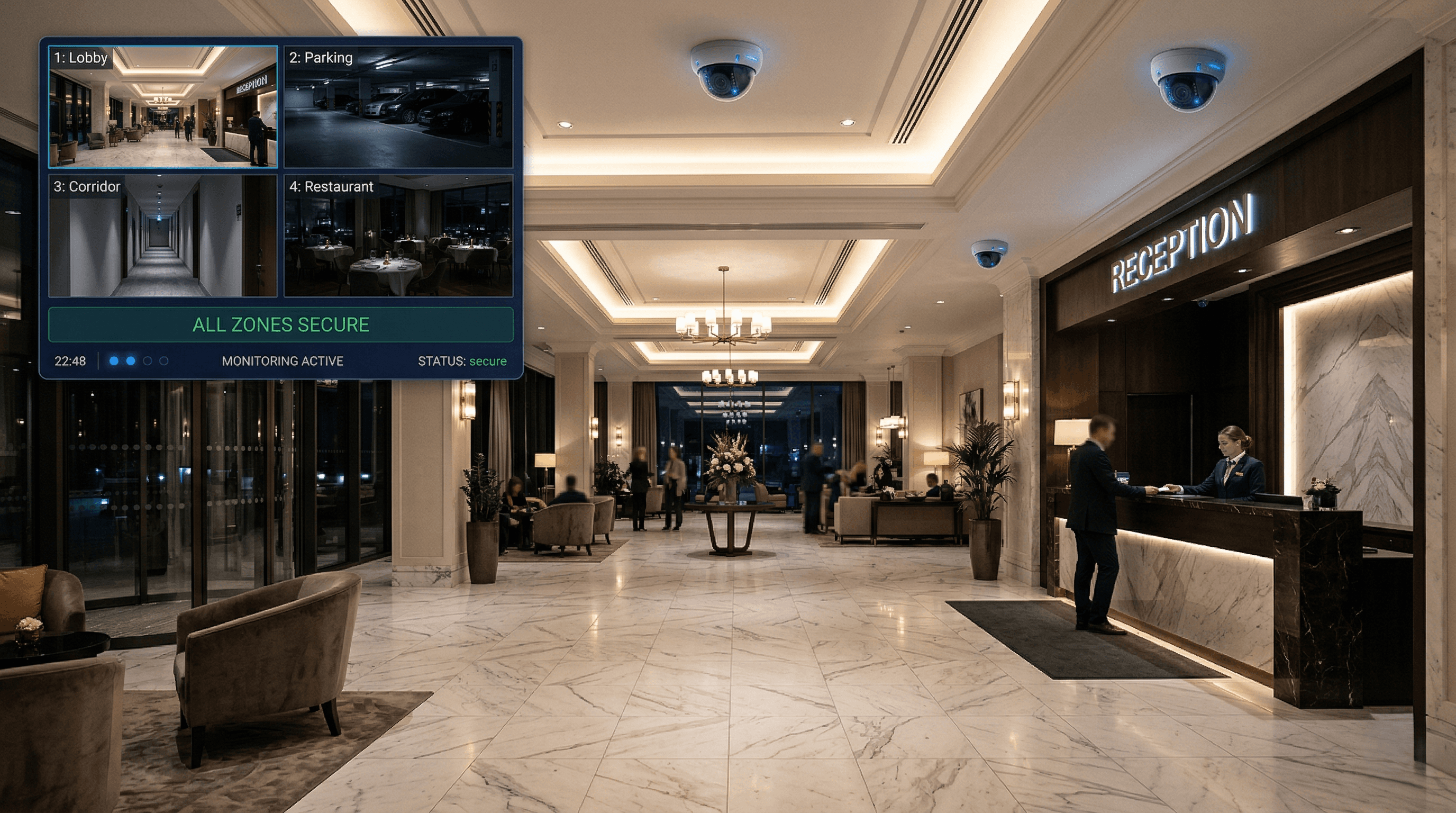
When a hotel owner thinks about security, they're thinking about a lobby, a front desk, a concierge station, a restaurant and bar, a kitchen, a gift shop, a fitness center, a pool area, a parking structure, hallways on eight floors, service corridors, a laundry facility, a loading dock, and a management office where cash and sensitive data are processed.
All of that is happening simultaneously. All of it has security implications. And in most mid-size US hotels, the security infrastructure watching all of it is a combination of passive recording cameras, a front desk agent who can't leave their post, and a manager who's handling seventeen other things at any given moment.
This is the hospitality security problem in 2026. It's not one security challenge. It's a dozen simultaneous security challenges operating across a property where guests, staff, vendors, and the general public all have overlapping access to different zones — and where the financial and reputational cost of a security failure is dramatically higher than in a retail environment.
This blog covers the specific security vulnerabilities that US hotels face in 2026 — and how the properties managing them most effectively are doing it.
The Hospitality Security Landscape: What Hotels Are Actually Losing
Before addressing solutions, let's be precise about where hotel losses come from.
Guest Property Theft Theft of guest property — in rooms, from vehicles, in public areas — creates direct financial liability, insurance claims, and the reputational damage that follows a negative guest experience posted to TripAdvisor, Google, or Yelp. A single guest theft incident that results in a one-star review mentioning security concerns can cost a hotel far more in lost future bookings than the value of what was stolen.
Employee Theft — Multiple Vectors Hotel employees have access to more theft opportunities than almost any other retail or service environment:
Housekeeping staff with access to unoccupied guest rooms. Front desk staff with access to payment information and cash transactions. Restaurant and bar staff with the same POS manipulation opportunities as any food service operation. Gift shop staff with unmonitored retail inventory. Maintenance staff with after-hours access to virtually every area of the property.
Industry data suggests hotel employee theft costs US properties an estimated $8 billion annually — a figure that most individual hotel operators dramatically underestimate at their own properties.
Gift Shop and Retail Losses Hotel gift shops face the same external shoplifting and internal fraud challenges as any retail environment — with the added complexity that their customers are transient guests who check out and leave, making post-incident recovery essentially impossible.
Food and Beverage Theft Hotel restaurants, bars, and room service operations face the full spectrum of restaurant theft vulnerabilities: cash skimming, inventory removal, unauthorized comps, and bar theft. In a hotel context, these losses often go unnoticed for longer because they're reported into the broader hotel P&L where individual line items have more variance tolerance.
Parking and Vehicle Area Incidents Hotel parking structures and surface lots are high-incident zones. Vehicle break-ins, vehicle theft, and after-hours loitering create both direct losses and significant guest satisfaction impacts. Without active monitoring of parking areas, most incidents are discovered by guests rather than prevented by staff.
Liability Incidents Slip and fall incidents, altercations in common areas, pool and fitness center accidents — all create liability exposure that active monitoring both helps prevent and helps defend against. A hotel with footage of an alleged incident from an active monitoring system is in a fundamentally different legal position than one with passive recording cameras.
The Multi-Zone Monitoring Challenge
The most distinctive feature of hotel security is the multi-zone problem. Unlike a convenience store where a few cameras can cover the full operational footprint, a hotel security system needs to maintain active coverage across radically different environments simultaneously:
High-Traffic Public Zones: Lobby, front entrance, elevator banks, restaurant entrance. High volume, continuous movement, legitimate access for all guests and visitors.
Semi-Restricted Staff Zones: Kitchen, laundry, maintenance corridors, service elevators, loading dock. Staff access only, but with high physical throughput during operational hours.
Restricted Management Zones: Front desk back office, cash counting room, management offices, server room. Limited access, highest sensitivity for data and financial security.
Guest Floor Corridors: Semi-public, guest access only with key, but physically accessible from stairwells and service corridors in ways that bypass key card requirements.
External Perimeter: Parking structures, surface lots, building perimeter, external service entrances.
Each zone has different threat profiles, different access levels, different appropriate camera positioning, and different monitoring protocols. A security system that works well for the lobby doesn't necessarily work for the parking structure. A monitoring approach designed for the front desk doesn't translate directly to the kitchen.
Effective hotel security in 2026 requires a unified monitoring platform that addresses all five zone types with zone-specific protocols — not a one-size-fits-all camera installation.
What 2026 Hotel Security Technology Looks Like
The properties running the most effective security programs in 2026 have built systems with several consistent components.
AI-Powered Zone-Specific Detection
Different zones require different AI detection parameters.
In the lobby and public areas, AI monitors for loitering behavior — individuals spending extended time in public areas without clear guest purpose. Patterns associated with pickpocketing. Individuals accessing elevator banks without appearing to proceed to a room. Unattended bags.
In parking areas, AI monitors for vehicle loitering, individuals approaching parked vehicles without appearing to be the vehicle owner, after-hours movement, and perimeter approach patterns.
In staff zones, AI monitors for individuals in areas inconsistent with their role assignments, inventory movement patterns that fall outside normal operational timing, and after-hours access.
At the front desk and gift shop, AI monitors for register interaction anomalies and shoplifting behavioral patterns with the same capability deployed in retail environments.
Integrated Access Control Correlation
In 2026, leading hotel security systems correlate camera monitoring with key card access data. When a key card access event occurs — a room entry, a staff zone access, a service corridor entry — the associated camera angle captures who physically presented the card and whether the access matches the profile of the authorized user.
This correlation catches both tailgating (unauthorized individuals following authorized staff through restricted doors) and key card sharing (employees lending access credentials to unauthorized individuals). Both are documented security vulnerabilities at most hotel properties and both are extremely difficult to catch without the camera-and-access-data correlation.
24/7 Live Monitoring With Zone-Aware Response Protocols
The monitoring team watching a hotel property needs zone-specific response protocols. An alert from the lobby AI requires a different response than an alert from the parking structure or the kitchen.
In 2026, professional monitoring services for hotel properties include custom response protocol development — specific escalation paths for each zone type, with appropriate responses ranging from audio announcements for public area incidents to immediate security team or law enforcement contact for restricted zone breaches.
Guest Incident Documentation
When a guest reports a theft, a slip and fall, or any incident on the property, the ability to pull timestamped camera footage for the relevant zone within minutes rather than hours is operationally critical.
Active monitoring systems that maintain organized, searchable footage archives — tagged by location, time, and incident type — dramatically improve both the speed and the accuracy of guest incident response. This has direct impact on insurance claims, liability exposure, and the guest relations outcomes that affect online review scores.
Real Hotel Security Scenarios: 2026
Scenario 1 — The Housekeeping Theft Pattern
A mid-size hotel in Las Vegas had been experiencing guest complaints about missing items — primarily cash, jewelry, and small electronics — at a rate of approximately two to three reports per month. The incidents were attributed to guest error or external intrusion and handled through insurance claims.
After deploying corridor monitoring correlated with housekeeping assignment logs, the pattern became clear within 21 days. A specific housekeeper's assigned rooms on specific days showed camera activity inconsistent with standard cleaning procedures — extended time in rooms, unusual movement near guest storage areas, and exit timing that didn't match the room cleaning log.
Three documented incidents occurred during the monitoring period. The evidence package was sufficient for termination and a police report. The guest complaint rate dropped to zero in the following quarter.
Scenario 2 — The Parking Structure Problem
A hotel in Atlanta had experienced four vehicle break-ins over two months in its parking structure — incidents that generated $14,000 in guest claims and several damaging online reviews mentioning security concerns.
Perimeter and parking structure monitoring identified a pattern: a specific vehicle was entering the structure during evening hours, parking briefly, and leaving within 20–30 minutes — a timing pattern inconsistent with any hotel guest activity. The vehicle's plate was captured on LPR. On the third occurrence, a monitoring agent contacted local law enforcement in real time with the vehicle description and location. The individuals were apprehended during an active attempt.
Scenario 3 — Front Desk Cash Manipulation
A hotel in Houston with a high cash transaction volume at the front desk discovered through POS-integrated monitoring that a front desk agent was consistently processing cash-paying walk-in guests through the system in ways that generated a legitimate check-in record but at a rate below the room's actual price — pocketing the difference.
The transactions looked correct in isolation. The price variance was within the range of promotional rates. The pattern across 60 days of POS and camera correlation made it unmistakable. Documented loss: approximately $4,200 over a two-month period.
The Reputational Dimension of Hotel Security
In 2026, the financial cost of a hotel security failure extends well beyond the direct loss. In the era of instant online reviews and travel platform ratings, a single well-publicized security incident can cost a hotel 10–15 times the value of the incident itself in lost future bookings.
A guest whose vehicle was broken into in your parking structure and who posts a detailed one-star review on Google and TripAdvisor creates a reputational liability that affects every prospective guest who researches your property over the following months. A guest who experienced a room theft and was handled poorly in the aftermath creates content that lives permanently in your review profile.
Active monitoring with real-time incident response doesn't just reduce losses — it changes the guest experience of security incidents when they do occur. A property that responds immediately, has footage available within minutes, contacts law enforcement on the guest's behalf with documentation already prepared, and demonstrates professional security infrastructure creates a fundamentally different recovery outcome than a property that reviews passive footage three days later and offers an apology.
In 2026, the reputational ROI of professional hotel monitoring is as important as the direct financial ROI.
How Survill Serves Hotel Properties
Survill's hotel monitoring configurations address the multi-zone challenge that makes hospitality security uniquely complex.
Zone-specific AI detection parameters, key card access correlation, staff assignment log integration, POS synchronization for front desk and F&B operations, and parking perimeter LPR capability all operate under a single unified platform with a single monitoring team maintaining situational awareness across the full property footprint.
For hotel owners managing multiple properties, a consolidated multi-location dashboard provides simultaneous visibility across all sites — with the same zone-specific alert protocols operating independently at each location.
Conclusion: Your Hotel Has Twelve Security Problems. One Platform Solves Them.
Hotel security in 2026 is genuinely complex. The multi-zone challenge, the overlapping access levels, the combination of guest-facing and back-of-house vulnerabilities, and the reputational stakes that amplify every incident — all of it makes hospitality security more demanding than almost any other commercial environment.
But the tools to address that complexity exist and are accessible to hotels of every size. AI-powered multi-zone monitoring, key card correlation, POS integration, parking perimeter coverage, and live human oversight from a professional monitoring team — these are the components of a 2026 hotel security system that actually works.
Your guests trust you with their safety, their belongings, and their experience. In 2026, honoring that trust requires infrastructure that matches the responsibility.
Frequently Asked Questions
Q1. What are the biggest security risks for US hotels in 2026? The highest-dollar risks for US hotel properties in 2026 are employee theft across multiple departments (estimated at over $8 billion annually industry-wide), guest property theft with associated liability and reputational exposure, parking area vehicle incidents, food and beverage internal fraud, and front desk cash manipulation. Each requires zone-specific monitoring protocols because the threat profiles and appropriate detection methods differ significantly by area of the property.
Q2. How do hotels monitor housekeeping staff for theft? The most effective approach combines corridor camera monitoring with housekeeping assignment logs — correlating which housekeeper was assigned to which rooms with camera activity in those room corridors. AI-assisted timing analysis flags extended room visits that fall outside normal cleaning time ranges. Access control correlation identifies entry and exit timing for each room assignment. Together, these create a monitoring framework that catches theft patterns without requiring camera placement inside guest rooms.
Q3. Can hotels use surveillance cameras in all areas of the property? Hotels can use video surveillance in all common areas, public spaces, parking areas, service corridors, staff zones, and administrative areas. Cameras may not be placed inside guest rooms or bathrooms. Staff-only areas like locker rooms and restrooms are also excluded. All monitored areas should have visible signage noting surveillance is active. Survill ensures all hotel deployments are fully compliant with applicable state and federal privacy law.
Q4. How does live monitoring improve guest incident response? When an incident occurs, an active monitoring system can pull organized, timestamped footage for the relevant zone within minutes rather than hours. This enables immediate, informed response to guest complaints — contacting law enforcement with documentation already prepared, providing footage to guests for insurance purposes, and demonstrating professional security infrastructure that changes the guest's experience of the incident recovery. Properties with active monitoring consistently generate better post-incident guest satisfaction outcomes than those relying on passive footage review.
Q5. Is professional hotel monitoring cost-effective for independent properties? Yes. For an independent hotel generating $150,000–$300,000 in monthly revenue and experiencing theft and security-related losses at industry average rates, the direct financial ROI of active monitoring typically closes within 60–90 days. When reputational ROI is included — the future booking value of prevented negative reviews versus the cost of incidents that occur under passive monitoring — the case becomes even stronger. Survill's hotel monitoring configurations start at pricing appropriate for single-property independent operators.