Article
Apr 3, 2026
Gas Station Theft Prevention: Why Fuel Stations Are the #1 Target and How to Stop It in 2026
Gas stations lose money to drive-offs, shoplifting and employee fraud. Learn why fuel stations are top targets and how live AI monitoring stops theft.
Introduction: Your Gas Station Is Being Targeted Right Now
Every single day, across thousands of gas stations in America, the same crimes play out on repeat.
Someone pulls up to pump 7, fills up a full tank, and drives away without paying. A customer walks into your c-store, pockets a $14 vape cartridge while your cashier handles a lottery ticket transaction, and leaves with a coffee. Your overnight employee processes three refunds for items that were never returned, pockets $60, and clocks out like nothing happened.
None of it shows up until you do your weekly numbers. And by then, it's already gone.
Gas stations are the single most theft-vulnerable retail businesses in America. High customer volume, self-service fuel, 24-hour operations, limited staff, cash-heavy transactions, and large parking lots create a perfect environment for every category of theft — simultaneously.
The National Association of Convenience Stores (NACS) estimates that fuel drive-offs alone cost U.S. gas station operators over $600 million every year. Add in in-store shoplifting, employee theft, and vendor fraud, and the average gas station owner is absorbing losses that would make any accountant's stomach drop.
The difference between gas stations that bleed money and those that don't is not luck. It's surveillance infrastructure. This guide breaks down exactly what you're up against — and exactly how to stop it.
The Threat Landscape: Every Way Your Gas Station Is Being Stolen From
Understanding how theft happens at a gas station is the first step toward preventing it. Most owners focus on one category — usually drive-offs — and miss the full picture entirely.
Fuel Drive-Offs
The most visible and most discussed form of gas station theft. A vehicle pulls up, pumps fuel, and leaves without paying. Variations include:
Straight drive-offs: Full tank, drive away, no payment attempted
Prepay manipulation: Prepay $20, pump $20, then drive to a second pump and pump again before the system resets
Plate swapping: Stolen or swapped license plates used specifically to defeat LPR-based identification
Distraction drive-offs: One person enters the store to occupy the cashier while an accomplice pumps and drives
The average drive-off costs a gas station owner between $60 and $120 per incident in fuel alone. A station experiencing even five drive-offs per week is losing $16,000–$31,000 per year from fuel theft alone.
In-Store Shoplifting
Your convenience store is a shoplifter's favorite target for several reasons: the cashier is often managing fuel transactions simultaneously, the layout typically has blind spots near coolers and back shelves, and high-value compact items — vapes, energy drinks, prepaid cards, tobacco — are exactly what organized retail thieves target.
Shoplifting at gas station c-stores has specific patterns:
Distraction theft: One person at the register with a complex transaction while another walks product out
Cooler blind spots: Back-of-store refrigerated sections out of direct sightline from the register
Rush hour exploitation: High-traffic periods when the cashier is overwhelmed and attention is divided
Prepaid card theft: Cards activated without purchase by switching packaging or using defeat techniques at self-checkout
Employee Theft
Everything covered in the previous blog applies here — but gas stations have additional vulnerabilities specific to their operation:
Fuel credit manipulation: Crediting pumps for amounts not matching actual purchases
Car wash code theft: Issuing car wash codes without corresponding payment
Lottery ticket fraud: Scratching tickets before sale, returning losers, keeping winners
Cash drawer skimming during fuel rush: High transaction volume during morning commute hours creates cover for cash skimming
Pump calibration tampering: In rare but documented cases, employees coordinate with external actors to manipulate pump output
Vendor and Delivery Fraud
Delivery drivers who supply your store — beverages, snacks, tobacco, lottery — have access to your stockroom during receiving. Short-delivering while charging for full quantities is a documented and common fraud method. Without surveillance at the loading dock, it's nearly impossible to prove.
Parking Lot Crimes
Your parking lot is part of your liability. Vehicle break-ins, drug activity, loitering that deters legitimate customers, and physical altercations near the pumps all cost you — in insurance claims, in reputation, and in customer traffic loss.
Why Gas Stations Are Uniquely Difficult to Secure
Most retail environments have one primary point of vulnerability — the store floor. Gas stations have five simultaneous vulnerability zones:
The pump island
The store entrance and floor
The register and POS system
The stockroom and loading dock
The parking lot perimeter
Covering all five zones effectively with passive CCTV is nearly impossible. You end up with cameras everywhere and active oversight nowhere. A thief at the pump knows the cashier is dealing with the store. A shoplifter in the store knows the cashier is watching the pumps. The split attention is the exploit.
Traditional security approaches fail gas stations specifically because:
Pre-pay requirements alone don't stop theft. Determined drive-off thieves use stolen cards, fake pump authorizations, or simply override prepay at unmonitored stations.
DVR footage is useless without clear plate capture. Most gas station cameras aren't positioned correctly to capture plate numbers clearly — especially at night or with glare from pump canopy lighting.
One cashier cannot monitor five zones. No amount of training or attentiveness makes one person capable of simultaneously managing fuel authorizations, processing store transactions, watching for shoplifters, monitoring the lot, and receiving deliveries.
Local police response to drive-offs is limited. In most jurisdictions, a drive-off report results in a police report and nothing more. Without clear plate footage and a real-time report, recovery rates are near zero.
The Solution: What a Modern Gas Station Security System Looks Like
An effective gas station security setup in 2025 operates across all five vulnerability zones with a combination of hardware, software, and live human oversight.
Zone 1 — Pump Island: LPR + Pre-Auth Integration
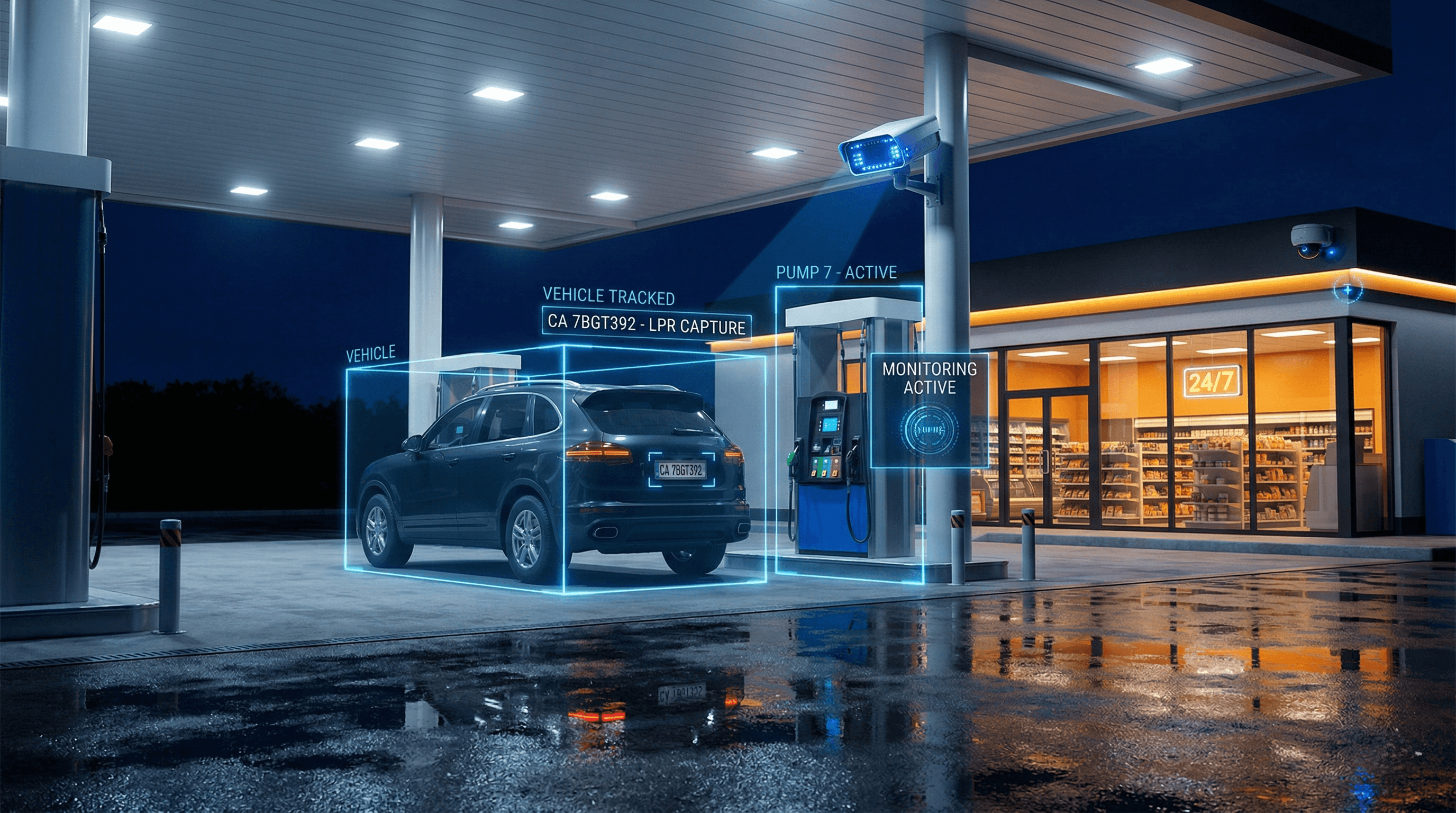
License Plate Recognition cameras positioned at the pump island entrance capture every vehicle's plate clearly before fuel is dispensed. This data feeds directly into your POS system.
When a drive-off occurs, you have a clear plate image, a timestamp, a pump number, and a fuel quantity — everything needed for a police report that actually goes somewhere.
More importantly, repeat offenders are flagged. Plates associated with previous drive-offs trigger an automatic alert to the cashier and monitoring agent before fuel authorization is granted.
Zone 2 — Store Floor: AI Behavioral Monitoring
Cameras positioned to cover all shelf areas, the entrance, and the register feed into an AI monitoring system that flags behavioral anomalies in real time — concealment movements, unusual dwell time near high-value merchandise, and suspicious register interactions.
The key difference from traditional cameras: someone is actually watching. A live monitoring agent sees the flag, assesses the situation, and can intervene via two-way audio before the theft is completed.
Zone 3 — Register and POS: Transaction Synchronization
Every transaction anomaly — void, refund, no-sale drawer open, discount override — is automatically flagged and correlated with camera footage from that exact moment. Cashier behavior at the register is monitored continuously, not reviewed selectively after a discrepancy is found.
Zone 4 — Stockroom and Loading Dock: Receiving Surveillance
Cameras covering the receiving area capture every delivery in real time. Footage is timestamped and retained for cross-referencing against delivery receipts. Short-delivery fraud becomes immediately detectable when camera footage shows twelve cases delivered against a receipt for fifteen.
Zone 5 — Parking Lot: Perimeter Monitoring with After-Hours Alerts
Wide-angle cameras covering the full lot perimeter feed into an after-hours monitoring system. Any movement detected during closed hours — or any suspicious loitering during open hours — triggers an immediate alert to a live agent who can deploy audio warnings or contact law enforcement.
Real-World Scenarios: Gas Stations That Changed Everything
Scenario 1 — The Drive-Off Problem Solved in 30 Days
A gas station owner in suburban Dallas was experiencing an average of eight drive-offs per week — roughly $4,800 in monthly fuel losses. After deploying LPR cameras at the island entrance integrated with a live monitoring system, drive-offs dropped to fewer than two per month within 30 days.
The mechanism was simple: when a vehicle pulled up that matched a plate flagged in the system, the monitoring agent immediately alerted the cashier and the pump required pre-authorization before dispensing. Word spread among local drive-off regulars faster than the owner expected — within two weeks, several flagged vehicles simply stopped coming to that station.
Scenario 2 — Catching the Lottery Fraud
A gas station in Georgia had been losing $200–$300 per week in lottery discrepancies that nobody could explain. After POS integration with camera monitoring, a pattern emerged: a specific cashier was scanning losing scratch tickets as returns and crediting herself cash refunds. Over nine months, she had stolen over $10,800 in documented lottery fraud. The synchronized POS and camera evidence was sufficient for both termination and criminal charges.
Scenario 3 — The Delivery Short-Count
A multi-location gas station operator in Florida suspected that a beverage distributor was short-delivering product but couldn't prove it. After installing loading dock cameras and implementing a receiving verification protocol backed by footage, a single delivery driver was caught short-delivering cases of high-value energy drinks across three locations simultaneously. The operator recovered losses through the distributor's insurance and renegotiated the delivery contract with mandatory camera verification.
Benefits Breakdown: The Numbers That Matter
Fuel loss reduction: LPR-integrated monitoring reduces drive-off incidents by 60–80% within the first 60 days at most locations.
In-store theft reduction: Active AI monitoring with live agents reduces shoplifting incidents by 40–60% — the deterrence effect alone accounts for a significant portion of that reduction.
Employee fraud detection: POS-synchronized monitoring identifies internal fraud patterns typically within 2–4 weeks of deployment, compared to the industry average of 12–18 months without a system.
Insurance premium savings: Gas stations with documented professional monitoring systems qualify for commercial liability and property insurance reductions of 10–20% with most major carriers.
Incident response improvement: When incidents do occur, live monitoring provides real-time footage, plate data, and timestamped documentation that dramatically improves police response outcomes and insurance claim processing.
ROI timeline: Most gas station operators see full return on their monitoring investment within 45–90 days based on reduced fuel losses alone — before accounting for in-store theft and employee fraud prevention.
How Survill Technologies Protects Gas Stations
Survill Technologies was built with multi-zone retail environments in mind. Gas stations represent one of the most complex surveillance challenges in American retail — and it's one Survill is specifically equipped to handle.
Here's what Survill brings to gas station security:
Full five-zone coverage — pump island, store floor, register, stockroom, and lot all monitored under one system
LPR integration — license plate capture correlated with drive-off history and real-time alerts before fuel authorization
POS synchronization — every transaction anomaly flagged and camera-correlated instantly
24/7 live monitoring agents — trained professionals watching all zones simultaneously, not a passive recording system
Two-way audio intervention — real-time announcements through in-store and pump island speakers when suspicious activity is detected
Multi-location dashboard — operators with two or more stations see everything on one unified interface
Incident documentation packages — complete evidence files with footage, timestamps, and transaction data ready for police or insurance use
Conclusion: The Gas Station That Doesn't Lose Is the One Being Watched
Running a gas station in 2025 means operating in one of the highest-theft retail environments in the country. The volume of transactions, the self-service fuel model, the 24-hour exposure, and the multi-zone vulnerability make it genuinely difficult to stay ahead of theft with traditional tools.
But the operators who have made the shift to active, AI-assisted, live-monitored security aren't just losing less. They're operating with a fundamentally different level of confidence — knowing that every pump, every register, every shelf, and every delivery is being watched by a system designed to intervene before the loss happens.
Your fuel margin is already thin. Your c-store margin is already competitive. You cannot afford to keep donating thousands of dollars a month to theft that a proper system would have stopped.
Frequently Asked Questions
Q1. What is the best way to stop fuel drive-offs at my gas station? The most effective combination is pre-authorization requirements plus license plate recognition cameras at the pump island entrance, integrated with a live monitoring system. Pre-pay alone doesn't stop all drive-offs — determined thieves use stolen cards or defeat prepay systems. LPR creates a documented record and flags repeat offenders before fuel is dispensed. Combined with a live monitoring agent who can intervene in real time, drive-off rates drop dramatically within weeks.
Q2. How much do gas stations lose to drive-offs every year? Industry estimates from NACS and retail loss prevention groups put total U.S. gas station drive-off losses at over $600 million annually. Individual station losses depend on location, traffic volume, and existing security measures — but stations without LPR or active monitoring commonly report 5–15 drive-offs per week, translating to $30,000–$90,000 in annual fuel losses per location.
Q3. Can surveillance cameras actually reduce theft at a gas station or just record it? Passive recording cameras reduce theft very little — experienced thieves know they're being recorded and not actively monitored. Active surveillance systems — where AI flags suspicious behavior and live agents can intervene via audio in real time — create genuine deterrence. The key word is intervention, not documentation. When potential thieves know someone is watching and can respond immediately, the risk calculation changes entirely.
Q4. How does AI surveillance work at a gas station? AI surveillance systems analyze camera feeds in real time, identifying behavioral patterns associated with theft — loitering at pumps, concealment movements in the store, suspicious register interactions, unusual after-hours activity in the lot. When the AI detects a flagged behavior, it alerts a live monitoring agent immediately. The agent reviews the situation and can respond via two-way audio, alert your staff, or contact law enforcement — all within seconds of the behavior occurring.
Q5. Is 24/7 live monitoring worth the cost for a single gas station location? For almost every gas station operator, yes — and the math is straightforward. If your station experiences average drive-off and in-store theft losses of $3,000–$5,000 per month, and a professional monitoring system costs $500–$800 per month, a 30–40% reduction in losses more than covers the cost. Most operators see full ROI within 60–90 days. Beyond the direct loss prevention, insurance premium reductions and improved incident documentation add additional long-term value.