Article
Apr 14, 2026
Gas Station Drive-Off Prevention Technology in 2026: Why Prepay Alone Isn't Enough — and What Actually Works
Gas stations lose $600M yearly to drive-offs. Gas station drive-off prevention technology has changed. Here's what actually stops it in 2026.
They Drove Away. Your Cameras Got It. Law Enforcement Did Nothing. This Happens Every Week.
You know the number. Maybe it's six drive-offs per month. Maybe it's twelve. Maybe you've stopped counting because counting it doesn't change it. Someone pulls up to pump 4, fills a tank worth $85, and drives away before your cashier even registers what happened.
You have the footage. You filed the report. The officer told you there's not much they can do without a clear plate. Except your camera didn't get the plate clearly enough — the angle was wrong, the lighting was bad, the car moved before the shot resolved. So the case goes nowhere, the $85 stays gone, and next Tuesday it happens again.
Gas station drive-off prevention technology in 2026 has moved well past the "put up cameras and hope" stage. The operators who have solved this problem — genuinely solved it, not just documented it better — are running systems where drive-off rates drop 60 to 75 percent within the first 60 days. Not because they've hired more staff or asked their cashiers to watch more carefully. Because the technology they've deployed changes the economics of attempting a drive-off at their specific station.
Here's what that technology actually consists of and why it works.
Why Prepay Requirements Don't Fully Solve Drive-Offs
Mandatory prepay was the first serious industry response to fuel theft and it's still the most widely adopted measure. It works — partially. It eliminates the naive drive-off: the person who simply forgot to pay, or the opportunist who saw an easy chance and took it.
What it doesn't eliminate is the determined drive-off. Stolen payment cards used to authorize a pump that then continues dispensing. Partial payment followed by additional unauthorized dispensing on the same or adjacent pump. Genuine authorization with a card that declines after fueling — a method that creates a legitimate-looking authorization attempt and a drive-off outcome. And pre-authorization holds that expire before the pump settles, allowing fueling to continue without completed payment.
These aren't theoretical exploits. They're documented methods used by individuals who specifically target stations relying on prepay as their primary drive-off control. In 2026, any station running prepay as its only drive-off prevention measure is protected against casual theft and unprotected against the organized fuel theft that accounts for the largest per-incident losses.
What Effective Drive-Off Prevention Actually Requires
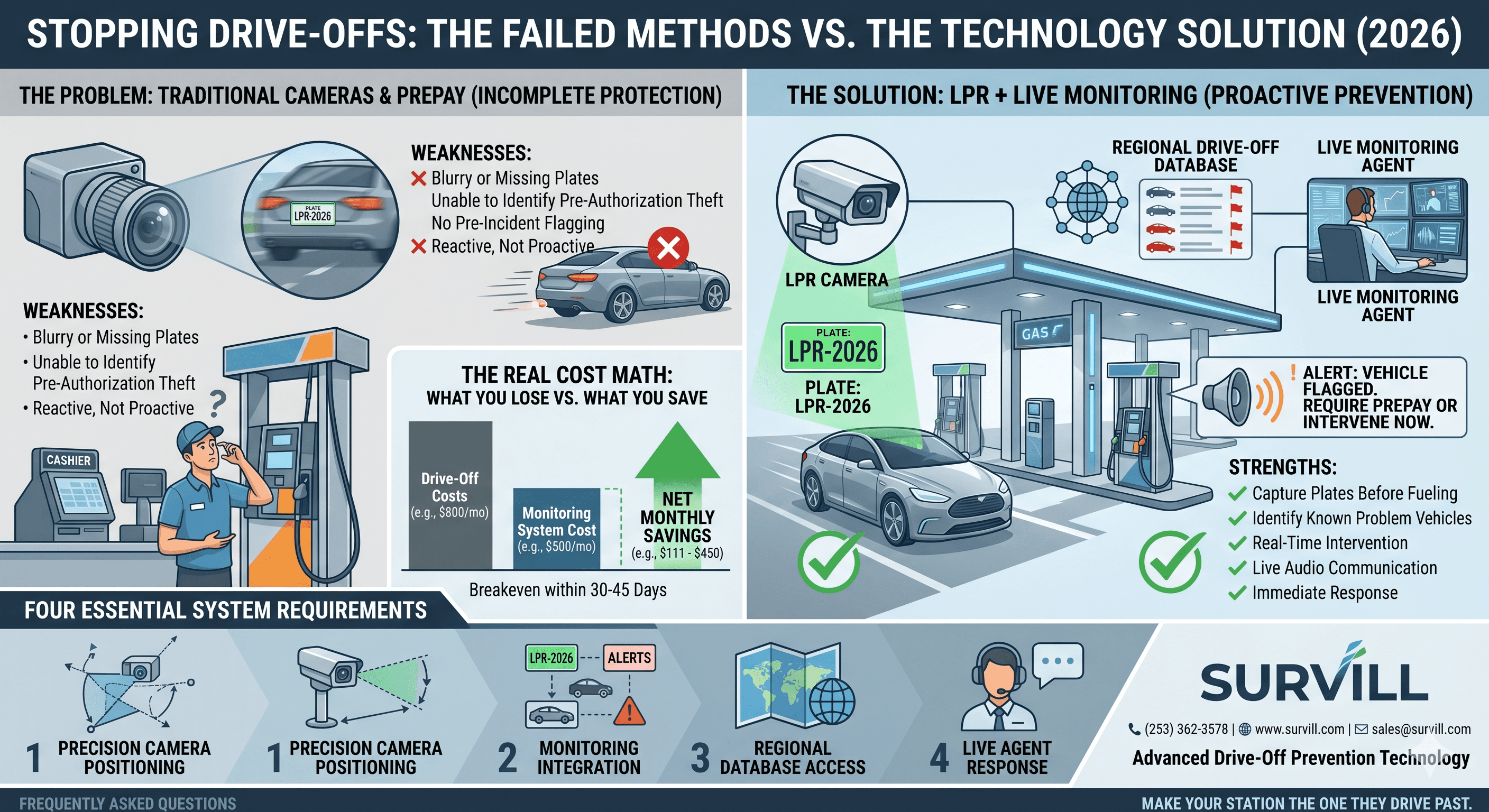
Definition moment: Effective gas station drive-off prevention technology is a three-component system: license plate recognition cameras positioned to capture every vehicle plate before fueling begins, integration of that plate data with a monitoring system that flags known drive-off associated vehicles before authorization, and live agent capability to respond to flagged pump events in real time via audio and law enforcement contact.
Each component addresses a specific gap in prepay-only protection.
License plate recognition cameras — not standard HD cameras pointing in the general direction of the pump island, but LPR-grade cameras positioned at the correct angle and distance to capture plate characters clearly in all lighting conditions — create a record before dispensing begins. This is the foundational shift. You're no longer trying to capture a plate from a vehicle that's already driving away. You're capturing it when the vehicle arrives.
Integration with a monitoring platform that cross-references captured plates against a drive-off history database flags known problem vehicles before fuel is authorized. A vehicle associated with two previous drive-offs at any monitored station in your region gets flagged when it enters your pump island. Your cashier is notified before the pump opens. Prepay is required regardless of any other payment attempt. This doesn't require you to recognize the vehicle yourself. The system remembers what you never had a chance to learn.
Live agent capability converts detection into response. When a LPR flag occurs, a monitoring agent reviews the situation in real time and can communicate with the cashier, trigger a pump island speaker announcement, or contact local law enforcement with the vehicle description and plate before the fueling is even completed. This is the difference between a system that says "that vehicle is a drive-off risk" and a system that does something about it before the fuel is gone.
The Real Cost Math: What Drive-Offs Are Costing You Versus What Prevention Costs
Let's run honest numbers for a mid-volume gas station.
A station experiencing eight drive-offs per month at an average of $75 in fuel per incident is losing $600 per month — $7,200 per year — in fuel revenue alone. That doesn't include the staff time spent on incident reporting, insurance documentation, or law enforcement coordination. Adding those costs — roughly $150 to $200 per month for a station with a consistent drive-off problem — puts total monthly drive-off cost at $750 to $800.
A professional LPR-integrated monitoring system for a single gas station location runs $399 to $649 per month. At a 60 percent reduction in drive-off incidents — the low end of what most operators report after deployment — this station reduces monthly fuel losses from $600 to $240. Monthly net savings after monitoring cost: $111 to $361 per month at the low reduction estimate.
At a 75 percent reduction — consistent with what operators running LPR plus live monitoring report — monthly fuel losses drop to $150. Monthly net savings after monitoring cost: $250 to $450.
The break-even calculation is simple and it closes fast. Most gas station operators see positive financial ROI on drive-off prevention technology within the first 30 to 45 days. Operators with higher drive-off frequency see it within weeks.
Three Gas Station Scenarios Where This Technology Changed the Outcome
A station outside Houston running eight to ten drive-offs per week deployed LPR-integrated monitoring with live agent coverage. In the first week, four pump island audio announcements were triggered by flagged plate events. Two vehicles departed without completing an unauthorized fuel dispensing. Drive-offs in month one dropped from an estimated 35 to 9. Monthly fuel losses dropped from approximately $2,600 to $675.
A rural station in Georgia — a location law enforcement acknowledged had response times of 25 to 30 minutes — had been operating with minimal drive-off prevention beyond prepay because the operator assumed nothing else was practical given the location. LPR-integrated monitoring with live agent capability showed that the station's drive-off problem was concentrated in three specific time windows across the week. Adjusting pump authorization protocols during those windows — and having a live agent monitoring those periods specifically — reduced drive-off incidents by 70 percent within 60 days.
A multi-location operator in Florida discovered through LPR data that three of their five stations were being targeted by the same two vehicles on a rotating basis — the vehicles had learned which stations had the weakest prevention infrastructure and cycled through them to avoid pattern detection at any single location. Cross-location LPR data sharing flagged the pattern. Both vehicles were identified and communicated to local law enforcement, resulting in a trespass order across all five locations.
What to Look For in a Drive-Off Prevention System
Not all LPR systems are equal. Four specific requirements separate effective drive-off prevention technology from LPR cameras that produce clear plates but don't change your outcome.
Camera positioning matters more than resolution. An LPR camera at the wrong angle doesn't produce usable plates regardless of its resolution specification. Your provider should conduct a physical site assessment to determine correct camera mounting positions relative to your pump island layout before any hardware recommendation.
Integration with monitoring is non-negotiable. Plate capture without monitoring integration is documentation, not prevention. A clear plate image produced after a drive-off is marginally more useful than a blurry one for police reporting purposes. It does not prevent the drive-off. Prevention requires the plate data to be actionable before the fuel is dispensed, which requires integration with a monitoring system that can respond.
Regional database cross-referencing transforms LPR from single-location awareness to network-wide protection. A drive-off history database shared across multiple monitored locations means your station benefits from incidents that happened at other operators' stations — and vice versa. Isolated LPR data identifies plates you already know. Networked data identifies plates you've never encountered before.
Live agent response capability is what converts a flag into an outcome. The agent needs to be able to reach your pump island — through speaker systems — within 60 seconds of a flag event. If the response workflow requires a phone call to your cashier who then makes a separate decision, the window for intervention has usually passed.
How Survill Handles Drive-Off Prevention
Survill's gas station monitoring configurations include LPR-grade camera setup assessment, regional database integration for cross-location plate flagging, pump island speaker capability for live agent audio response, and full coordination with local law enforcement when incidents require it.
The result is a drive-off prevention system where your pump island knows who's pulling up before the fuel starts flowing — and where someone with authority to respond is watching when a problem vehicle arrives.
Conclusion: The Drive-Off You Can't Stop Is the One You Don't See Coming
Every drive-off at your station is a bet that went wrong — a vehicle that gambled your station wouldn't have effective prevention infrastructure. Most of those bets are calculated, not spontaneous. Organized fuel thieves assess stations before they target them. They know which operators are running prepay only. They know which stations don't have LPR. They return to the same locations because the math keeps working in their favor.
Gas station drive-off prevention technology in 2026 changes that calculation. When your pump island captures every plate before fueling begins, when known problem vehicles are flagged before authorization, and when a live agent can respond to a flag event within 60 seconds — the math changes. Your station stops being the easy choice.
Make your station the one they drive past.
Get a Free Drive-Off Prevention Assessment
📞 (253) 362-3578 | 🌐 www.survill.com | ✉️ sales@survill.com
Frequently Asked Questions
Q1. What is the most effective technology to prevent gas station drive-offs in 2026? The most effective gas station drive-off prevention technology in 2026 is a three-component system: LPR-grade cameras capturing every vehicle plate before fueling begins, integration with a regional drive-off database that flags known problem vehicles before pump authorization, and live monitoring agents who can respond to flagged events via pump island audio and law enforcement contact in real time. Prepay requirements alone reduce opportunistic drive-offs but don't stop organized fuel theft. The combination of plate capture before fueling, database cross-referencing, and live response capability produces 60 to 75 percent drive-off reductions at most single-location operators within 60 days.
Q2. How much do gas stations lose to drive-offs annually? US gas stations collectively lose an estimated $600 million annually to fuel drive-offs, according to National Association of Convenience Stores industry data. Individual station losses depend heavily on location, traffic volume, and existing prevention measures. A station experiencing eight drive-offs per month at an average of $75 per incident loses approximately $7,200 in annual fuel revenue from drive-offs alone — before accounting for staff time, administrative costs, and insurance implications. Stations near highway interchanges, in high-traffic urban areas, or running prepay as their only prevention measure typically experience significantly higher drive-off rates.
Q3. Does prepay completely stop gas station drive-offs? No — prepay requirements significantly reduce opportunistic drive-offs but do not eliminate drive-offs from organized or determined fuel thieves. Common prepay bypass methods include stolen payment card authorizations, partial payment with continued dispensing, authorization holds that expire before payment settles, and pump manipulation techniques specifically designed to produce a legitimate-looking authorization attempt with a drive-off outcome. Operators who have reduced prepay-era drive-offs to near zero have added LPR plate capture and live monitoring to their prepay requirement — not replaced it.
Q4. Do license plate recognition cameras work at night and in bad weather? LPR-grade cameras designed for gas station pump island installation include infrared illumination for night capture and weather-resistant housing for outdoor use. Plate capture quality in low-light conditions depends primarily on camera positioning and the IR specification of the unit — not on ambient lighting. A properly positioned LPR camera at a gas station pump island should produce readable plates in complete darkness and in rain conditions. Standard HD surveillance cameras repurposed for LPR use typically fail to meet this standard. Your provider should specify LPR-rated equipment and demonstrate night capture performance before installation.
Q5. How does LPR data help if local law enforcement doesn't respond to drive-off reports? LPR-integrated monitoring improves law enforcement outcomes in two ways that don't depend on response time. First, a clear plate image captured before fueling — with timestamp and fuel dispensed quantity — creates a complete evidence package that dramatically improves the likelihood of follow-up investigation compared to a post-incident partial plate from a standard camera. Second, regional LPR database cross-referencing identifies repeat offenders whose pattern of incidents across multiple locations meets the threshold for organized retail crime investigation — a category that receives more substantial law enforcement engagement than individual drive-off incidents. Several Survill clients have had regional plate flagging data contribute directly to organized fuel theft investigations that resulted in arrests.