Article
Apr 2, 2026
Employee Theft Detection Systems: How Smart Surveillance Is Stopping the Inside Job in 2026
Employee theft costs US businesses billions a year. Learn how smart surveillance and live monitoring catch inside theft early, before losses pile up.
Introduction: The Thief You Already Trust
You hired them. You trained them. You gave them keys, register access, and maybe even a closing shift on their own.
And they've been stealing from you for months.
This is the hardest truth in retail: the most expensive theft in your store isn't coming from shoplifters off the street. It's coming from behind your counter.
The Association of Certified Fraud Examiners (ACFE) reports that employee theft costs U.S. businesses over $50 billion annually. The National Retail Federation consistently finds that internal theft — employees stealing from employers — accounts for nearly 28–35% of all retail shrinkage.
And here's what makes it worse: the average employee theft case goes undetected for 12 to 18 months before it's discovered. By then, the losses have compounded into numbers that genuinely threaten a small business's survival.
The good news? Modern employee theft detection systems — combining AI-powered surveillance, POS integration, and 24/7 live monitoring — have made it dramatically harder for dishonest employees to steal undetected. And dramatically easier for honest employees to prove their integrity.
This guide covers everything you need to know.
The Problem: Why Employee Theft Is So Hard to Catch
Unlike shoplifting, employee theft is calculated. Patient. Methodical. The person doing it knows your systems, your blind spots, your schedule, and your habits.
Here's what makes it uniquely difficult to detect:
They know where the cameras point. An employee who's worked your store for six months knows exactly which angle your camera covers, how far it reaches, and where the blind spots are. They plan around it.
They control the transaction. A shoplifter has to physically take merchandise past a point of sale. An employee IS the point of sale. They can manipulate transactions directly — and make it look completely normal.
They're trusted. Managers check on new employees. Over time, trust builds and oversight decreases. Experienced employees who steal exploit this trust gap deliberately, waiting until they've established themselves before they start.
Small amounts add up invisibly. A cashier who pockets $20 from the register twice a week generates $2,000 in losses per year at a single location. It's small enough to hide in normal variance but large enough to devastate your margins over time.
The methods are surprisingly sophisticated. Modern employee theft isn't just grabbing cash. It includes:
Sweet hearting: Scanning items for friends and family at a discount or not scanning them at all
Refund fraud: Processing refunds for items never actually returned, pocketing the cash
Void manipulation: Voiding legitimate transactions after the customer pays, keeping the cash
Short-change schemes: Deliberately miscounting change and keeping the difference
Inventory theft: Walking out with merchandise during receiving, restocking, or end-of-shift cleanup
Time theft: Clocking in for coworkers, padding hours, or simply not working during paid shifts
Vendor collusion: Coordinating with delivery drivers to falsify quantities and split the difference
Each of these methods is designed to look like a mistake, a system error, or normal variance — not theft.
Why Traditional Oversight Isn't Enough
Most small business owners rely on one or more of these approaches to manage employee honesty:
Reviewing end-of-day register totals
Doing weekly or monthly inventory counts
Watching camera footage when something seems off
Relying on other employees to report suspicious behavior
These methods have serious limitations.
Register reviews only catch what shows up in the numbers. An employee who voids transactions before they close out leaves no trace in the final count. Sweet hearting doesn't show up in cash discrepancies at all — it shows up in inventory shortages, which are often attributed to shoplifting.
Inventory counts are lagging indicators. By the time your monthly count reveals a discrepancy, you've already absorbed weeks of losses. And without surveillance correlation, you can't prove who did it or how.
Watching footage after the fact requires knowing what to look for. Reviewing hours of camera footage in response to a suspicion is time-consuming, inconclusive, and only works after the problem has already grown.
Employee reporting is unreliable. Co-workers may be complicit, afraid of retaliation, or simply unaware. Depending on peer reporting as a primary detection mechanism almost never works in small retail environments.
The pattern is consistent: reactive oversight catches theft after the damage is done. What stops employee theft is a system that makes it nearly impossible to steal undetected in the first place.
The Solution: Modern Employee Theft Detection Systems
An effective employee theft detection system in 2025 combines three layers working simultaneously:
Layer 1 — AI-Powered Camera Surveillance
Modern AI surveillance goes far beyond recording footage. It actively analyzes behavior at the point of sale and throughout the store in real time.
What it monitors:
Register interactions: Every transaction is visually tracked. Unusual hand movements near the cash drawer, items passed across the counter without being scanned, or customers handed back change in ways inconsistent with what was rung — all flagged automatically.
No-sale events: Every time a drawer opens without a transaction, it's logged and timestamped. Excessive no-sale events on a particular shift are an immediate red flag.
After-hours activity: Any movement in the store outside of business hours or after an employee should have left triggers an alert to a live monitoring agent.
Stockroom and back-of-house zones: Cameras in receiving areas, stockrooms, and exits monitor for merchandise removal that doesn't correspond to customer transactions.
Layer 2 — POS System Integration
This is where employee theft detection becomes genuinely powerful. When surveillance cameras sync directly with your point-of-sale system, the combined data creates a picture that's nearly impossible to falsify.
Here's what synchronized POS + camera monitoring catches:
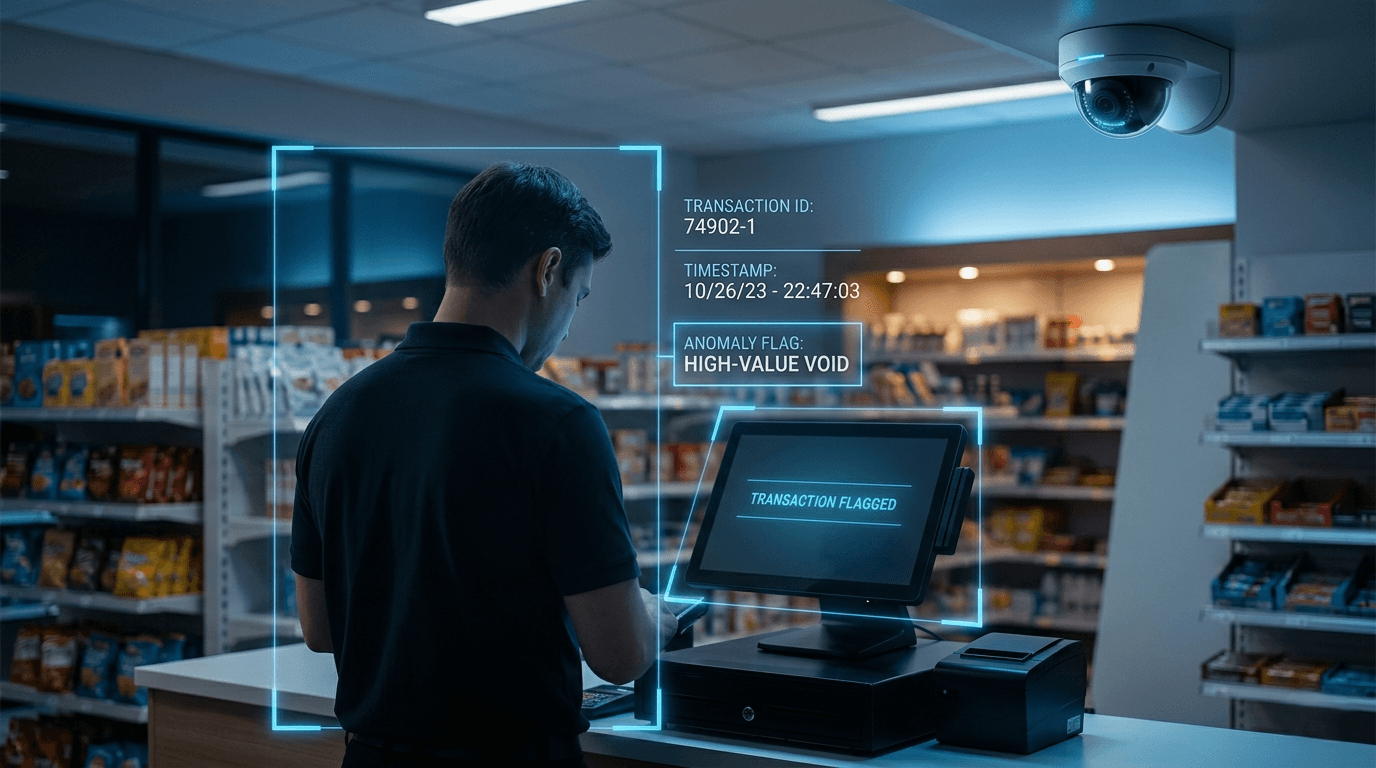
A void transaction at 8:47 PM, camera shows the cashier placing bills in their pocket at 8:47 PM — that's not a coincidence
A refund processed for $45 — camera shows no customer present at the register during that transaction
A discount applied to a transaction — camera shows the cashier texting immediately before and the customer appears to be a known associate
Three no-sale drawer opens in 20 minutes with no accompanying transactions — flagged for live agent review
The power of POS integration is that it removes ambiguity. A single anomaly could be a mistake. A pattern of anomalies that consistently correlates with specific employees on specific shifts is documented evidence.
Layer 3 — 24/7 Live Human Monitoring
AI catches patterns. Humans catch context. The most effective employee theft detection systems combine both.
A live monitoring agent watching your store in real time can:
Identify when a situation looks suspicious even if no automated flag has been triggered
Intervene immediately via two-way audio — "Attention: this transaction is being reviewed" — before a theft is completed
Coordinate with management in real time when something needs immediate action
Build a documented incident report with timestamped footage and transaction correlation for HR or law enforcement use
The presence of active, live monitoring also functions as a powerful deterrent on its own. Employees who know that a trained agent — not just a recording camera — may be watching any transaction at any time make very different decisions than those who know the camera is passive.
Real-World Scenarios: What This Looks Like in Practice
Scenario 1 — The Refund Scheme
A convenience store in Atlanta had been experiencing unexplained cash shortages averaging $300–$400 per week for nearly four months. The owner assumed it was register error or occasional shoplifting.
After deploying a POS-integrated monitoring system, a clear pattern emerged within two weeks: a specific cashier was processing refund transactions on items that had never been purchased, on shifts when the store was quiet, always for amounts between $15 and $40. Over four months, the documented loss from this single employee exceeded $6,800. The owner had footage, transaction logs, and timestamps — enough for termination and a police report.
Scenario 2 — Sweet hearting at a Gas Station C-Store
A gas station in Ohio noticed that inventory counts at one register consistently ran short on high-margin items — energy drinks, vape products, and prepaid cards. Shoplifting was assumed.
Synchronized camera and POS review told a different story. A cashier was systematically not scanning items for a group of five or six regular customers — people she clearly knew — effectively giving away $60–$90 in merchandise per shift. The behavior had been occurring for seven months. Total estimated loss: over $12,000.
Scenario 3 — The Early Clock-Out
A hotel gift shop in Houston installed monitoring after noticing that evening revenue was consistently lower than afternoon revenue despite similar traffic volumes. Live monitoring revealed that the closing shift employee was clocking out 45–60 minutes early routinely, leaving the shop unstaffed and losing sales — and occasionally pocketing small cash items before leaving. The combination of time-stamp discrepancies and camera correlation resolved what had looked like a revenue mystery.
The Benefits: What Changes When You Deploy This System
Immediate behavioral change. When employees know active monitoring is in place, most honest employees aren't affected at all — and most dishonest ones stop. The presence of a credible detection system is itself a prevention mechanism.
Documented evidence, not accusations. Confronting an employee about theft without evidence creates legal liability and HR nightmares. A system that produces timestamped footage correlated with transaction anomalies gives you everything you need to act — and protects you from wrongful termination claims.
Protection for honest employees. A monitoring system doesn't just catch thieves — it exonerates honest workers when shortages occur. When a register comes up short and the system shows no anomalous behavior from the cashier on duty, you can investigate other causes with confidence.
Multi-location visibility. For operators with two, three, or more locations, centralized live monitoring means consistent oversight across all sites simultaneously — without physically being present anywhere.
Measurable ROI. A professional employee monitoring system typically costs $400–$800/month depending on the number of cameras and integrations. If it prevents or recovers $3,000/month in internal theft losses — a conservative figure for a mid-volume store — the return is 4–7x the investment. Most operators recover the full annual cost within the first 60–90 days.
The Right Way to Implement Employee Monitoring
A few important notes on doing this correctly:
Be transparent with your team. In most U.S. states, employers are legally permitted to monitor employees in common work areas — but you should always consult a local employment attorney on your specific situation. More practically, announcing that your store uses professional security monitoring is itself a deterrent. You don't need secrecy — you need credibility.
Focus on behavior, not identity. Effective monitoring systems are designed to flag transaction anomalies and behavioral patterns — not to single out individuals based on suspicion alone. Let the data lead.
Have a clear response protocol. Know in advance: if the system flags potential theft, who reviews it? Who has authority to act? What's the documentation process before a confrontation? Having a clear protocol prevents reactive mistakes.
Work with a provider who understands retail compliance. Not all surveillance providers are equal. The best ones have experience with retail environments, understand POS integration requirements, and can help you build a system that holds up legally if it ever needs to.
Where Survill Technologies Fits In
Most security companies will sell you cameras and walk away. Survill Technologies was built for exactly this problem — the inside job that passive surveillance doesn't catch.
Here's what Survill brings to employee theft prevention specifically:
POS-synchronized monitoring — camera feeds and transaction data reviewed together, not separately
24/7 live agents — trained professionals watching for behavioral anomalies, not just automated flags
Incident documentation — timestamped evidence packages built for HR action or law enforcement reporting
Multi-location dashboard — unified oversight across all your locations from a single interface
Retail-specific expertise — Survill's team understands the specific patterns and methods used in c-store, gas station, and hospitality environments
Survill doesn't just help you catch theft after it happens. The system is designed to make your store an environment where theft is simply too difficult and too visible to attempt.
Conclusion: The Inside Job Ends When the Blind Spots Do
Employee theft is not a character judgment about everyone you've hired. Most of your staff are honest people who work hard for what you pay them. But in any business where cash changes hands, access exists, and oversight has gaps — the risk is real, and the cost accumulates quietly.
The answer isn't paranoia. It's infrastructure. A system that makes every transaction visible, every anomaly detectable, and every shift accountable — to data, not assumptions.
You built your business. You deserve to keep what it earns.
Frequently Asked Questions
Q1. Is it legal to monitor employees on camera in my store?
In most U.S. states, employers can legally use video surveillance in work areas where employees have no reasonable expectation of privacy — sales floors, registers, stockrooms, and parking lots. Audio recording laws vary by state and are more complex. You should always consult a local employment attorney before deploying a monitoring system, and in most cases, notifying employees that monitoring is in place is both legally safer and more effective as a deterrent.
Q2. What are the most common signs that an employee is stealing from my store?
Key warning signs include unexplained cash register shortages on specific employee shifts, inventory discrepancies in high-margin product categories, unusually high void or refund transaction rates, an employee who is always available to close or work unsupervised, and lifestyle changes inconsistent with their pay. However, signs alone aren't evidence — a proper detection system provides documented proof.
Q3. How does POS integration improve theft detection?
POS integration connects your point-of-sale transaction data directly to your camera system. This allows you to pull up the exact camera footage for any flagged transaction — a voided sale, an unusual refund, excessive no-sale events — and see exactly what was happening at the register at that precise moment. The combination of video and transaction data is far more conclusive than either source alone.
Q4. Will employees know they're being monitored?
That's actually your choice — and in most cases, transparency works in your favor. Visible cameras and a posted notice that the store uses professional live monitoring deters most would-be thieves without requiring any confrontation. Employees who are honest are unaffected. Those who were considering theft typically reconsider. Active deterrence outperforms secret detection in terms of loss prevention outcomes.
Q5. How quickly can a live monitoring system be deployed in my store?
Deployment timelines vary by location size and existing camera infrastructure. For stores with existing cameras, POS integration and live monitoring activation can often be completed within 5–10 business days. For full new installations, most professional providers — including Survill Technologies — can complete setup within 2–3 weeks, including camera placement assessment, POS sync, and live agent onboarding.