Article
Apr 16, 2026
Employee Accountability and Surveillance: Why Knowing Someone Is Watching Changes Everything — For Every Employee
Employee accountability surveillance systems prevent theft before it starts. Here's what changes when your team knows someone is actually watching.
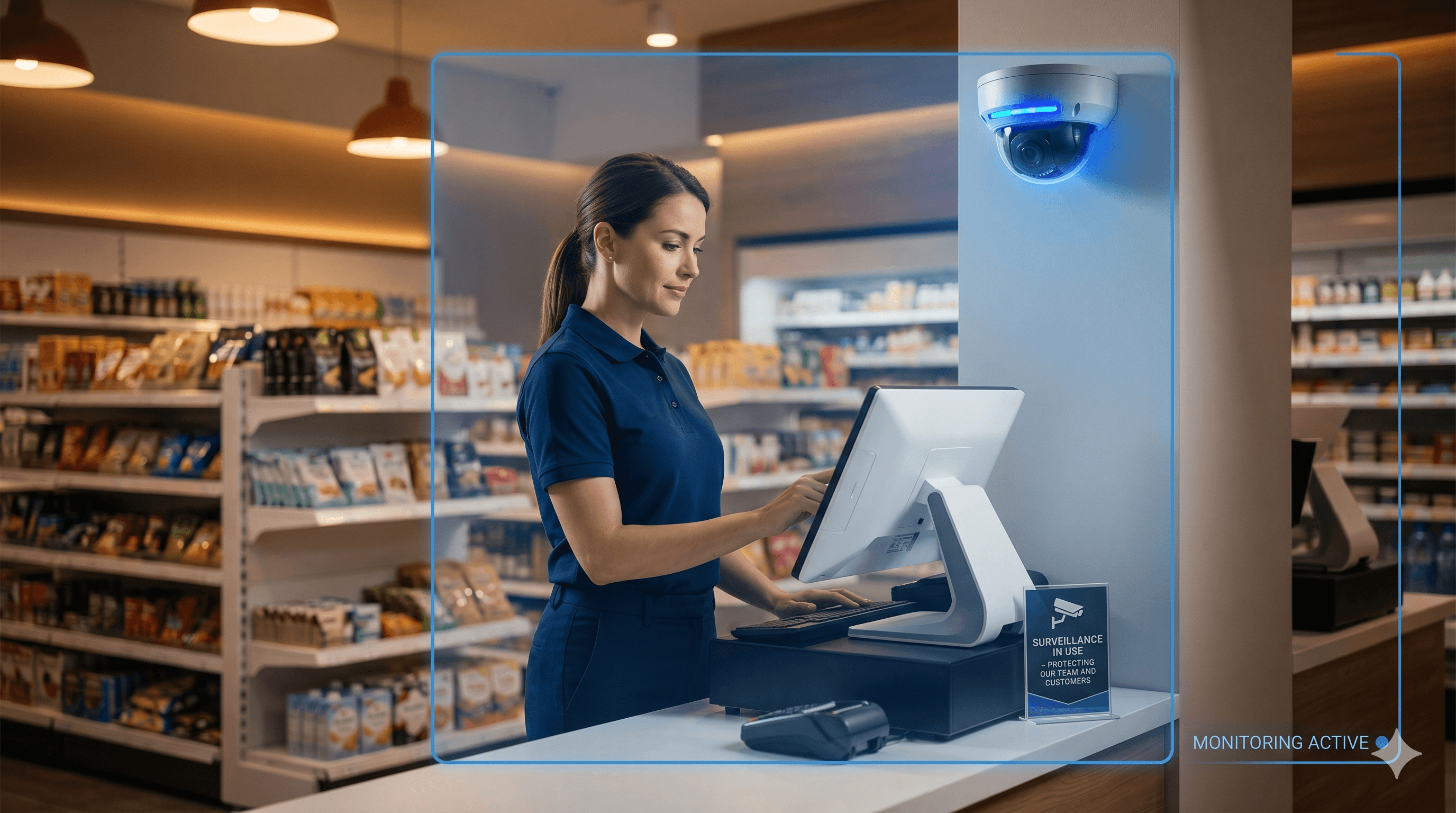
Your Employees Behave Differently When They Think You're Watching. The Question Is Whether You Are.
Ask any retail manager what happens when the owner walks through the door unexpectedly and they'll tell you the same thing: people stand up straighter. Transactions get processed more carefully. The register gets counted more precisely. The stock room gets tidier.
This isn't cynicism about your staff. It's a documented behavioral reality. Human behavior changes in the presence of observation — a phenomenon so consistent that it has a name in social psychology: the Hawthorne effect. The awareness of being observed changes what people do, independent of any stated policy or threat of consequence.
An employee accountability surveillance system for retail applies this principle consistently, at scale, across every shift — including the ones where you're not there, the overnight cashier who hasn't seen you in two weeks, and the manager who closes on Fridays. The question isn't whether monitoring changes behavior. It's whether the monitoring you have right now actually creates the awareness of being observed that produces that behavioral change.
Most passive camera systems don't. Here's why — and what does.
Passive Cameras Don't Create Accountability. Active Monitoring Does.
Here's the distinction that matters most for employee accountability: the difference between a camera that records and a monitoring system that watches.
Your employees know the difference. They've worked in retail long enough to understand that the dome camera in the corner records continuously but that nobody is watching the feed in real time. They know that footage gets reviewed when something is suspected — not as a continuous management practice. They know that if they're careful about what they do and when, the recording is not a practical deterrent to behavior they've already decided to engage in.
This knowledge is not cynical. It's accurate. And it means that passive recording cameras, despite their physical presence, do not create the psychological state of being observed that actually changes behavior.
Active live monitoring is different in a specific and important way: it creates genuine uncertainty about whether someone is watching right now. An employee who knows that a trained monitoring agent might be reviewing their register interaction at this exact moment — not just recording it, but actively watching it — operates under a fundamentally different psychological condition than one who knows the camera is on but nobody is home.
That uncertainty is the accountability mechanism. And unlike a recording camera, it can't be reasoned away.
The Three Behaviors That Change Immediately With Active Monitoring
Operators who implement active employee accountability surveillance consistently report improvement in three specific behavioral categories within the first 30 days — before any fraud has been identified or any disciplinary action has been taken. The change is purely deterrence-driven.
Register accuracy improves. End-of-shift register counts come closer to expected totals. Voids and refunds occur at lower frequency. No-sale drawer events — a consistent indicator of register manipulation — drop noticeably in the first weeks of active monitoring. These improvements occur without any change to staffing, training, or pay structure. They occur because the behavioral calculation around register honesty has changed.
Inventory shrinkage in staff-accessible areas decreases. The stockroom, the receiving area, the space behind the counter — areas where employee access creates internal theft opportunity — show reduced shrinkage rates within the first inventory cycle after active monitoring is deployed. Again: no new policy, no new staffing, no intervention. Just the awareness of observation.
Operational compliance improves. This one surprises most operators because it has nothing to do with theft. Shift start compliance, break length adherence, proper product handling, correct cash handling procedures — all of these improve meaningfully when employees operate with the awareness that professional monitoring is active. The monitoring doesn't need to flag a single compliance violation. The awareness alone produces behavioral improvement across the board.
The Honest Employee Benefit That Almost Nobody Talks About
Most discussions of employee monitoring focus on catching dishonest employees. There's an equally important effect that gets far less attention: active monitoring actively protects your honest employees.
Think about what happens when a register shortage is discovered without monitoring. Someone has to be responsible. The cashier on that shift is the obvious candidate regardless of whether they actually caused the shortage. Without documented evidence of what actually happened at that register during that shift, you're making a judgment call that affects a potentially innocent person's employment and reputation.
Active monitoring with documented camera and POS correlation means that when a shortage occurs, you know whether the cashier on that shift caused it. If the footage and POS data show a clean shift with no anomalies, your honest cashier has documented protection against an unfair accusation. If the data shows fraud, your investigation has evidence rather than suspicion.
Definition moment: An employee accountability surveillance system in retail creates documented behavioral records that protect honest employees from false accusations while creating a deterrence environment that reduces the likelihood of dishonest behavior across the full workforce.
Honest employees — the majority of your team — don't experience active monitoring as surveillance. They experience it as protection. And when you communicate this clearly, most employees respond positively to monitoring rather than resentfully.
What Telling Your Staff About Monitoring Actually Does
The intuition for many operators is to keep monitoring discreet — to catch people in the act rather than warn them in advance. This intuition, while understandable, is backwards in terms of what produces the best outcomes for your business.
The primary value of employee accountability surveillance is not catching theft after it occurs. It's preventing theft from occurring. Catching a cashier who has stolen $8,000 over six months recovers nothing — the money is gone, the merchandise is gone, and you've absorbed the loss and the disruption of termination and replacement. The outcome you want is the cashier who never starts stealing because they believe the risk of being caught is too high.
Telling your team clearly, professionally, and without accusatory tone that your store uses professional live monitoring — that a trained team watches your feeds and that register transactions are reviewed in real time — creates the deterrence environment you're after. Not the vague threat of "we're watching" that every retail employee has heard and discounted. A specific, credible statement about what the monitoring actually involves.
The behavioral change this produces in employees who were considering theft is immediate and significant. The behavioral change in honest employees who weren't — a slight increase in operational precision and compliance — is a net benefit to your operation.
Real Outcomes From Employee Accountability Monitoring
A convenience store chain with six locations in the Midwest implemented centralized employee accountability monitoring and communicated the change clearly to all staff at a team meeting. No fraud was identified in the first 30 days. What the operator did observe: average end-of-shift register variance dropped from $23 to $7 across all locations, no-sale drawer events decreased by 58%, and two managers independently reported that their opening and closing procedures had become "cleaner and more consistent" since the monitoring had been explained to staff.
A restaurant in Atlanta with a recurring bar theft problem had terminated two bartenders in 18 months without being able to fully document what had occurred. After implementing POS-integrated monitoring and communicating its existence to the full bar team, documented bar theft dropped to zero in the subsequent quarter — confirmed through POS and inventory reconciliation. The operator reported that they had not needed to terminate anyone, flag any incident, or take any disciplinary action. The monitoring's existence, combined with the team's awareness of it, had been sufficient.
A hotel in Dallas had experienced two consecutive years of front desk cash handling discrepancies that averaged $400 to $600 per month. After implementing employee accountability surveillance and conducting a team briefing on the monitoring protocols, front desk cash discrepancies averaged $30 per month over the following six months. No fraud was identified, no staff were terminated, and no disciplinary action was taken. The awareness of monitoring had produced the behavioral change that policy alone hadn't achieved.
How Survill Positions Employee Monitoring
Survill's employee accountability monitoring approach is built around the principle that the best outcomes come from deterrence, not from catching. The monitoring infrastructure — live agents, AI detection, POS integration — is designed to create genuine awareness of observation across every shift and every zone.
The communication guidance Survill provides to clients about how to introduce monitoring to their teams is based on what actually produces positive behavioral outcomes: transparent, professional, non-accusatory communication that frames monitoring as protection for honest employees and accountability for everyone equally.
Conclusion: The Accountability That Policy Can't Create, Monitoring Can
You can write the best employee handbook in your industry. You can conduct thorough onboarding. You can communicate clear expectations and consequences. And then your cashier is alone at the register at 1:30 AM on a Tuesday, and the decision about what they do is entirely their own.
The difference between the cashier who takes the money and the one who doesn't is rarely the employee handbook. It's the genuine belief that someone might be watching. Active monitoring creates that belief because it's true. And when it's true, and when your team knows it's true, the behavior that costs you thousands per month stops — not because you caught someone, but because the conditions that made theft feel low-risk no longer exist.
The best employee accountability system is one your employees never need to be caught by.
Get a Free Employee Accountability Assessment
📞 (253) 362-3578 | 🌐 www.survill.com | ✉️ sales@survill.com
Frequently Asked Questions
Q1. Does employee surveillance actually improve accountability and reduce theft? Yes — and the mechanism is deterrence, not detection. Active employee accountability surveillance systems reduce theft primarily by creating genuine uncertainty about whether someone is watching right now, which changes the risk calculation for employees considering fraudulent behavior. Operators who implement active monitoring consistently report measurable behavioral improvements — reduced register variance, fewer POS anomalies, improved operational compliance — within the first 30 days, before any fraud has been identified or disciplinary action taken. The deterrence effect alone, independent of any actual monitoring event, produces the behavioral change.
Q2. Should I tell my employees that surveillance monitoring is active? Yes — and the evidence strongly supports this approach. Transparent communication about active monitoring creates the deterrence environment you want: employees who know monitoring is active and credible change their behavior based on that knowledge. Covert monitoring, by contrast, only produces accountability after a fraud event has already occurred — which means losses have already been absorbed. Telling your team clearly that professional live monitoring is active, that register transactions are reviewed, and that all areas of the store are watched protects honest employees and deters dishonest ones simultaneously. Frame it as protection for your honest staff, not surveillance of your suspicious ones.
Q3. How does active monitoring protect honest employees from false accusations? When a register shortage or inventory discrepancy occurs, active monitoring with documented camera and POS correlation provides objective evidence of what actually happened during that shift. If the footage and POS data show a clean shift with no anomalies — no void manipulation, no cash handling irregularities, no behavioral flags — your honest employee has documented protection against unfair accusation. Without this documentation, shortage investigations depend on judgment calls that can unfairly implicate innocent staff. Active monitoring makes the investigation objective by providing a record of what actually occurred, protecting honest employees while ensuring that genuine fraud has documented evidence for appropriate action.
Q4. What specific employee behaviors improve with active accountability monitoring? Operators implementing active employee accountability surveillance consistently see improvement in four behavioral categories: register accuracy (end-of-shift variance decreases significantly), POS anomaly frequency (voids, refunds, and no-sale events decline), inventory handling in staff-accessible areas (stockroom and back-of-house shrinkage decreases), and operational compliance (shift adherence, break length, and procedural consistency improve). These improvements typically appear within the first 30 days of active monitoring — before any fraud identification or disciplinary action — driven purely by the deterrence effect of employees operating with awareness that professional monitoring is active.
Q5. Is employee surveillance legal in retail businesses across the United States? Yes — businesses are legally permitted to use video surveillance in customer-facing areas and employee work zones including sales floors, registers, stockrooms, receiving areas, and parking lots in all US states. Employees in these areas have no reasonable expectation of privacy. Audio recording laws vary by state — California, Florida, Massachusetts, Washington, and several others require all-party consent for audio recording. Visual monitoring without audio is legal everywhere. We recommend posting visible surveillance notices and communicating monitoring practices to employees, both for legal protection and because transparent communication produces better behavioral outcomes than undisclosed monitoring. Consult a local employment attorney for state-specific guidance.