Article
Apr 19, 2026
Does Your Surveillance System Reduce Your Business Insurance Premium? In 2026, the Answer Is Often Yes.
Professional video monitoring can lower business insurance premiums in 2026. Learn why insurers reward it, what they look for and how much you could save.
Your Insurance Company Is Paying Attention to Your Security System. Are You?
Most retail business owners think about their commercial insurance and their security system as two separate operating costs with nothing to do with each other. The insurance premium is what it is. The security system is what it is. They go in different budget lines and get reviewed at different times of year.
This separation is costing you money.
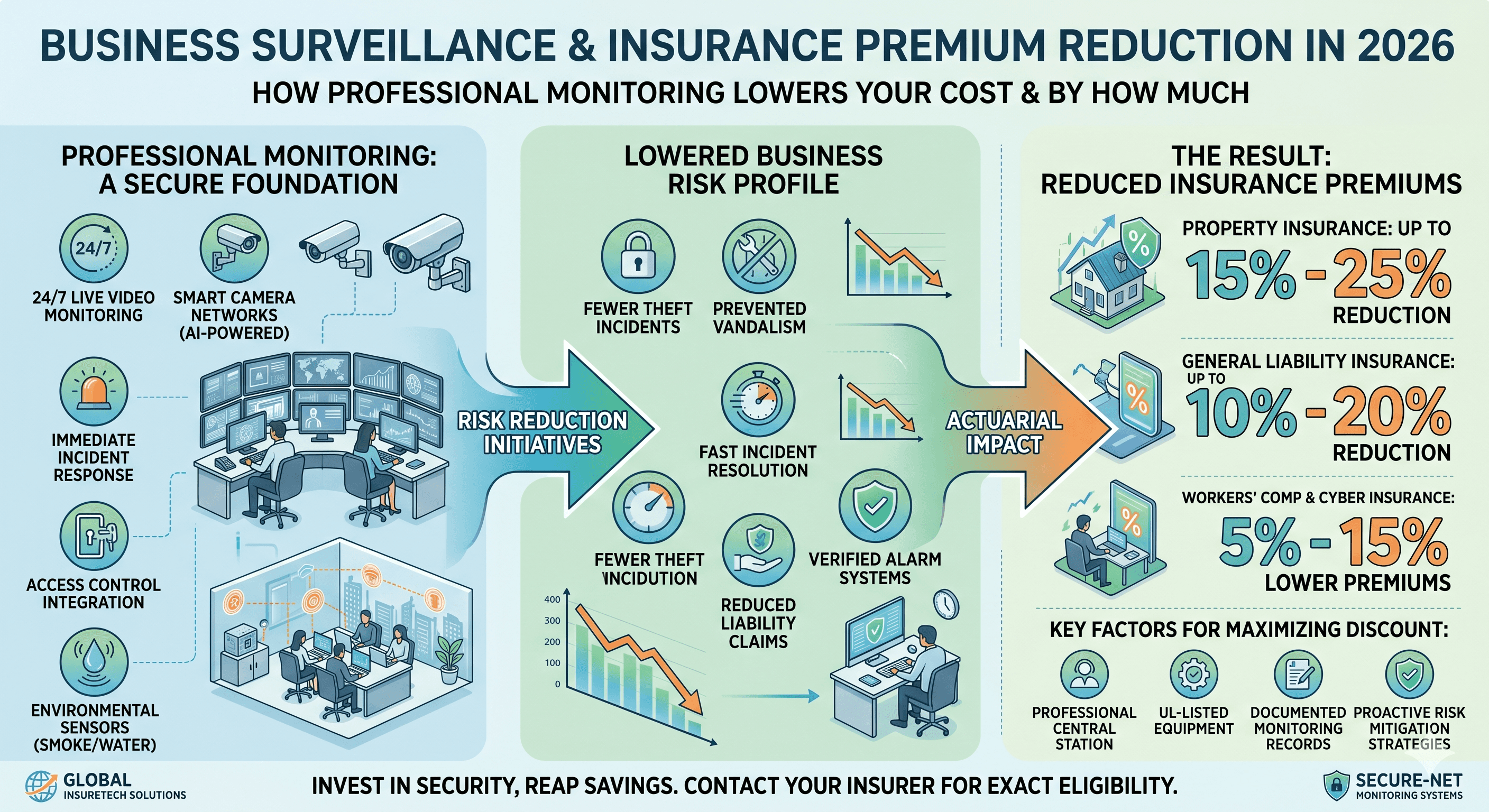
Commercial insurance carriers in 2026 are actively pricing business surveillance and insurance premium reductions into their rate calculations for retail clients — and the delta between what a documented professional monitoring system saves you in premiums versus what a passive camera installation saves you is measurable, real, and frequently large enough to offset a significant portion of your monthly monitoring cost.
The business surveillance system insurance premium reduction isn't a rumor or a marketing claim from security companies. It's a documented pricing behavior from carriers who understand that professionally monitored businesses have lower theft and liability claim rates — and who price their risk accordingly. Here's exactly how it works and how to capture it.
Why Insurance Companies Care About Your Security Infrastructure
Insurance pricing is risk pricing. Your commercial property and liability carrier is calculating the probability that you'll file a claim and the likely cost of that claim — and charging you a premium that reflects that calculation.
Everything that reduces your claim probability or claim severity reduces your theoretical risk profile. A business that has documented professional 24/7 monitoring, active theft prevention technology, and a verifiable incident response protocol is a statistically lower-risk client than one running passive cameras and an alarm system. Insurance actuaries know this because the claims data says so.
The specific risk factors that professional monitoring addresses directly:
Theft and burglary claims drop at monitored locations because active deterrence reduces incident frequency. When incidents do occur, they're caught earlier — smaller in dollar value — because the monitoring system flags them before they compound.
Liability claims from customer incidents — slip and fall events, altercations in the parking lot, assaults near the entrance — are both less frequent at well-monitored locations and better defensible when they occur. A business with timestamped footage of an alleged incident from an active monitoring system is in a fundamentally different legal position than one with passive footage reviewed after a lawsuit is filed.
Employee dishonesty claims — a category that most retail commercial insurance policies cover — are lower at locations with POS-integrated monitoring because fraud is caught earlier with better documentation, reducing claim amounts even when claims are filed.
The carrier's exposure is lower across every claim category at a professionally monitored business. The premium reduction reflects that reduced exposure.
What Qualifies for Insurance Discounts — and What Doesn't
Not every camera system qualifies for meaningful insurance premium reductions. Here's what carriers in 2026 are actually looking for.
Documented professional monitoring. A self-monitored camera system — one where you're personally reviewing footage on your app — typically produces no premium reduction. Carriers are looking for third-party professional monitoring documentation: a monitoring service agreement with a licensed security company that shows active 24/7 coverage.
Specific coverage zones. Carriers increasingly require that monitored zones include exterior perimeter coverage and register area coverage specifically — the zones most associated with theft and liability claims. A system that covers only the store floor interior may not qualify for the same reduction as one covering the full property footprint.
Incident response documentation. The ability to demonstrate that your monitoring system generates documented incident reports — timestamped, camera-correlated, formatted for insurance use — is increasingly relevant to premium negotiations. Carriers want to see that when a claim is filed, you'll have clean evidence that reduces their investigation and dispute costs.
System verification. Some carriers require verification of your monitoring system's technical specifications — camera resolution, storage retention period, monitoring service license status — before applying a discount. Working with a professional monitoring provider who can supply this documentation on request is important for actually capturing available discounts.
Definition moment: Business surveillance insurance premium reductions are pricing adjustments applied by commercial insurance carriers to retail businesses that maintain documented professional monitoring systems — typically third-party 24/7 monitoring services with verified incident documentation capability — reflecting the statistical reduction in claim frequency and severity at professionally monitored locations.
The Real Numbers: What Insurance Reduction Looks Like
Let's use concrete examples because "10 to 20 percent" sounds vague until you apply it to actual premium numbers.
A convenience store or gas station operator paying $18,000 per year in combined commercial property and liability insurance saves $1,800 to $3,600 annually with a documented professional monitoring system at the 10 to 20 percent discount range. That's $150 to $300 per month — directly offsetting $150 to $300 of a monitoring service that might run $399 to $649 per month.
A hotel property paying $45,000 annually in commercial insurance saves $4,500 to $9,000 per year with professional monitoring documentation. The monitoring cost is offset by 50 to 100 percent of the premium reduction alone — before any theft prevention ROI is calculated.
A restaurant paying $12,000 per year in commercial insurance sees $1,200 to $2,400 in annual premium savings. At a monitoring cost of $399 per month ($4,788 annually), the insurance savings offset 25 to 50 percent of the monitoring cost — meaning the monitoring system needs to prevent roughly $200 to $300 per month in theft losses to fully pay for itself, a threshold most restaurants exceed in the first 30 days.
These numbers vary by carrier, by coverage type, by location, and by the specific documentation your monitoring provider supplies. But the direction is consistent: professional monitoring reduces commercial insurance premiums in ways that are financially meaningful relative to monitoring cost.
The Liability Documentation Benefit — Beyond Premiums
The insurance benefit of professional surveillance extends beyond premium reductions to what happens when you actually file a claim.
When a customer alleges a slip and fall at your location, the difference between footage reviewed from a passive recording system and footage flagged and timestamped by an active monitoring system at the time of the incident is significant. The active monitoring record shows that the system was operating and watching at the exact time of the alleged incident. The passive recording shows that footage exists but doesn't establish that the area was actively monitored.
In liability disputes — particularly in states where comparative fault analysis affects claim outcomes — this documentation quality difference can determine whether a claim is settled favorably for the business or unfavorably. Carriers know this. Their willingness to defend claims more aggressively on behalf of businesses with strong monitoring documentation reflects it.
The same principle applies to employee dishonesty claims. A claim supported by timestamped POS correlation and corresponding camera footage is processed faster, settled more accurately, and defended more effectively than one based on inventory variance and suspicion. The documentation quality that active monitoring produces has direct financial value in the claims process — not just in the premium calculation.
How to Actually Capture These Savings
Capturing insurance premium reductions from your surveillance system requires proactive documentation rather than passive hope that your carrier will ask.
Contact your commercial insurance carrier or broker directly and ask specifically: what security monitoring documentation would qualify our business for a premium reduction, and by what percentage? Get the specific requirements in writing. Then verify that your monitoring provider can supply exactly that documentation.
If your current carrier offers no premium reduction for professional monitoring — a position that is increasingly rare among carriers writing retail policies in 2026 — request quotes from carriers who do. The monitoring documentation your provider supplies becomes a policy shopping tool: a documented risk reduction argument that puts your business in a more favorable risk category across multiple carriers.
Work with a monitoring provider who understands the insurance documentation process. Survill provides clients with monitoring certification documentation specifically formatted for insurance carrier submission — including system specifications, coverage zone documentation, incident response capability verification, and monitoring service history reports that carriers use for premium adjustment calculations.
Conclusion: Your Security System Should Pay Twice
The financial case for professional retail surveillance has always been straightforward: prevent losses that cost more than monitoring does. That case closes at almost any retail revenue level.
What most operators haven't fully accounted for is the second payment: the insurance premium reduction that professional monitoring documentation produces. The monitoring system that costs $399 per month and prevents $1,200 per month in theft losses is also reducing your annual insurance premium by $1,800 to $3,600.
Run the full math. The monitoring investment doesn't just pay for itself through loss prevention. In 2026, with carriers actively pricing monitoring documentation into their risk calculations, it pays for itself through insurance savings too — and then prevents losses on top of both.
One system. Two returns. Neither one complicated.
Get Your Free Security and Insurance Assessment
📞 (253) 362-3578 | 🌐 www.survill.com | ✉️ sales@survill.com
Frequently Asked Questions
Q1. Can a business surveillance system actually reduce commercial insurance premiums? Yes — commercial insurance carriers in 2026 actively offer premium reductions for retail businesses with documented professional third-party monitoring systems. The reductions reflect statistically lower claim frequency and severity at professionally monitored locations compared to businesses running passive camera-only security. Typical premium reductions range from 10 to 20 percent for qualifying businesses with documented 24/7 monitoring, specific coverage zones, and verified incident documentation capability. A business paying $18,000 annually in commercial property and liability insurance saves $1,800 to $3,600 per year — directly offsetting a portion of the monthly monitoring cost.
Q2. What type of surveillance system qualifies for insurance premium reductions? Commercial insurance carriers specifically look for third-party professional monitoring documentation — a licensed monitoring service agreement showing 24/7 active coverage — rather than self-monitored camera systems. Additional qualifying factors typically include verified exterior perimeter and register zone coverage, documented incident response capability with timestamped and camera-correlated reporting, system specification verification (resolution, retention period), and monitoring service license status. Working with a professional monitoring provider who supplies insurance-formatted documentation on request is important for actually capturing available discounts rather than assuming coverage qualifies.
Q3. How do I find out if my insurance carrier offers surveillance premium discounts? Contact your commercial insurance carrier or broker directly and ask specifically: what security monitoring documentation qualifies our business for a premium reduction, and what percentage reduction is available? Request the specific requirements in writing. Then verify that your monitoring provider can supply that exact documentation. If your current carrier offers no reduction for professional monitoring, request comparative quotes from carriers who do — professional monitoring documentation is increasingly a competitive factor in commercial retail insurance pricing, and shopping carriers with documentation in hand frequently produces better overall pricing than your current policy.
Q4. Does surveillance footage help in insurance claims and liability disputes? Yes — significantly. Active monitoring footage with incident timestamps and documented monitoring system operation at the time of an incident is substantially more valuable in insurance claims and liability disputes than passive recording reviewed after the fact. Active monitoring records establish that the system was operational and watching at the exact time of an alleged incident — relevant in slip and fall liability disputes, theft claims, and employee dishonesty coverage. Documentation quality from POS-integrated monitoring also improves the speed and accuracy of employee dishonesty claims processing, reducing dispute resolution costs for both the business and the carrier.
Q5. How much can professional surveillance monitoring save a retail business on insurance annually? Annual insurance savings from professional monitoring documentation vary by carrier, coverage type, business size, and location risk profile. For typical retail businesses — convenience stores, gas stations, restaurants, hotels — premium reductions of 10 to 20 percent on qualifying commercial property and liability coverage are achievable with proper documentation. At $18,000 annual premium, that's $1,800 to $3,600 in savings. At $45,000 annual premium (typical for mid-size hotel), savings reach $4,500 to $9,000. These figures are for the insurance benefit alone — before theft prevention ROI is calculated. The combined financial return (insurance reduction plus loss prevention) typically produces total annual savings of 4 to 8x the monitoring cost for qualifying retail businesses.