Article
Apr 17, 2026
Convenience Store Security Systems in 2026: The Complete Guide to Protecting Every Zone of Your Store
A convenience store security system in 2026 needs to cover 5 distinct zones simultaneously. Here's the complete guide to what works — and what doesn't.
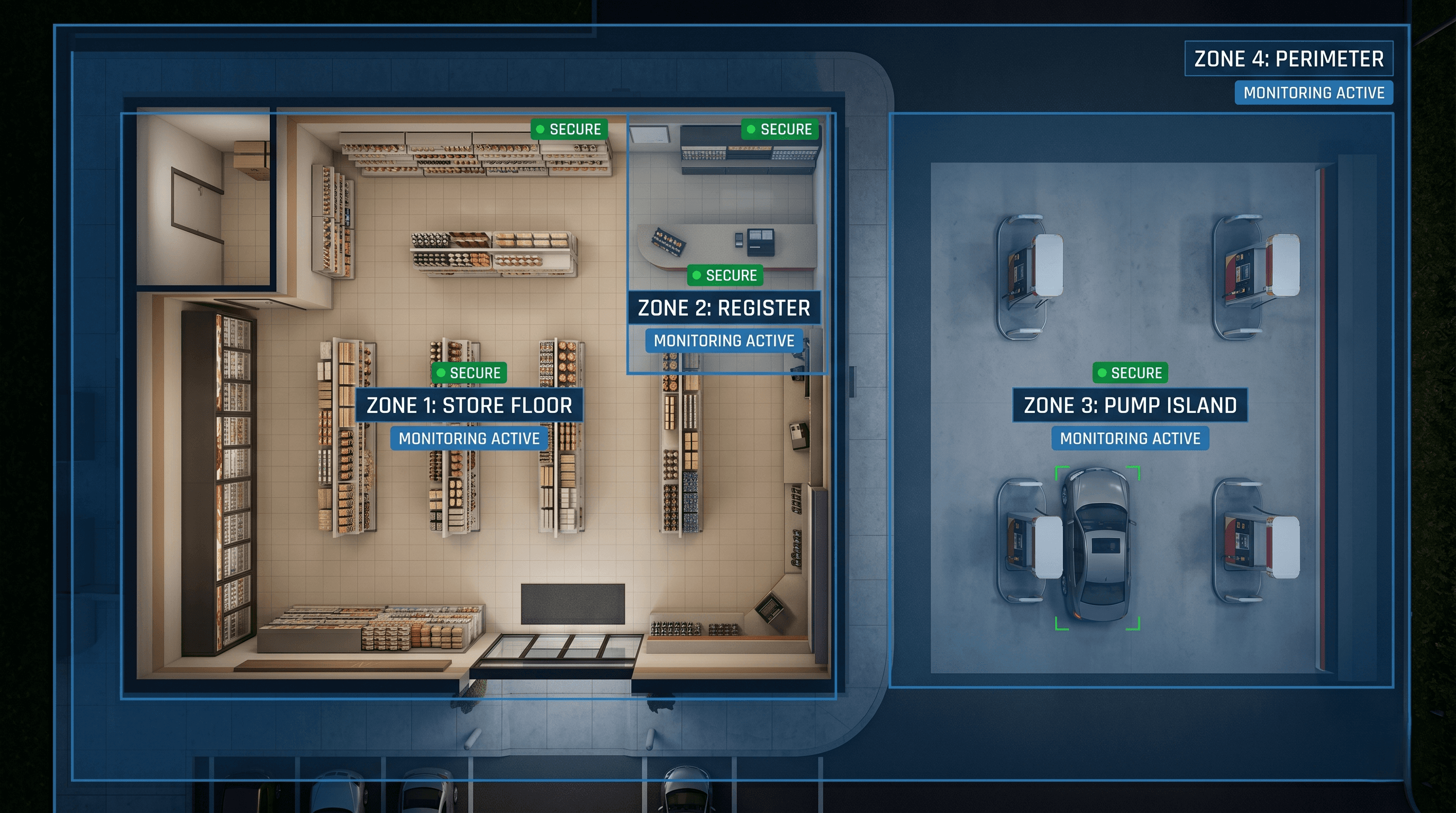
Your Convenience Store Has Five Security Problems. Most Systems Only Solve One.
Walk through your store right now and count the places where theft can happen without anyone catching it. The back corner near the coolers where your camera angle doesn't quite reach. The register during a busy morning rush when the cashier is managing four transactions simultaneously. The stockroom during receiving when the delivery driver and your employee are the only two people present. The parking lot after 11 PM when your overnight cashier is too focused on the store interior to notice what's happening outside.
That's four of the five. The fifth is inside your register — not a place, but a mechanism. The void that looks like a correction. The refund that looks like customer service. The no-sale that looks like a legitimate operational action.
A convenience store security system in 2026 has to address all five simultaneously. Not sequentially. Not with different vendors managing different zones. Simultaneously, in an integrated system where what's happening at the pump island informs what's happening at the register, and what's happening on the floor informs what's happening in the stockroom.
Here's what that actually looks like — zone by zone, technology by technology — and how to build it without overspending on hardware you don't need.
Zone 1: The Store Floor and Merchandise Areas
The store floor is where external shoplifting happens. It's your highest-visibility zone and, paradoxically, the one where your cameras probably have the most blind spots.
Standard camera installations in convenience stores tend to prioritize wide-angle coverage — one or two cameras covering the broadest possible floor area from the highest possible mounting point. The result is footage that shows general activity but lacks the specificity to identify merchandise concealment with any clarity. Experienced shoplifters know this. They work at ground level, near the bottom shelves, in the areas where a wide-angle overhead camera sees the top of their head but not their hands.
Effective store floor coverage in 2026 uses zone-specific camera positioning — one camera per high-risk merchandise category, positioned at an angle that captures hand-level activity, not just general body position. Vape and tobacco displays, high-value OTC medications, prepaid cards, and energy drinks each need dedicated coverage from angles that make concealment behavior visible.
AI behavioral detection running on store floor footage adds the pattern recognition layer that camera positioning alone can't provide. Concealment behavior — specific movement patterns associated with hiding merchandise — is detectable even in standard-quality footage when the AI analysis layer is present. Individual incidents might look ambiguous. The pattern across multiple visits is not.
Zone 2: The Register and Point of Sale
The register is your highest-dollar vulnerability zone for internal theft and the one most operators are least prepared to monitor effectively.
Camera coverage of the register needs to accomplish two specific things that most installations don't: capture the employee's hands clearly enough to see what they're doing with cash, and capture the POS screen clearly enough to see what transaction has been entered. Wide-angle register coverage that shows the general counter area does neither reliably.
POS integration is what makes register zone monitoring genuinely effective. When your camera system is synchronized with your POS transaction data, every anomalous event at the register — void, refund, no-sale, discount override — pulls corresponding camera footage automatically. The surveillance isn't watching the register generally. It's watching specific events that have already been flagged as potentially anomalous.
Definition moment: A convenience store register security zone requires two specific camera positions — one capturing hand-level cash handling and one capturing the POS screen transaction — plus POS data integration that triggers automatic camera correlation for every anomalous transaction event.
Zone 3: The Pump Island and Fuel Area
For gas station convenience stores, the pump island is a separate security challenge with its own specific technology requirements.
Standard HD cameras on the store exterior do not function as effective pump island security. The angles are wrong, the distance is too great for plate capture, and the lighting conditions — particularly at night under canopy glare — produce footage that looks comprehensive but is rarely usable for drive-off identification.
LPR-grade cameras positioned specifically for pump island plate capture are the foundational requirement. Not as a supplement to your existing camera system. As a replacement for general cameras in pump island coverage. The cost difference between a standard HD camera and an LPR-grade unit is modest. The outcome difference is substantial.
Pre-authorization integration — where plate data from arriving vehicles cross-references a drive-off history database before pump authorization is granted — converts LPR from a documentation tool into a prevention tool. Flagged vehicles require prepay regardless of payment method presented. This doesn't require you to recognize the vehicle. The system flags it before you ever see it.
Zone 4: The Stockroom and Receiving Area
The stockroom and receiving area are the most under-monitored zones in most convenience stores — and the zones where vendor fraud and inventory theft cause losses that are almost entirely attributed to other causes.
A single camera covering the stockroom entrance and the area where deliveries are processed addresses two simultaneous vulnerabilities: inventory removal by employees during stockroom access, and short-delivery fraud during vendor deliveries. Both are invisible without camera coverage of this zone. Both are immediately detectable with it.
The receiving audit capability this creates is particularly valuable. When your delivery receipt says 15 cases were delivered and your inventory count shows 12 cases three days later, the question of what happened to the three cases is answerable with camera footage of the delivery rather than a dispute you'll likely lose with the vendor.
Zone 5: The Parking Lot and Exterior Perimeter
Your parking lot is part of your security liability whether you think of it that way or not. Vehicle break-ins, drug activity, loitering that deters legitimate customers, physical altercations near your entrance — all of these create insurance claims, reputation damage, and customer experience failures that have real financial consequences.
Parking lot coverage needs to address the full perimeter with specific attention to areas where loitering or vehicle activity could occur outside the immediate entrance sightline. After-hours perimeter monitoring — with AI motion detection that distinguishes vehicle drive-throughs from foot traffic approaching your building — creates an alert layer for attempted intrusions outside business hours.
Live monitoring agent capability for parking lot alerts is what converts detection into deterrence. An agent who can trigger an external speaker announcement when suspicious activity is detected in your lot changes the environment without requiring physical presence.
Building the Integrated System: What to Prioritize and When
Not every zone needs to be addressed simultaneously if budget is a constraint. Here's the priority sequence based on financial impact.
Start with register POS integration. This addresses your highest-dollar internal theft vulnerability and produces the fastest measurable outcome — internal fraud detection within two to four weeks of activation. It requires minimal hardware if you have existing register area cameras and a compatible POS system.
Add store floor AI monitoring second. External shoplifting is your highest-volume incident category. AI behavioral detection on existing floor cameras significantly improves detection without requiring complete camera replacement.
Add LPR and pump island monitoring third if you operate a fuel station. Drive-off prevention technology produces rapid ROI for any station with consistent drive-off activity.
Add stockroom and receiving coverage fourth. This addresses vendor fraud and internal inventory theft — lower frequency but high impact per incident.
Add parking lot perimeter monitoring fifth. Important for overall safety and liability, but typically lower immediate financial impact than the preceding zones.
The complete integrated system — all five zones under a single monitoring platform with live agent coverage and POS integration — is the goal. But building it in priority order over 60 to 90 days is more practical than attempting everything simultaneously and underbuilding each zone to stay within a fixed budget.
What This System Costs and What It Saves
A fully integrated convenience store security system covering all five zones with live monitoring, AI behavioral detection, and POS integration runs $399 to $649 per month depending on location size and camera count.
A convenience store operating at industry-average shrinkage — 1.5 to 1.8 percent of revenue — absorbs $1,200 to $1,800 per month in direct losses at $80,000 monthly revenue. The full economic impact including margin replacement, insurance, and administrative cost is typically $4,500 to $6,000 per month.
A 40 percent reduction in combined losses from active five-zone monitoring generates $1,800 to $2,400 in monthly savings at the direct loss level — a 3 to 6x return on the monitoring investment before accounting for insurance premium reductions that often provide an additional 10 to 20 percent offset.
Most single-location convenience store operators see positive ROI within 30 to 45 days of full activation. Operators with active internal fraud — often a surprise discovery in the first month — frequently see ROI within the first two weeks.
How Survill Builds Convenience Store Security Systems
Survill's c-store monitoring configurations are built around the five-zone framework described in this blog. Every installation begins with a site assessment that maps specific camera positions for each zone before any hardware is recommended.
The integrated platform connects all five zones to a single monitoring feed with unified AI detection, POS synchronization for register zone monitoring, LPR capability for pump island operations, and 24/7 live agent coverage that maintains consistent watch across the full property footprint.
Conclusion: A Convenience Store Isn't One Security Problem. Stop Treating It Like One.
The operators who are running the lowest shrinkage rates and the most profitable convenience stores in 2026 have one thing in common: they stopped treating their security as a single-solution problem and started treating it as a five-zone operational system that requires dedicated technology and active oversight for each zone.
The store floor needs AI behavioral detection. The register needs POS integration. The pump island needs LPR. The stockroom needs receiving oversight. The parking lot needs perimeter monitoring. And all five need a live monitoring team watching the complete picture simultaneously.
That system exists. It's accessible. And it works.
Get Your Free C-Store Security Assessment
📞 (253) 362-3578 | 🌐 www.survill.com | ✉️ sales@survill.com
Frequently Asked Questions
Q1. What is the best security system for a convenience store in 2026? The most effective convenience store security system in 2026 covers five distinct vulnerability zones with integrated technology: AI behavioral detection cameras on the store floor for shoplifting prevention, POS-integrated camera monitoring at the register for internal fraud detection, LPR-grade cameras at the pump island for drive-off prevention (gas station c-stores), receiving area cameras for vendor fraud and inventory theft detection, and perimeter cameras for parking lot and after-hours monitoring. All five zones should connect to a single monitoring platform with live agent coverage and AI behavioral detection running continuously. No single-zone system adequately addresses the full loss profile of a modern convenience store.
Q2. How many security cameras does a convenience store need? Camera count should be determined by zone coverage requirements, not a target number. A typical single-location convenience store with a fuel island generally needs 8 to 12 cameras: 2 to 3 covering the store floor at zone-specific angles for merchandise areas, 2 covering the register from hand level and screen level, 2 to 3 covering the pump island including LPR-positioned units, 1 covering the stockroom entrance and receiving area, and 1 to 2 covering the parking lot perimeter. More cameras deployed generically produce lower security value than fewer cameras deployed with zone-specific positioning. Site assessment before hardware specification is essential.
Q3. How does a convenience store security system prevent employee theft specifically? Effective convenience store security systems prevent employee theft through two integrated mechanisms: deterrence and detection. The deterrence effect — employees operating with awareness that a live monitoring agent may be reviewing their register transactions at any moment — changes behavioral calculations before any fraud occurs. The detection mechanism — POS integration that automatically correlates anomalous transaction events with camera footage — identifies fraud patterns within days that would take months to surface through manual investigation. Operators implementing both mechanisms typically see register accuracy improvements within 30 days even before any fraud is formally identified or any disciplinary action taken.
Q4. What's the difference between a security camera system and live monitoring for a c-store? A security camera system records footage continuously and stores it for review after an incident. Live monitoring means trained agents actively watch your camera feeds in real time and respond to suspicious behavior through audio announcements, staff alerts, or law enforcement contact while an incident is occurring. For a convenience store, this difference determines whether your security system documents theft or prevents it. Camera systems record the shoplifter leaving with merchandise. Live monitoring triggers an announcement when the concealment behavior is detected — typically before they reach the exit. The deterrence and intervention capability of live monitoring produces 40 to 60 percent theft reductions that recording-only systems cannot achieve.
Q5. How long does it take to set up a complete convenience store security system? A complete five-zone convenience store security system installation typically takes 5 to 14 business days from site assessment to live monitoring activation, depending on camera count, existing infrastructure, and POS integration complexity. For stores with existing cameras that meet minimum specifications, POS integration and live monitoring activation can begin in as few as 5 business days. Full new camera installations including pump island LPR setup, stockroom coverage, and parking perimeter cameras typically require 10 to 14 business days. Survill conducts an initial site assessment before providing a specific timeline for your location.